Dance Shoe Fit: Match the Shoe to Your Class and Floor
On this page
Quick answer
A good dance shoe fits the foot without painful pressure, excessive toe crowding, heel slip, or uncontrolled movement inside the shoe. The correct fit also depends on the dance style, studio floor, socks or tights, class level, and teacher requirements. Try both shoes while standing and moving, and buy from a fitter or retailer that allows an appropriate return or exchange.
This guide is for adult recreational dancers in the United States choosing common class shoes. Children, pre-professional dancers, pointe work, significant foot differences, and current pain need more individualized fitting. A teacher, experienced dance-shoe fitter, and qualified healthcare professional may all have different useful roles.
Confirm the class requirements first
Ask the studio before shopping:
- Is a specific shoe type required, recommended, or optional?
- Are color, material, sole, heel height, or brand/model specified?
- Does the class use marley/vinyl, sprung wood, unfinished wood, concrete, carpet, or a multiuse floor?
- Are outdoor shoes prohibited in the studio?
- Will the shoes be used for class only, rehearsal, performance, examination, or social dancing?
- Does the teacher want a full sole, split sole, suede sole, leather sole, rubber sole, taps, or another feature?
- Should beginners wait until after the first class or teacher assessment to buy?
A shoe can fit the foot and still be wrong for the class. A rubber sole that grips safely in one setting may resist a turn on another floor. A suede sole may be appropriate for an indoor ballroom floor but damaged or unsafe outdoors. Verify the actual environment.
Use dance-specific fit basics
Check both feet
Feet are often slightly different in length, width, volume, or shape. Fit the larger or more demanding foot, then use only the manufacturer- and fitter-approved adjustment for the other. Do not force the larger foot into the smaller size.
Fit while weight-bearing
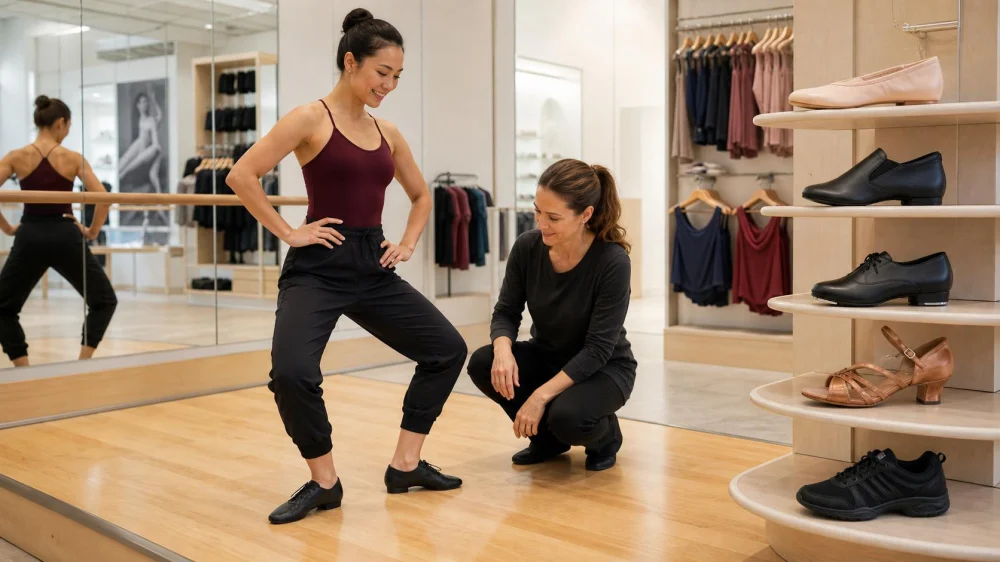
The foot changes shape when standing, rising, pointing, bending, and turning. A seated fit can miss toe crowding or heel movement. Try the shoe in the positions allowed by the store without damaging the sole.
Separate close fit from painful compression
Many soft dance shoes fit closer than street shoes so they follow the foot. Close does not mean numb, burning, pinched, overlapping, or curled toes. The foot should not slide, but circulation and normal toe position still matter.
Wear the real class layer
Try shoes with the same tights, thin socks, barefoot liner, orthotic, toe padding, or other approved layer you will use. A thick store sock can change the result. Ask the teacher and fitter before adding an insert that changes how the shoe holds the foot.
Check retention
The heel and upper should hold the foot during class movements. Straps, elastics, laces, or buckles should secure the shoe without digging into tendons, skin, or bone. The shoe should not require toe gripping to stay on.
Try-on checks by dance style
Ballet flats
- The toes should lie long and flat rather than curl or overlap.
- Excess fabric should be limited, but the drawstring or binding should not cut into the foot.
- The heel should stay on during plié, tendu, and relevé.
- The sole position should match the ball and heel of the foot.
- Follow the teacher’s full-sole or split-sole requirement.
Pointe shoes are a separate category. Do not select or size them from a general article. Pointe readiness requires teacher approval, and the shoe should be fitted by a trained pointe-shoe fitter who evaluates the foot, strength, technique, padding, and model.
Jazz shoes
- Look for a close, smooth fit without toe compression.
- The arch should follow the shoe rather than float inside it.
- The heel should not lift during plié, relevé, or a gentle direction change.
- Check that the forefoot can articulate while the upper still holds the foot.
- Confirm slip-on versus lace-up expectations and floor use.
Tap shoes
- The heel should stay secure so the shoe responds predictably.
- The toe box should allow normal toe position without excess sliding.
- Taps and screws should sit securely and follow the manufacturer’s service guidance.
- Walk and perform only store-approved basic weight shifts to listen for unwanted movement.
- Confirm the studio permits the tap type and that the floor is protected.
Ballroom and Latin shoes
- Check foot security during forward, backward, and side weight transfer.
- For open-toe styles, toes should not hang excessively over the front edge.
- For closed-toe styles, toes should not be compressed into a narrow shape.
- The heel counter and straps should stabilize without rubbing or cutting.
- Choose a heel height and shape that match current skill, choreography, and teacher guidance.
- Confirm suede or other sole care and keep indoor-only soles off wet or rough ground.
Character and theatrical heels
- Check heel stability and secure attachment before every use.
- Use a strap or closure that prevents the foot from sliding forward.
- Practice in the performance shoe gradually and early enough to adapt.
- Ask whether a lower rehearsal heel is acceptable for longer practice sessions.
- Do not assume a fashion shoe is built for repeated dance movement.
Dance sneakers and street-style classes
- Follow the teacher’s sole and floor rules; some studios require clean indoor-only shoes.
- Check forefoot flex, lateral containment, cushioning, and heel stability for the actual movement.
- Avoid a sole that grips so strongly that turns feel blocked.
- Confirm the shoe works for jumps, slides, or directional changes used in class.
- Keep tread free of stones, dirt, and moisture before entering the studio.
Match the sole to the floor
Friction is part of dance technique and safety. Too much grip can make pivots and turns resist; too little can make stopping and weight transfer uncertain. The same shoe can behave differently on marley, polished wood, dusty wood, concrete, carpet, or a social-dance floor.
Ask the studio what dancers actually use on that floor. Do not apply rosin, water, oil, hairspray, powder, wax, tape, or a sole treatment without permission. These substances can create hazards for everyone and damage the floor or shoe.
Inspect the sole before each class. Moisture, embedded debris, worn suede, peeling rubber, a loose tap, or a damaged heel can change traction. Clean and maintain only according to the shoe and studio instructions.
A practical try-on sequence
- Shop later in the day when practical. Feet can change over the day; use the timing most like your class.
- Bring the class layer and studio requirement. Show the fitter the written shoe guidance.
- Measure both feet as a starting point. Brand and model sizing can differ, so do not treat the number as the decision.
- Put on both shoes correctly. Adjust every strap, lace, elastic, or buckle as intended.
- Stand and check toe position. Look for curling, overlap, pressure, gapping, or sliding.
- Use approved basic movements. Plié, rise, point, weight shift, and take a few steps on the shop’s test surface.
- Check retention and pressure. Note heel slip, forefoot movement, strap marks, numbness, or hot spots.
- Compare sizes or widths, not just styles. A different width or model may solve a problem better than forcing one size.
- Ask about expected stretch. Leather, canvas, synthetic uppers, elastic, and linings change differently.
- Confirm the return policy. Know whether soles must remain unmarked and whether elastics, ribbons, taps, or accessories make the shoe final sale.
Online buying checklist
- Use the manufacturer’s current model-specific chart.
- Check whether the chart uses foot length, street size, or a brand-specific scale.
- Read width and volume options separately from length.
- Order from a retailer with a clear unworn-return process.
- Try shoes only on the permitted clean surface.
- Do not sew elastics, install taps, scuff suede, or remove labels until fit is confirmed.
Break-in, care, and replacement
Introduce new shoes gradually. Use them for short portions of class or rehearsal when the teacher agrees, then increase exposure as comfort and control allow. A shoe that causes immediate pain is not simply “breaking in.”
Rehearse in performance shoes early enough to understand traction, balance, sound, and endurance. Changing heel height or sole type can change how the ankle, knee, and whole body share load. Avoid switching directly from flat practice shoes to unfamiliar high heels for a long performance.
Air shoes after class and follow cleaning instructions. Do not leave damp shoes sealed in a bag. Replace or professionally repair shoes when the upper no longer holds the foot, the sole separates, taps or heels become insecure, support changes, or traction can no longer be maintained safely.
Limitations and important notes
Dance-shoe size is not standardized across brands or models. Street-shoe size, foot tracing, and online calculators can start the search but cannot judge dynamic fit. A child should not receive substantial “growing room” that allows the foot to move unpredictably inside the shoe.
Stop using a shoe that produces persistent pain, numbness, tingling, skin breakdown, unusual swelling, or loss of control. A blister, corn, nail problem, bunion, prior injury, diabetes, circulation concern, or other foot condition may need evaluation by a qualified healthcare professional such as a podiatrist or dance-medicine clinician.
Do not use padding to make an obviously wrong size seem correct. Padding can fine-tune a professionally fitted shoe when appropriate; it should not compress toes, change circulation, or hide pain.
This article is general education, not medical advice or a substitute for an in-person fitting. Studio rules, choreography, examinations, and performance designs may impose additional requirements.
Frequently asked questions
Should dance shoes fit tighter than street shoes?
Many soft dance shoes fit closer to the foot, but they should not cause painful pressure, curled toes, numbness, or overlap. “Tight” is too vague; evaluate toe position, foot movement, retention, and comfort during dance-specific motion.
Should my toes touch the end of a ballet flat?
The toes may reach the front in a close fit, but they should remain long and uncurled when standing and moving. Follow the teacher and fitter because material, model, foot shape, and age affect the decision.
Can I wear socks with dance shoes?
Use the layer required or accepted by the class. Socks change fit and friction; a smooth sock can make the foot slide inside a shoe, while a thick sock can crowd the toes. Try on with the actual layer.
Can ballroom shoes be worn outdoors?
Many suede-soled ballroom shoes are designed for indoor dance floors. Rough, wet, or dirty surfaces can damage the sole and change traction. Use shoe covers or change at the venue according to manufacturer and studio guidance.
How long should dance shoes last?
There is no universal lifespan. Style, material, floor, body weight, frequency, sweat, movement, care, and fit all matter. Replace based on loss of secure fit, damaged structure, changed traction, and teacher or fitter assessment.
Can I buy pointe shoes without a fitting?
It is not recommended. Pointe shoes need teacher approval and an in-person fitting by a trained fitter. Model, box, shank, vamp, width, padding, foot shape, strength, and technique must work together.
Sources and evidence notes
- International Association for Dance Medicine & Science: Choosing a dance shoe explains how fit, dance genre, desired movement, and shoe design affect performance and injury risk.
- IADMS: Dancing in heels discusses how heel height can redistribute movement demands and why rehearsal exposure matters.
- American Podiatric Medical Association: Hammer toes describes problems associated with shoes that squeeze the toes and the role of adequate toe-box space.
These sources support the importance of fit and task-specific footwear. Individual teachers, fitters, and healthcare professionals should apply those principles to the dancer and class.
Next steps
Ask the studio for the exact shoe and floor requirement, then bring it to an in-person fitting with your real class socks or tights. Test both shoes through a few approved class movements and write down the model, size, width, and return rules. Buy the pair that stays with the foot without pain—not the pair that matches your street-shoe number.
 BollyNaach Bollywood Dance Classes - Santa Clara0.0 (0 reviews)
 Mistalocks Dance Studio5.0 (9 reviews)
 Rhythm and Funk School of Dance - Best in Dance5.0 (2 reviews)
 Seaside Ballroom5.0 (1 reviews)
 CREW studios4.0 (21 reviews)
 Sparrow Dance Productions4.0 (82 reviews)
 How a Dance School in Instagram Builds Community and Success
 How to Build a Dance Class Schedule You Can Sustain
 How to Master Zumba to Try in 2025
 Foxtrot for Kids – Complete Guide
 The History of Pole Dance Near Me in the USA | Cultural Evolution & Modern Studios
 Can Dance Schools Open Yet? What You Need to Know in 2025