Dance Class Corrections: Listen, Clarify, Apply One Cue
On this page
Quick answer
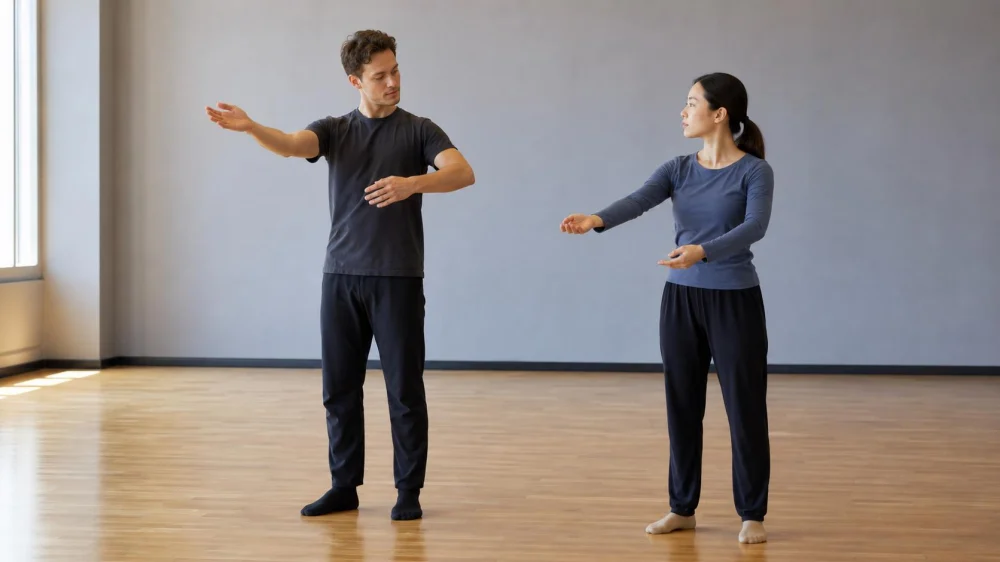
When a teacher gives a dance correction, pause long enough to identify the exact action, timing, or quality they want changed. Repeat the cue in your own words if invited, apply one adjustment on the next attempt, and notice the result without judging your whole performance. If the instruction feels painful, unsafe, or unclear, stop and ask for a different explanation or demonstration.
Separate a usable cue from a global judgment
A dance correction is information intended to change a specific part of movement, such as timing, direction, weight placement, pathway, focus, dynamics, or spacing. It may be addressed to one dancer or offered to the whole room. Treating it as a small test keeps attention on the task. A correction is not proof that every earlier attempt failed, and silently copying another dancer may miss the teacher's actual goal.
This guide is for dancers learning in group or private classes in the United States. It does not replace the teacher's style-specific knowledge, physical therapy, medical assessment, or safeguarding procedures. Teachers also differ in when they welcome questions, so learn the class's communication rhythm.
Practical checklist
- Identify the correction's target: body part, direction, timing, pathway, energy, partner connection, spacing, or musical cue.
- Listen through the full instruction before moving or rehearsing a different idea.
- Keep neutral posture and enough space to try the change safely.
- Translate figurative language into one physical experiment without forcing range or shape.
- Ask a short clarifying question at the permitted moment when two interpretations remain.
- Apply one variable first so you can tell what changed.
- Notice whether the cue improves the teacher's stated goal, not whether it instantly feels familiar.
- Save one brief phrase after class and test it again slowly before adding speed.
Step-by-step plan
- Stop the previous attempt and look or listen. Capture the teacher's complete phrase, demonstration, count, and direction.
- Name the goal in plain language: for example, arrive earlier, transfer weight fully, soften the landing, face a new direction, or leave more space.
- Choose the smallest change that could meet that goal. Do not simultaneously alter arms, feet, rhythm, and expression unless the teacher asked for all of them.
- Try the cue at a safe speed and range. Use a barre, wall, mark, or reduced movement only when the instructor permits it.
- Compare the result with the demonstration or feedback. If it is still unclear, ask a specific question such as whether the change concerns timing or placement.
- Repeat correctly a few times with rest as needed, then reconnect the change to the phrase before and after it.
- After class, write a short cue and context, then practice it at low intensity. Recheck with the teacher later instead of turning one image into a rigid rule.
Use a three-part note: the movement context, the teacher's cue in a few words, and the physical result you are testing. Avoid writing personal criticism or reconstructing an entire class. One clear cue tied to one phrase is easier to retrieve and verify.
Limits and important notes
Imagery such as lengthen, melt, attack, or lift can guide quality without describing literal anatomy. A cue that works for one combination may not apply universally. More range, force, turnout, arch, speed, or repetition is not automatically better. Fatigue and pain can change movement and learning. Do not use another student's correction as a mandate for your body unless the teacher confirms it applies.
Stop when a correction produces sharp pain, instability, dizziness, numbness, or a sense of unsafe partner pressure. Tell the teacher what you felt and request a lower-range option or different explanation. Persistent symptoms need appropriate healthcare assessment. Report humiliating, discriminatory, sexualized, coercive, or unsafe teaching behavior through the studio's safeguarding or complaint process.
Frequently asked questions
Should I ask a question every time I get a correction?
Not necessarily. Try the clear cue once when safe, then ask if the goal or action remains ambiguous. Keep the question specific and use the moment the teacher designates for questions.
What if a metaphor does not make sense to me?
Ask for another form of information: a demonstration, direction, count, anatomical landmark, rhythm, or contrast. Different explanations can point toward the same movement goal.
Why does a corrected movement feel worse at first?
A new coordination can feel unfamiliar, and conscious attention can temporarily reduce flow. That does not prove the change is right or wrong. Test it slowly and ask the teacher to confirm the result.
How many corrections should I practice after class?
Choose one or two high-value cues connected to a specific phrase. Quality, rest, and verification matter more than repeating every note while tired or without context.
Sources and evidence
This article presents general teaching and motor-learning principles: define the task, change one controllable variable, test it safely, use specific feedback, and retrieve a concise cue later. Studio culture and dance technique determine how a correction should be interpreted. No instructor credential, therapeutic effect, injury-prevention guarantee, or universally correct body shape is claimed.
Conclusion and next steps
At the next class, turn one correction into a small cycle: listen, name the target, make one safe change, and check the result. Write one phrase afterward and revisit it slowly. If a cue remains unclear or causes pain, ask for another explanation instead of adding force or silently practicing uncertainty.
 The Dance Company Moorpark4.0 (55 reviews)
 RAVE Studios by Dance Progressions5.0 (2 reviews)
 CAT Choreography5.0 (9 reviews)
 ES Dance Studio4.0 (42 reviews)
 Arthur Murray Dance Studio Boulder5.0 (37 reviews)
 A-Glow Dance & Fitness5.0 (39 reviews)
 Dance Class Clothing: Fit, Layers, and Studio Rules
 How a Video of School Dance Becomes a Lasting Memory
 Ballet Every Dancer Should Know – Complete Guide
 Contemporary Dance for Adults – What You Need to Know for a Great Start
 How a Dance School with 54 Students Cultivates a Thriving Dance Community
 Why Hip Hop Is Popular to Improve Flexibility: Benefits of Dance for Mobility and Health