
Small Dance Studio Etiquette: Travel, Turns, and Spacing
On this page
Quick answer
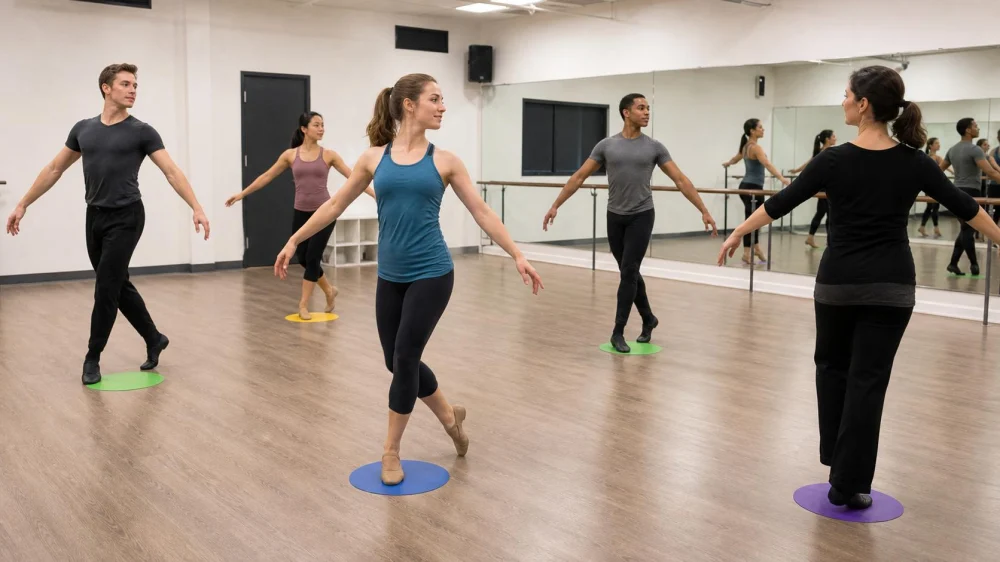
In a small dance studio, keep your eyes active, preserve the teacher’s assigned lines, and adjust step size before a pathway becomes crowded. Begin traveling combinations only when the previous group has cleared the landing zone. For turns, spot without losing peripheral awareness and abort safely when space closes. Never push through another dancer’s path simply to finish the choreography at full size.
Treat space as shared
Personal space changes as dancers travel, face different directions, and use limbs at full reach. Mirrors can make distances look misleading, so combine the reflection with direct awareness of the room. Learn fixed hazards such as barres, columns, speakers, doors, and changes in floor surface.
Follow the instructor’s group size and starting marks. If you are taller, have a longer stride, or are modifying a phrase, choose placement that gives others a predictable path rather than claiming extra space without discussion.
Manage travel patterns
- Watch one group first. Identify the diagonal, direction changes, final pose, and exit path.
- Know your lane. Maintain the assigned relationship to dancers beside you instead of drifting toward open space.
- Wait for clearance. The previous group needs room to finish and exit before the next group starts.
- Scale consistently. Reduce stride or arm reach early rather than making an abrupt correction near another dancer.
- Exit promptly. Move to the designated side without crossing the next group’s entry.
- Reset at the perimeter. Do not stand in landing zones while reviewing the combination.
Turn with awareness
Prepare turns from stable placement and check the intended finish before starting. Spotting supports orientation but does not replace awareness of other bodies. Keep arms controlled during preparation and opening, particularly when formations are staggered.
If another dancer enters your path, reduce rotation, step out under control, or stop as your training permits. Do not grab the other dancer. After a near collision, reset calmly and tell the instructor if spacing or group timing needs adjustment.
Class checklist
- Floor is dry and appropriate footwear is secure.
- Bags, bottles, and warm-up clothing are outside movement areas.
- Starting line, direction, group, and exit are understood.
- Step and arm size fit the available lane.
- Peripheral awareness continues when using the mirror.
- Questions about traffic patterns are asked before the music starts.
For improvisation or freestyle work, the same principle applies: scan before traveling, establish a readable direction, and yield when paths converge.
Limitations and safety notes
Studio layout, dance style, and instructor conventions vary. Follow class-specific traffic rules. Small-space modification is not permission to perform a technically unsafe version; ask how to adapt a movement.
Stop when a collision causes pain, head impact, dizziness, or loss of function and follow the studio’s incident and medical procedures. Do not continue merely to avoid interrupting class.
Sources and evidence notes
The guidance reflects common group-class practice: stagger lines, control entry and exit, scale movement to the room, and preserve awareness beyond the mirror. The instructor is the primary source for a particular combination and studio.
Frequently asked questions
Who has the right of way in a traveling combination?
Follow the teacher’s group and lane instructions. Generally, let the active group finish and clear before entering.
Should I always dance smaller in a crowded room?
Scale when needed for safety, but ask the teacher how to preserve the movement’s intent and technique.
Can I rely on the mirror to watch others?
No. Reflections can distort distance and reverse orientation. Use direct and peripheral awareness too.
What should I do after a near collision?
Stop or recover safely, then identify whether timing, group size, or lane placement needs clarification.
Next steps
Before the next combination, locate fixed hazards, watch the route, confirm your group and exit, and choose a movement scale that fits. Keep eyes and peripheral awareness active, and ask the instructor to adjust traffic when repeated conflicts occur.
 Elite Dance Academy recital4.0 (8 reviews)
 Jordan School of Ballet5.0 (1 reviews)
 Elegance In Dance4.0 (15 reviews)
 Naad Studios0.0 (0 reviews)
 Strand Studios Learning Center for Music, Film and Acting4.0 (58 reviews)
 Suzannah Stage School0.0 (0 reviews)
 Zumba for Seniors: Tips from Experts | American Dance Academy
 Why K-Pop Dance Is Popular and How You Can Learn It
 Shuffle Dance for Seniors: Common Mistakes to Avoid and Tips for Success
 Waltz for Seniors – Everything You Should Know
 Bollywood Dance to Improve Flexibility – Complete Guide for Beginners
 Jazz Dance Step by Step Guide: Expert Tips and Techniques