Dance Class Corrections: Listen, Apply, and Ask Clearly
On this page
Quick answer
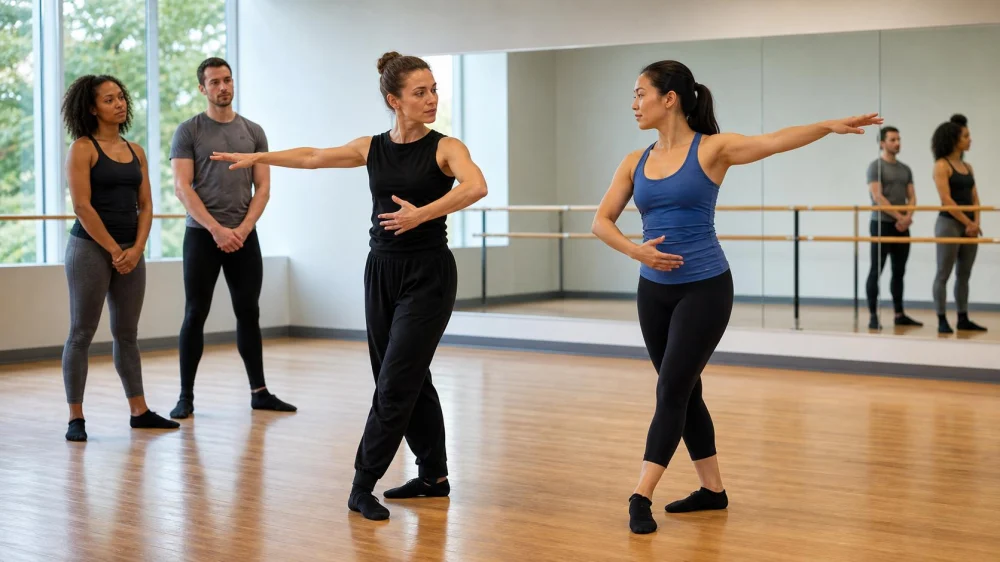
When a teacher gives a dance correction, pause long enough to identify the action, timing, and body area involved. Watch the demonstration, repeat the cue in plain words, try one controlled version, and compare the result. Ask a short question if the cue remains unclear. Never force range, speed, turnout, balance, or pain to make a correction look immediate.
This guide is for adult and teen students in U.S. recreational or pre-professional classes. A qualified teacher who can see your movement—and a healthcare professional when pain or injury is involved—should guide individual decisions.
What a correction means
A correction is information intended to change a movement choice, coordination pattern, musical timing, spacing, quality, or safety habit. It is not necessarily proof that the entire combination was wrong. Teachers may give an individual correction, address the whole group, or offer an image that helps students explore a quality.
Different corrections require different responses. “Start on count five” is a timing instruction. “Travel farther” concerns space. “Soften the landing” describes quality and load management. “Keep the supporting knee aligned” may require slower practice and teacher observation rather than a cosmetic pose.
General cues do not affect every body identically. The goal is to understand the intended function, not to imitate another dancer's shape at any cost.
Listen before changing movement
Stop talking, face the teacher if appropriate, and keep enough space that you do not collide with another student. Listen for three pieces: what should change, where in the phrase it changes, and what result the teacher wants.
Watch the demonstration from an angle that makes the action visible. If the class is moving, mark the pathway with reduced range instead of trying a full-power change before you understand it. Use the teacher's vocabulary first; translating too quickly into a familiar but different idea can lose the point.
Acknowledge the correction briefly, then try it. Long apologies or explanations consume class time and can turn useful feedback into a judgment about identity. A correction is most useful when it produces an observable experiment.
Apply one cue at a time
Select the smallest actionable instruction. For example: change the arm pathway on count three, keep the gaze level through the turn preparation, or land with less sound. Repeat at a speed that preserves control, then return to the combination.
Use a before-and-after question: What changed in balance, timing, effort, sound, or direction? The mirror can confirm some external shapes, but internal sensation, musical relationship, and teacher feedback matter too.
When several corrections arrive together, prioritize safety and the teacher's stated focus. Write brief notes after class rather than trying to hold every detail during a fast phrase. Revisit recurring cues in a warm, adequately spaced practice session.
Correction-to-practice checklist
- Identify the target. Name the movement, count, direction, body area, or quality.
- Watch once fully. Notice the preparation and transition, not only the final position.
- Restate the action. Turn an abstract image into a safe experiment you can perform.
- Reduce complexity. Slow down, mark, lower the range, or isolate the relevant counts when allowed.
- Try one change. Keep unrelated parts stable so you can tell what the cue affected.
- Check the result. Use teacher feedback, balance, timing, sound, and comfort—not appearance alone.
- Record one sentence. Note the cue and where it belongs after class.
- Revisit with context. Apply it later in the phrase without forcing or adding fatigue.
Ask questions and set boundaries
Ask a concise either-or or location question: “Should the change begin in the preparation or after the turn?” or “Are you asking for more travel or a longer reach?” Demonstrate your current interpretation if words are not enough.
Choose an appropriate moment. A quick clarification may fit immediately; a detailed discussion may need the end of class or office time. Respect that a teacher may need to watch again before answering.
Physical correction requires clear studio practice and student consent. You can ask for a verbal cue or demonstration instead of touch. Tell the teacher about relevant boundaries before class when possible, and speak up if contact, range, or pressure feels unsafe.
Important limits
- Pain, numbness, dizziness, sudden weakness, or instability is not a cue to push harder.
- Do not force turnout, flexibility, back extension, joint position, or pointe work to copy another body.
- A dance teacher can teach movement but should not be expected to diagnose an injury outside their scope.
- Fatigue can reduce the ability to apply a correction safely; scale down or stop when control deteriorates.
- Corrections delivered disrespectfully, discriminatorily, or without appropriate consent are not made acceptable by artistic tradition.
- Video can assist review only when recording is permitted and everyone’s privacy is respected.
Frequently asked questions
Why does the teacher repeat the same correction?
Motor habits take time, and the cue may need practice across different combinations. Ask whether your interpretation is correct and choose one repeatable reminder.
Should I say thank you after every correction?
A brief acknowledgment is fine, but applying the cue usually communicates attention. Follow the tone and pace of the class.
What if a correction makes movement hurt?
Stop the painful action and tell the teacher. Do not continue to prove effort. Persistent or concerning symptoms warrant appropriate healthcare evaluation.
Can a group correction apply to me?
Often yes. Listen even when no name is used, then decide whether the cue fits your movement without assuming every general comment is personal.
How many corrections should I practice after class?
Prioritize one or two recurring, actionable cues. Quality repetitions with adequate warm-up and space are more useful than an exhausted review of every note.
Sources and evidence notes
This article reflects broad motor-learning and dance-teaching principles: feedback works best when it identifies a task, supports focused practice, allows an observable trial, and respects safety, individual anatomy, and consent.
Studio policy, teacher guidance, style-specific technique, and licensed healthcare advice where needed are the appropriate sources for an individual dancer.
Conclusion and next steps
At your next class, turn one correction into a four-part loop: name the target, watch the transition, try a reduced version, and check the result. Write one sentence afterward and bring a concise question if the cue remains unclear. Consistent, safe application matters more than producing an instant dramatic change for the mirror.
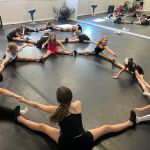 Dance By Carly4.0 (28 reviews)
 Gotta Dance4.0 (68 reviews)
 Judi T. Dance Studio / Party Line5.0 (25 reviews)
 Five Star Dance Studios5.0 (28 reviews)
 Seacoast Stilettos4.0 (30 reviews)
 Salon Eventos | Le Monde | Garland5.0 (3 reviews)
 Top 10 Cha Cha Moves Explained for Beginners and Dancers
 Did the Dance Moms Girls Go to School? Insights into Their Education
 Belly Dance to Burn Calories – Complete Guide to Effective Weight Loss
 Professional Hip Hop Dance Videos School: Train Anywhere with the Best
 Top 10 Samba Moves for Kids
 How to Choreograph a Dance as a High Schooler: A Complete Guide