Dance Marking: Rehearse Choreography With Less Impact
On this page
Quick answer
Dance marking means rehearsing choreography at reduced size or intensity while keeping the sequence, timing, direction, focus, and artistic intention clear. Use it to learn transitions, conserve energy between full-out runs, or review material in limited space. Marking is not careless half-dancing: choose deliberately what to reduce, keep your alignment organized, and return to full range progressively.
What dance marking means
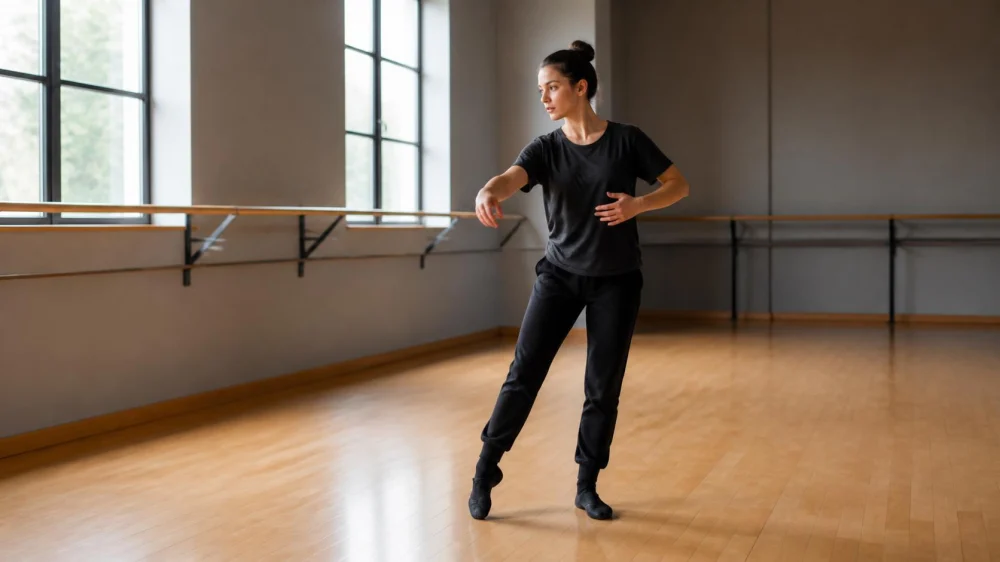
Dance marking is a deliberate rehearsal strategy in which a dancer simplifies the physical demand of choreography without abandoning its essential information. Depending on the movement, you might make a traveling step smaller, replace a jump with a rise through the feet, trace an arm pathway without maximum force, or walk the floor pattern while preserving the musical counts.
This approach can help dancers remember order, clarify spacing, repeat difficult transitions, and manage effort during a long class or rehearsal. It is useful for adult beginners learning a combination, experienced dancers reviewing a sequence, and groups establishing traffic patterns before they add speed. It is not a substitute for technique training, an appropriate warm-up, or enough full-range practice to prepare for performance.
The best version of marking depends on the goal. If the goal is memory, keep counts and sequence. If the goal is staging, keep pathways and orientation. If the goal is musical detail, preserve accents, pauses, and phrasing. Decide what information matters before you reduce the movement.
What to keep when you reduce the movement
Good marking retains the choreography's structure. Before starting, identify these five anchors:
- Order: Know which action follows which, including small preparation steps.
- Timing: Keep the correct counts, rhythmic values, pauses, and tempo relationship.
- Direction: Face the intended wall or diagonal and track changes of focus.
- Pathway: Preserve where the body and limbs travel, even when the range is smaller.
- Intention: Retain the movement quality—such as sustained, sharp, suspended, or weighted—without forcing maximum effort.
A useful decision rule is to reduce load before information. For example, lower the height of a leg while keeping its direction, or replace a leap with a coordinated step that follows the same pathway. This is usually more informative than performing a large but rhythmically inaccurate approximation.
A practical marking method
- Name the purpose. Choose one focus for the pass: sequence, timing, floor pattern, arms, focus, or dynamics. Trying to correct everything at once makes a reduced run less useful.
- Set safe boundaries. Check the available space, floor condition, footwear, and nearby dancers. Decide which jumps, turns, drops, lifts, or extreme ranges you will replace.
- Speak or hear the counts. Count quietly, use rhythmic syllables, or follow the music closely. Do not let smaller movement become slower movement unless the teacher has intentionally reduced the tempo.
- Trace the real pathways. Let the arms, head, torso, and feet travel in the correct directions at a manageable scale. Include preparation and recovery, not just the final shapes.
- Place transitions accurately. Notice weight changes, supporting legs, and facing changes. A missed transfer often causes more confusion than a forgotten pose.
- Pause and identify one gap. Instead of repeating the whole combination automatically, isolate the shortest section you cannot recall and verify it with the teacher or choreographer when appropriate.
- Repeat with one added layer. Add fuller arms, clearer dynamics, more travel, or greater range while keeping the earlier information stable.
For group rehearsals, agree on what “mark it” means for that pass. One dancer may assume small movement while another keeps full travel, creating avoidable traffic conflicts. A clear instruction such as “walk the spacing, keep the arms, no jumps” gives everyone the same boundary.
How to progress from marking to full-out dancing
Marking works best as one stage in a progression. After the sequence feels reliable, increase demand in controlled steps rather than jumping from minimal effort to maximum output.
- Walk or gesture through the sequence while preserving counts and facings.
- Add accurate weight transfers and the intended arm pathways.
- Increase range and travel while keeping impact low.
- Restore turns, jumps, drops, or faster direction changes only after the body is prepared and the space is clear.
- Perform a full-out section, then review whether timing and technique stayed organized.
Choose a fuller run when you need to test stamina, momentum, balance, landing mechanics, partner timing, costume restrictions, or performance-scale projection. Those demands cannot be evaluated completely through marking. If accuracy disappears as intensity rises, step back one level and rebuild the missing layer.
Common marking mistakes
- Dropping alignment: Reduced effort does not require collapsed posture, locked knees, or uncontrolled joints. Keep the body organized for the version you are doing.
- Skipping weight changes: Vague feet make the next step uncertain. Show which leg supports you and where the weight goes.
- Ignoring musical timing: A slow, approximate run may teach the wrong rhythm. Reduce size while respecting the intended counts whenever possible.
- Removing all dynamics: You can suggest attack, suspension, resistance, or flow without using full force.
- Marking indefinitely: Some skills require speed, momentum, impact management, or full range. Schedule appropriate full-out practice rather than assuming a marked run proves readiness.
- Copying another dancer blindly: Use the teacher's stated choreography and your own spatial cues. A neighbor may be marking differently or correcting a separate detail.
Limitations and important notes
Marking can lower physical demand, but it does not make every movement risk-free. Small turns can still challenge balance, and incomplete weight transfers can place the body in an awkward position. Avoid reducing a partner lift, acrobatic element, floor drop, pointe exercise, or other specialized skill unless the instructor has explained a safe substitute.
Stop if you feel sharp pain, sudden instability, dizziness, or another symptom that makes continued movement unsafe. General rehearsal guidance cannot diagnose an injury or set an individual return-to-dance plan. Follow qualified medical or rehabilitation advice when pain, injury, pregnancy, a medical condition, or recovery restrictions affect participation.
In a United States class or studio, ask the instructor how they use terms such as “mark,” “half-out,” and “full-out”; definitions can vary by style and teacher. Also confirm whether a particular part of class is meant for observation rather than participation. The instructor's safety and spacing directions take priority over a general method.
Frequently asked questions
Is marking the same as dancing at half speed?
No. Marking usually reduces size, force, impact, or complexity while retaining the intended timing. Half-speed practice deliberately changes tempo. Both can be useful, but they solve different problems and should be named clearly.
Should I mark jumps and turns?
You can replace a jump with a rise, step, or indicated pathway and simplify a turn to clarify its preparation and direction. However, the complete skill still needs appropriately supervised practice because takeoff, momentum, spotting, balance, and landing cannot be assessed fully in a substitute.
Can beginners use dance marking?
Yes. Beginners often benefit from separating sequence memory from full physical demand. The method is most helpful when the teacher explains which details must remain accurate and provides safe substitutions for technical elements the dancer has not learned.
Can marking replace a warm-up?
No. A marked run may be gentle, but it does not automatically prepare every joint, muscle group, movement range, or impact demand used later. Follow the class or rehearsal warm-up before increasing intensity.
How do I know when to stop marking?
Move toward fuller dancing when you can recall the sequence, maintain timing and direction, and perform the necessary transitions without guessing. Progress in layers, and return to a reduced version if added speed or range causes technique or memory to break down.
Evidence and practice notes
This article reflects common dance-teaching and rehearsal practice: complex choreography is often learned by separating sequence, timing, pathways, dynamics, and physical intensity. The exact vocabulary and substitutions differ across ballet, jazz, contemporary, ballroom, hip-hop, and other forms. For style-specific technique or safety decisions, use the guidance of a qualified instructor who can see the dancer, floor, space, and movement.
No statistic, medical claim, or universal performance standard is implied here. Manufacturer guidance should be followed for footwear, flooring, braces, or other equipment, and venue rules should be followed for shared rehearsal spaces.
Next steps
At your next class, choose one short phrase and make two deliberate passes. First, keep the counts, directions, and weight changes at low intensity. Second, add one layer—such as full arm pathways or greater travel—without losing the first pass's accuracy. Before attempting a full-out run, confirm any uncertain transition and the safe substitute for demanding elements.
When comparing dance classes or studios in the United States, ask how combinations are taught, whether instructors offer scaled rehearsal options, and how the room manages spacing during group practice. Clear instruction should help dancers understand both what to perform and how to build toward it.
 MHLV Dance5.0 (16 reviews)
 Flaunt Entertainment5.0 (50 reviews)
 Natural Wedding Dance5.0 (11 reviews)
 Twist & Shout Norman - Cheerleading and Tumbling4.0 (23 reviews)
 Ballet Theatre of Maryland4.0 (16 reviews)
 Shivaay Dance Academy0.0 (0 reviews)
 Samba for Beginners – Complete Guide to Learning Samba
 Are There School Dances in 6th Grade? A Complete Guide
 Bollywood Dance for Couples: Expert Tips for Romantic and Confident Partner Dancing
 Jazz Dance Workout Benefits – What You Need to Know
 Are There Middle School Dances? What Students and Parents Should Know
 Bachata Explained: Common Mistakes to Avoid