
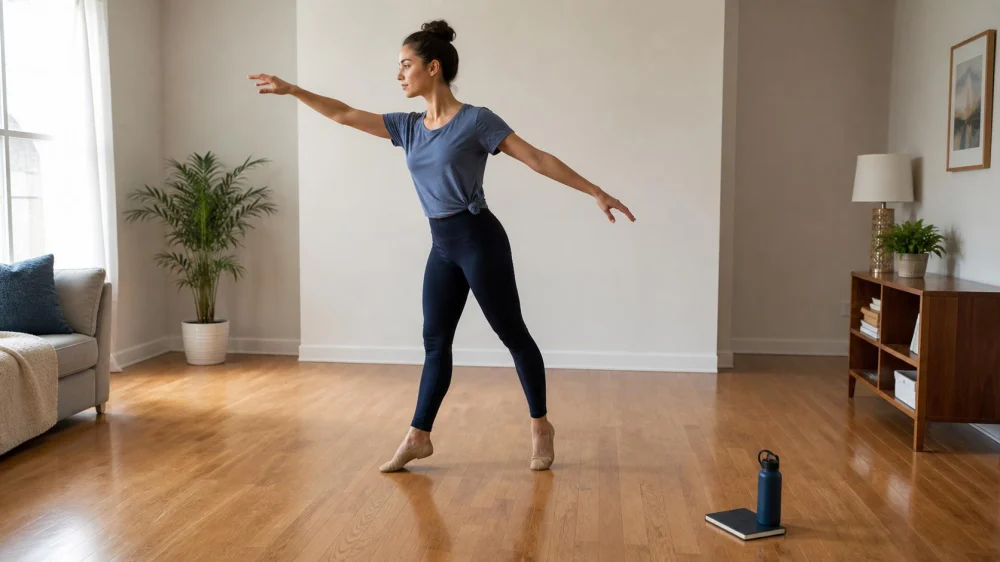
At-Home Dance Practice: Space, Surface, and Safety
On this page
Quick answer
For safer dance practice at home, clear more space than the step appears to need, check the floor for slip and impact risk, use suitable footwear, warm up, reduce travel and jump height, and keep furniture, pets, children, fans, and breakable objects outside the movement zone. Practice timing, pathways, and control—not maximum range—when the room or surface is limited.
This guide is for dancers adapting class material to a typical U.S. home. It does not make a household floor equivalent to a professional dance floor or replace teacher guidance, injury care, or building rules.
Choose practice that fits the room
Begin with the room, not the choreography. A small space can support marking, musical timing, arm pathways, weight transfers, foot articulation, notes review, and slow coordination. It may not support traveling combinations, turns with uncertain balance, lifts, acrobatics, large jumps, floorwork near furniture, or partner work.
Reduce the movement while preserving its purpose. A traveling phrase can be marked in place, a jump can become a plié-and-rise pattern, and a fast sequence can be walked through. Ask the teacher which elements can be safely scaled without teaching the wrong coordination.
Do not use online difficulty or performance videos as evidence that a movement belongs in your room. Skill, warm-up, surface, ceiling, camera angle, and off-screen supervision may be unknown.
Clear the full movement zone
Stand in the center and slowly extend arms, legs, and likely pathways without momentum. Check front, back, both sides, overhead, and the floor. Account for doors opening, low lights, ceiling fans, shelves, plants, rugs, cords, heaters, glass, sharp corners, and objects that can roll.
Move furniture fully out of the zone rather than shifting it a few inches. Secure pets and keep children from entering unexpectedly. Tell household members when the practice begins and keep doorways and exits clear.
A chair, countertop, portable barre, or wall is not automatically a safe support. It must be stable, appropriate for the load, free from wheels, and positioned without trapping feet. Do not pull on shelves, radiators, towel bars, or furniture that can tip.
Match surface and footwear
Floor friction must work with the footwear and style. Socks on smooth wood or tile may slide unexpectedly, while rubber soles can grip and twist a joint during turns. Thick carpet can catch feet, hide objects, and change balance. Concrete beneath a thin finish can be harsh for impact.
Inspect for moisture, dust, cleaning residue, loose boards, transitions, rug edges, and uneven areas. Test simple steps at low speed before adding direction changes. Never apply powder, water, oil, wax, or an improvised floor treatment.
A small portable dance surface must be installed and used according to its manufacturer, lie flat, and stay within its intended movement type. A mat that is suitable for stretching may be unsuitable for turns or jumps.
At-home practice checklist
- Select one goal. Choose counts, pathway, balance, quality, memory, or conditioning rather than running everything full-out.
- Clear the zone. Remove furniture, rugs, cords, liquids, breakables, and unexpected traffic.
- Check all directions. Include ceiling, doors, mirrors, floor edges, and the space needed to lose balance safely.
- Test floor and footwear. Start with walking, weight shifts, and gentle pivots.
- Warm up progressively. Raise temperature and rehearse the movement pattern before adding speed or range.
- Mark first. Use smaller steps, lower force, and slower tempo until spacing is reliable.
- Limit repetitions. Stop before fatigue changes alignment, landings, or attention.
- Restore the room. Cool down as appropriate, dry any moisture, and return furniture without lifting unsafely.
Noise, neighbors, and recording
Impact travels through floors and walls. Follow lease, building, and quiet-hour rules and choose lower-impact practice when others are resting. Do not add thick, unstable padding simply to reduce noise; it can create a new balance problem.
If recording yourself is permitted, place the device outside the movement zone on a stable support. Do not watch a small screen while traveling or turn around furniture to stay in frame. Review after the attempt.
Protect household privacy. Check mirrors, windows, screens, mail, photographs, and people in the background before saving or sharing. Obtain consent from anyone who may be recorded.
Stop rules and limitations
- Stop for pain, dizziness, numbness, sudden weakness, loss of control, or repeated slipping.
- Do not practice pointe work, lifts, acrobatics, large jumps, or unfamiliar skills without the space, surface, training, and supervision they require.
- Do not force turnout, flexibility, extensions, backbends, or splits because a camera or mirror encourages a larger shape.
- Do not practice under a running ceiling fan or near glass, hot appliances, stairs, balconies, or open exterior doors.
- A home session should not replace medical evaluation or a gradual return plan after injury.
- If the only way to perform the movement is to ignore the room's limits, save it for an appropriate studio.
Frequently asked questions
Can I dance on carpet?
Some low-travel marking may be possible, but carpet changes friction, balance, and foot contact. Avoid turns and high-impact work unless a qualified teacher confirms the setup suits the movement.
Are socks safe on a wood floor?
They can be too slippery, and grip varies with material and floor finish. Use style-appropriate footwear and test slowly rather than assuming socks are safe.
How much space do I need?
Enough for the full movement plus a margin for balance errors and entrances. If you cannot extend and travel without nearing objects, reduce or change the content.
Can I use a chair as a ballet barre?
Only light support may be appropriate if the chair is stable, non-wheeled, and cannot tip or slide. Do not lean or pull on household furniture.
Should I practice jumps quietly to avoid neighbors?
Trying to hide impact can change landing mechanics. Replace jumps with a teacher-approved reduced exercise when the floor, space, or building rules do not support them.
Sources and evidence notes
This article reflects common dance training and home-safety principles: match task to environment, manage surface friction and impact, progress from marking to fuller movement, control fatigue, and keep people and objects outside the movement zone.
Teacher guidance, studio standards, equipment instructions, building rules, and licensed healthcare advice when symptoms or injury are involved should guide individual practice.
Conclusion and next steps
Before the music starts, choose one goal, clear the entire movement zone, test the surface and footwear, and decide what will be marked instead of performed full-out. Keep the session short enough to preserve attention and control. The most useful home practice is not the biggest choreography you can squeeze into the room; it is the smallest safe version that improves a specific skill.

 Dance By Carly4.0 (28 reviews)
 Gotta Dance4.0 (68 reviews)
 Judi T. Dance Studio / Party Line5.0 (25 reviews)
 Five Star Dance Studios5.0 (28 reviews)
 Seacoast Stilettos4.0 (30 reviews)
 Salon Eventos | Le Monde | Garland5.0 (3 reviews)
 Top 10 Cha Cha Moves Explained for Beginners and Dancers
 Did the Dance Moms Girls Go to School? Insights into Their Education
 Belly Dance to Burn Calories – Complete Guide to Effective Weight Loss
 Professional Hip Hop Dance Videos School: Train Anywhere with the Best
 Top 10 Samba Moves for Kids
 How to Choreograph a Dance as a High Schooler: A Complete Guide