
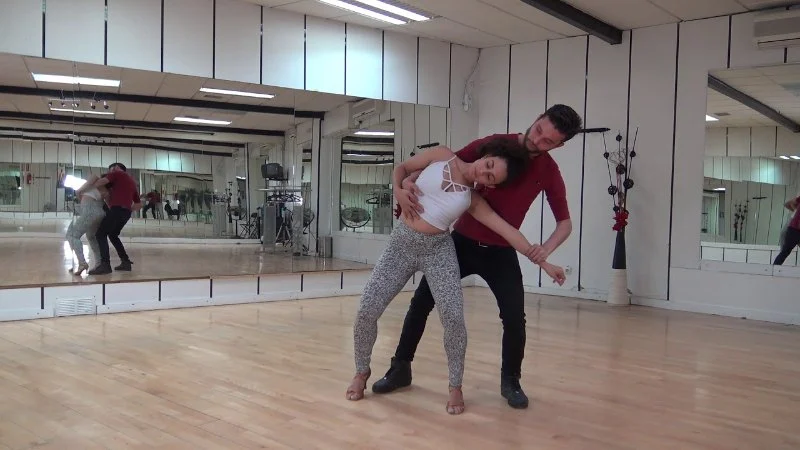
- foundation-basics - Why Bachata confidence starts with rhythm control and body awareness
- basic-step-core - The essential forward-backward step that anchors every combination
- hip-isolation - How controlled hip motion transforms stiffness into flow
- side-to-side-travel - Using lateral movement to unlock partner connection
- right-turn-entry - First spin mechanics that build trust in movement
- left-turn-control - Managing balance and timing under rotation pressure
- close-embrace-comfort - Building confidence through partner proximity
- musicality-sync - Dancing with beats instead of counting steps
- freestyle-transition - Moving beyond patterns into expressive flow
- social-floor-confidence - Applying everything in real dance floor situations
Building Confidence Through Structured Bachata Movement
Bachata is often misunderstood as a “simple” Latin dance, but anyone who has stepped onto a crowded social floor in the United States quickly realizes something different. Confidence is not something dancers are born with—it is something built through repetition, comfort with rhythm, and understanding how the body responds under pressure.
Many beginners feel overwhelmed in their first few classes because they try to memorize patterns instead of understanding movement. The real transformation happens when steps stop being mental puzzles and start becoming physical instincts.
Foundation Rhythm That Shapes Everything Else
Why timing matters more than fancy steps
The foundation of bachata is not about complexity—it is about consistency. The basic step anchors your entire dance identity. When beginners rush, they lose connection with both the music and their partner, which leads to hesitation.
Basic Step Core: The first confidence builder
The basic forward-backward step is deceptively simple. Step left, step right, tap—repeat. But within that repetition lies the first real breakthrough: control over weight transfer. Once a dancer understands where their weight sits at every moment, hesitation begins to disappear.
Hip Isolation: Turning stiffness into flow
A common beginner mistake is forcing hip movement. True bachata style comes from relaxed knees and natural weight shifts. A dancer who masters isolation begins to look “musical” even while doing basic steps.
A student at a small studio in Miami once shared that she felt “awkward and robotic” during her first month. After focusing only on hip relaxation drills for two weeks, she suddenly felt like her body was “responding to the music instead of fighting it.” That shift alone boosted her confidence more than any choreography.
Directional Movement and Space Awareness
Side-to-Side Travel: Expanding comfort zones
Lateral movement is where dancers start to understand space. Instead of staying in one spot, stepping side-to-side creates flow and prevents stiffness. This also prepares dancers for social floor navigation.
Right Turn Entry: First spin confidence milestone
Right turns often feel intimidating at first. The key is not speed—it is preparation. A stable frame, controlled spotting, and consistent timing remove the fear of losing balance.
Many instructors describe this moment as a “breakthrough stage.” Once a dancer completes their first clean right turn without panic, their confidence typically increases dramatically.
Left Turn Control: Mastering balance under rotation
Left turns are slightly more complex due to body mechanics. They require stronger core engagement and clearer lead-follow communication. Beginners who rush this step often feel dizzy or disconnected.
Partner Connection and Emotional Comfort
Close Embrace Comfort: Trust-building through connection
Social dancing is not just mechanical—it is relational. Learning to stay relaxed in close positions helps reduce tension and improves communication between partners.
A widely shared story in online dance communities involved a beginner who avoided partner dances entirely due to anxiety. After slowly practicing close-embrace basics in a structured class environment, she reported that “fear turned into curiosity,” allowing her to finally enjoy social events.
Musicality Sync: Dancing with sound instead of counting
One of the biggest shifts in confidence happens when dancers stop counting “1-2-3-tap” and start feeling the music. Bachata music has layered rhythms that reward emotional interpretation rather than strict timing.
Transition Skills That Create Freedom
Freestyle Transition: Moving beyond memorized steps
At some point, dancers need to stop thinking in patterns. Freestyle transitions allow movement between steps without breaking rhythm. This is where personality begins to show.
A dancer who can transition smoothly between basic steps and turns without hesitation often appears significantly more advanced than someone who only knows complex choreography.
Social Floor Confidence: Real-world application
Dancing in a studio is one thing. Dancing at a social night is another. The real test of confidence is not perfection—it is adaptability. Crowded floors, unfamiliar partners, and varying skill levels require calm awareness.
This is where structured learning environments like American Dance Academy can make a major difference. With guided practice sessions and progressive training, dancers gain exposure to real social conditions in a controlled way, reducing anxiety and building long-term confidence.
How Confidence Actually Develops Over Time
Confidence in bachata is not a single moment—it is a layered process. It begins with repetition, grows through correction, and stabilizes through social experience. Most dancers underestimate how important consistency is.
A common pattern among beginners is rapid improvement in the first month followed by frustration. This happens because early gains come from novelty, while long-term growth requires refinement. Those who persist past this stage typically experience the most dramatic confidence transformation.
Realistic Growth Stages
First stage: confusion and imitation.Second stage: repetition and discomfort.Third stage: awareness and control.Fourth stage: expression and confidence.
Understanding these stages helps dancers normalize frustration instead of interpreting it as failure.
Practical Insight for Faster Progress
The fastest way to improve is not learning more moves—it is improving the quality of existing ones. Clean basics always outperform messy advanced patterns. This principle applies across all social dance environments.
Dancers who focus on posture, timing, and relaxation tend to outperform those chasing complexity. The goal is not to impress—it is to connect.
Why simplicity often wins
Simple movements executed with confidence look far more professional than complicated combinations performed with hesitation. This is why experienced dancers often return to basics during social nights.
 Miss Luluh Dance0.0 (0 reviews)
 AMA Academy of Performing Arts4.0 (39 reviews)
 Wonderfully Made Dance5.0 (48 reviews)
 Serenity Movement Studio5.0 (7 reviews)
 Company 'N Tempo Music, Theatre & Dance Centre5.0 (20 reviews)
 Kaliente Dance Studio4.0 (42 reviews)
 Did Henry Ford Promote Square Dancing in Schools? Discover the Legacy
 Samba for Adults: Common Mistakes to Avoid
 Shuffle Dance for Couples – Complete Guide
 Jazz Dance Step by Step Guide – What You Need to Know
 Ballroom Dance Every Dancer Should Know – Complete Guide
 Why Dance Schooling Is Important for Growth, Confidence, and Expression