
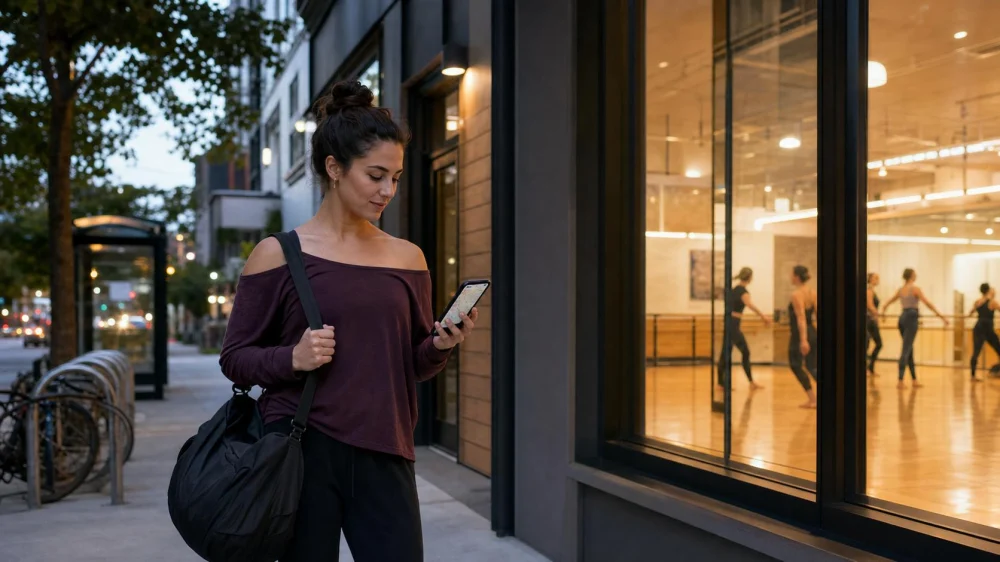
Dance Studio Commute Test: Will You Keep Showing Up?
On this page
- Quick answer
- Why the commute belongs in your decision
- Test the route at the real class time
- Measure door-to-door effort
- Compare driving, transit, cycling, and walking
- Check the weekly fit
- The studio commute checklist
- Limitations and important notes
- Frequently asked questions
- Sources and evidence notes
- Choose a sustainable route
Quick answer
Test a dance studio commute on the same weekday and near the same time as the class you may attend. Measure the full trip: getting ready, traffic or transit, parking, the walk to the entrance, check-in, and the return home. A studio is a practical choice when you can arrive warmed up but unhurried, repeat the trip most weeks, and still handle one predictable delay.
This guide is for U.S. dancers comparing local studios, schools, and class locations. It is especially useful before buying a package or committing to a recurring evening class. It does not replace a trial class, studio policies, current transit notices, or direct confirmation of parking and building access.
Why the commute belongs in your decision
A sustainable studio commute is a door-to-door route you can repeat during ordinary busy weeks without routinely arriving late, stressed, or unprepared. Distance is only one part of it.
A nearby studio can be difficult if its class begins during peak traffic, parking turns over slowly, the entrance is hard to find, or the last bus leaves before class ends. A farther studio can work well when the route is direct, parking is predictable, or it sits between work and home.
The right test asks “Can I do this on a normal Tuesday?” rather than “Can I make it once when everything goes well?” Consistent attendance depends on the complete routine, including the trip home when you are tired.
Test the route at the real class time
- Choose a representative day. Use the weekday on which the class runs, not a quiet weekend unless the class is also on weekends.
- Start from the real origin. Leave from work, school, home, or the childcare pickup that normally comes before class.
- Carry the normal load. Bring the dance bag, shoes, water, outerwear, and anything else you would manage each week.
- Follow the actual mode. Drive, ride transit, cycle, or walk as planned instead of testing an easier method you will not usually use.
- Reach the correct entrance. Find the building, floor, reception area, changing space, and studio room where permitted.
- Test the return. Check lighting, transit frequency, parking-lot exit, traffic, and the final walk after the scheduled class end.
Record the typical time and the slow points. One unusually easy or difficult test should not decide everything; repeat the route or compare current traffic and transit patterns when the commitment is significant.
Measure door-to-door effort
Map estimates usually omit some of the work around the trip. Build a more honest total:
- changing clothes or collecting equipment;
- walking to the vehicle, station, or stop;
- waiting for transit or leaving a parking structure;
- finding legal parking and paying when required;
- walking from the space or stop to the studio;
- check-in, elevator, stairs, changing, and shoe preparation;
- a buffer for a familiar, predictable delay;
- the full return trip.
A class that lasts one hour may occupy a much larger block of the evening. Compare that total with meals, sleep, work, family responsibilities, and recovery. The commute is not automatically too long; it needs to be worth the total time for your goals.
Compare driving, transit, cycling, and walking
Driving
Confirm lot or street-parking rules, cost, time limits, lighting, vehicle access, and the walk to the entrance. Ask the studio whether nearby spaces are reserved or shared. Do not assume an empty daytime lot will be available during an evening class.
Public transit
Check the schedule in both directions, transfer time, service frequency after class, and current notices. Build a plan for a missed connection or a class that ends a few minutes late. Save the route for offline use if coverage is uncertain.
Cycling
Evaluate the complete route, secure bicycle parking, lighting, traffic exposure, weather, and how you will carry gear. Confirm whether the building permits bicycles inside; never block an exit or accessibility route.
Walking
Test crossings, lighting, sidewalk continuity, weather exposure, and the return after dark. A short-looking route can feel different with a dance bag, tired legs, rain, heat, or winter conditions.
The best mode can change by season. A workable plan may include a primary route and a realistic backup rather than depending on one perfect method all year.
Check the weekly fit
Place the complete class block on a real weekly calendar. Include the commute, preparation, and return. Then ask:
- Can I leave the preceding commitment on time most weeks?
- Is there enough margin to check in and prepare without skipping the instructor’s warm-up?
- Will the return disrupt sleep, meals, caregiving, or the next morning?
- Can I afford recurring fuel, fares, tolls, parking, and occasional alternatives?
- What happens during rain, snow, extreme heat, road work, or transit disruption?
- Do I have a safe plan if class is canceled after I begin traveling?
A studio can be excellent yet not fit the current season of your life. Choosing a closer or better-connected class is a practical decision, not a judgment about instruction quality.
The studio commute checklist
- Verify the address and entrance. Confirm the exact building, floor, and after-hours access procedure.
- Confirm the schedule. Ask about arrival expectations, class length, building closing time, and known schedule changes.
- Test the correct day and time. Use the route and transportation method you expect to rely on.
- Measure door to door. Include preparation, parking or waiting, walking, check-in, and the trip home.
- Add one realistic delay. Test whether the plan survives ordinary traffic, a missed train, or a longer parking search.
- Check cost and safety. Include recurring expenses, lighting, crossings, building access, and late-evening travel.
- Create a backup. Identify another route, legal parking area, ride option, or class time.
- Try the class. Combine commute findings with teaching style, class level, flooring, space, and studio policies before committing.
Limitations and important notes
- Map travel times, parking listings, and transit schedules can change. Check current conditions and official notices.
- Special events, school calendars, construction, and seasonal weather can make a normal test unrepresentative.
- Do not enter restricted property or use private parking to test a route.
- Accessibility needs are specific. Confirm entrance, route, elevator, restroom, seating, and drop-off details directly with the studio or building.
- If driving fatigue, unsafe crossings, harassment, poor lighting, or severe weather affects the route, choose a safer option rather than forcing the schedule.
Travel testing helps evaluate practicality, but it cannot guarantee future traffic, service, or personal safety. Use current local information and your own transportation needs.
Frequently asked questions
How early should I arrive for dance class?
Follow the studio’s guidance. Allow time for the entrance, check-in, changing, shoes, and personal preparation so you can join the instructor-led warm-up from the beginning.
Is the closest dance studio usually the easiest?
No. Route simplicity, traffic direction, transit frequency, parking, class time, and the trip home can matter more than straight-line distance.
Should I test the commute before a trial class?
Yes when practical. The trial then evaluates both the instruction and the complete weekly routine. At minimum, inspect the route, parking or transit, entrance, and return plan in advance.
What if parking information is unclear?
Ask the studio which spaces are legal at class time, whether permits or payment apply, and what alternatives exist. Verify posted signs when you arrive; studio guidance does not override property or street rules.
How much delay buffer do I need?
There is no universal number. Use the most common delay on your route and the studio’s late-arrival policy. A plan that works only with zero delay is fragile.
Sources and evidence notes
This guide uses practical scheduling and local-discovery principles: test conditions close to the real event, measure the complete journey, include predictable friction, and prepare an alternative. Exact traffic, transit, parking, building access, and class policies must be verified through current official sources and the individual studio.
Choose a sustainable route
Shortlist a studio, place the full class block on your calendar, and test the real commute in both directions. If you can reach the correct room with time to prepare, return safely, and repeat the routine during an ordinary busy week, the location supports your dance goal instead of quietly competing with it.



 Flamenco 4 Kids!5.0 (7 reviews)
 Raleigh Dance & Tumble5.0 (2 reviews)
 Protege Dance Company4.0 (27 reviews)
 Top Hat Ballroom Dance Studio4.0 (5 reviews)
 A New Pointe Dance4.0 (19 reviews)
 Mi Chantli4.0 (61 reviews)
 Can California Public Schools Charge Students to Attend Dances
 Can Dance Schools Open Yet? What You Need to Know in 2025
 Zumba Tutorial – Everything You Should Know
 How to Choreograph a Dance as a High Schooler: A Complete Guide
 Samba for Adults: Common Mistakes to Avoid
 How a Dance School in Instagram Builds Community and Success