Dance Class Mirrors: When to Watch and When to Look Away
On this page
Quick answer
Use the studio mirror to answer one visible question at a time: Is the shape clear? Is the weight centered? Is the group spacing even? Then repeat the movement without watching your reflection so you can feel the pathway, remember the sequence, and direct your focus into the room. The mirror is best used as temporary feedback, not as a screen that controls every step.
This guide is for adult beginners and continuing dancers in U.S. studio classes. Follow the teacher’s instructions and the needs of the dance style. Mirror use cannot diagnose injury, prove that movement is safe, or replace direct coaching.
What a mirror can and cannot show
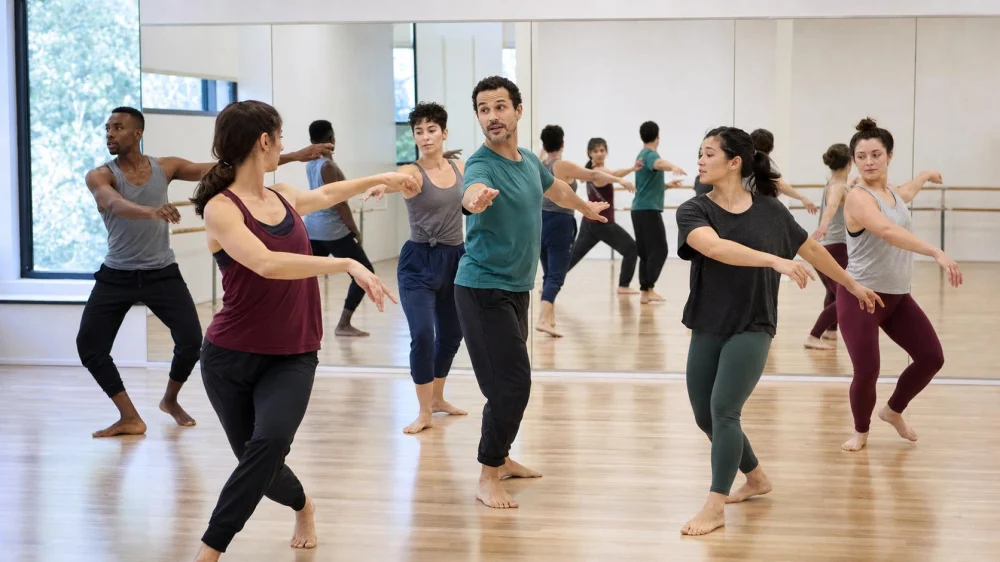
A dance mirror is a real-time visual feedback tool that shows your outward shape, direction, spacing, and relationship to other dancers from one viewpoint. It can help connect an instructor’s cue with something visible.
The mirror is useful for broad comparisons: shoulder height, arm pathway, leg direction, line of travel, group formation, and whether a shape matches the demonstrated idea. It can also reveal habits such as turning the head toward the reflection when the choreography asks the gaze to travel elsewhere.
But a reflection does not tell you how a movement feels inside the body, whether force is being managed well, or why a correction is difficult. It reverses the image, flattens depth, and shows only the angle available from your place in the room. A movement can look similar while being organized differently.
Use the mirror to gather information, then use the teacher’s cue, physical sensation, musical timing, and spatial awareness to decide what to change.
When watching helps
Learning the overall pathway
During a first demonstration, a quick mirror view can clarify where arms, torso, feet, and direction travel. Watch the instructor rather than becoming absorbed in your own reflection. Once the pathway is understood, try it from memory.
Checking one alignment idea
Choose a single cue such as level shoulders, knee direction, rib placement, or a clear arm line, when appropriate to the style and instruction. Slow the movement enough to observe that cue without forcing a position.
Matching timing and spacing
In unison work, the mirror can show whether you begin together, occupy the intended line, and leave safe space around other dancers. Use peripheral vision instead of staring only at yourself.
Comparing before and after a correction
Repeat the same small phrase with the instructor’s correction. Notice the visible difference, then perform it once without looking. This helps connect the cue to both an image and a movement experience.
When to look away
- When balance depends on a fixed focus: use the focal strategy taught for the turn, balance, or traveling phrase rather than chasing your moving reflection.
- When the choreography has a clear gaze: direct your eyes toward the partner, audience, pathway, or imagined point specified by the teacher.
- When memory is the goal: face another wall or soften visual dependence so the sequence must come from recall.
- When traveling through space: look where you are going, track nearby dancers, and prioritize collision avoidance.
- When the mirror increases self-criticism: return attention to a concrete task such as rhythm, weight shift, breath, or direction, and ask the instructor for another working position when possible.
- When partnering: use the visual connection, frame, or shared focus appropriate to the dance instead of monitoring the mirror continuously.
Looking away is not ignoring feedback. It is a deliberate test of whether the correction remains available without the visual prompt.
A three-pass practice method
- Observe: watch the instructor and identify the purpose of the phrase. Choose one visible question for the mirror, such as spacing or arm direction.
- Check: perform at an appropriate speed while using the mirror briefly for that one question. Avoid trying to correct every body part at once.
- Transfer: repeat without watching your reflection. Face another direction when the teacher permits, or keep the eyes on the intended focus while noticing timing, weight, and space.
After the third pass, ask a specific question. “Does my weight arrive before the arm?” gives the teacher more to work with than “Do I look right?” Use the answer for another focused cycle.
For home practice without a studio mirror, mark directions safely, work at reduced size, and use memory, rhythm, and a clear focal point. Recording yourself can provide delayed visual feedback when permitted, but it introduces another angle and should not replace instruction.
Mirrors in group and partner work
In a group, the mirror can help organize lines and shared timing. It can also tempt dancers to drift toward their reflections or copy a neighbor a fraction late. Learn the counts, musical cues, and formation landmarks so the group does not depend on visual following.
When several people share a mirror, do not step into another dancer’s path to improve your view. A partially blocked reflection is normal. Change position only when the instructor organizes a rotation.
In partner dance, the primary information often comes through the agreed connection, shared timing, floorcraft, and partner awareness. A mirror may help an instructor demonstrate a frame or line, but continuous mirror watching can pull attention away from the partnership and traffic around the floor.
A focused mirror-practice checklist
- Name the task. Pick one question about shape, direction, timing, or spacing.
- Find a safe place. Confirm enough room to move without crowding another dancer.
- Watch the teacher first. Understand the demonstrated goal before inspecting your reflection.
- Check briefly. Use the mirror during the most relevant moment rather than throughout the entire phrase.
- Avoid forcing. Do not push a joint or range merely to reproduce an appearance.
- Repeat without it. Keep the same correction while using the intended gaze or another wall.
- Ask specifically. Request teacher feedback on the chosen task.
- Apply in context. Restore music, travel, partner focus, or performance direction.
Limitations and important notes
- Dance styles and teachers use mirrors differently. Follow the class method rather than imposing one universal rule.
- Reflections reverse left and right and can complicate learning when the instructor changes orientation.
- A visual shape cannot confirm safe load, joint organization, or readiness for range and speed.
- If movement causes pain, dizziness, numbness, or instability, stop and tell the instructor. Seek appropriate professional guidance rather than correcting from appearance alone.
- Body image concerns can affect how mirror feedback is experienced. A task-focused cue and a different place in the room may help; discuss ongoing concerns with a qualified instructor or relevant professional.
The goal is not to eliminate mirrors or to watch constantly. It is to use visual information in proportion to the skill being learned.
Frequently asked questions
Should beginners always stand where they can see the mirror?
Not always. A clear view can help with demonstrations, but the instructor may arrange positions for level, spacing, safety, or rotation. Beginners also need chances to move without copying the reflection.
Why do I forget choreography when I turn away from the mirror?
You may have been following visual cues rather than encoding counts, directions, transitions, or musical landmarks. Practice a short section facing another direction and name its key cues before adding more material.
Can the mirror fix my alignment?
It can show an outward difference, but it cannot explain the cause or confirm that a correction is appropriate. Use the instructor’s cue and avoid forcing the body to match an image.
Is video better than a mirror?
They provide different feedback. A mirror is immediate; video can be reviewed later from a chosen angle. Both have visual limits, and recording requires studio permission and respect for other dancers’ privacy.
What if mirrors make it hard to focus?
Choose one external task, use a position with less direct reflection when the teacher allows, and explain the difficulty privately to the instructor. The class may offer alternative focus cues without changing the learning goal.
Sources and evidence notes
This guide reflects broad dance-teaching practice: use visual feedback for a defined task, reduce dependence by repeating without it, combine feedback with teacher instruction, and prioritize spatial safety. Technique details, alignment cues, and suitable range belong to the dance style, teacher, and individual dancer.
Build balanced visual feedback
At your next class, choose one mirror question and one no-mirror repetition. Check the visible detail, look away, and see whether the correction remains in timing, pathway, and space. That simple transfer turns the mirror from a constant judge into a practical learning tool.

 Flamenco 4 Kids!5.0 (7 reviews)
 Raleigh Dance & Tumble5.0 (2 reviews)
 Protege Dance Company4.0 (27 reviews)
 Top Hat Ballroom Dance Studio4.0 (5 reviews)
 A New Pointe Dance4.0 (19 reviews)
 Mi Chantli4.0 (61 reviews)
 Can California Public Schools Charge Students to Attend Dances
 Can Dance Schools Open Yet? What You Need to Know in 2025
 Zumba Tutorial – Everything You Should Know
 How to Choreograph a Dance as a High Schooler: A Complete Guide
 Samba for Adults: Common Mistakes to Avoid
 How a Dance School in Instagram Builds Community and Success