Dance Class Feedback: Turn Corrections Into Better Practice
On this page
Quick answer
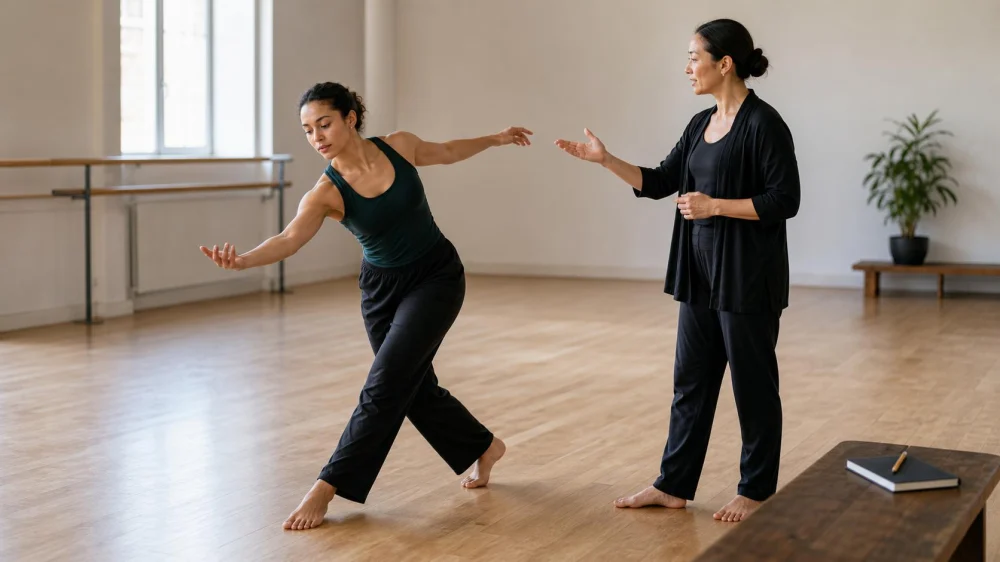
Turn a dance correction into practice by reducing it to one observable goal, trying it during the next safe repetition, noticing the movement result, and writing a brief note after class. Ask a short clarifying question when the cue is unclear, but do not interrupt a combination or create a safety problem. A useful correction is not a verdict about talent; it is information for the next attempt.
This guide is for adult students in group dance classes. Teaching styles, terminology, access needs, and class rules differ. Your teacher remains the best source for the intended technique, and pain or injury concerns belong with an appropriately qualified healthcare professional.
Decode what the teacher is asking
Dance feedback can arrive as a technical instruction, image, rhythm, sound, demonstration, question, touch cue, group reminder, or note about the effect of a movement. Before changing everything, identify the kind of information you received.
Find the action and the intended result
Separate the cue into two parts:
- Action: what you can try on the next repetition.
- Result: what should look, feel, sound, or travel differently.
For example, “send the floor away so the jump rises” contains an action image and an intended movement effect. “Arrive on count eight without rushing the last step” gives a timing target. “Keep the spacing even through the diagonal” identifies a group outcome. If you cannot find an action or result, note the teacher’s exact phrase and clarify later.
Distinguish individual and group feedback
A correction addressed to the room may still apply to you. During the next repetition, check whether you are doing the named behavior rather than assuming a group note is for someone else. An individual correction, however, may reflect one dancer’s body, role, level, or choreographic assignment; do not automatically copy it.
Translate without rewriting the technique
Convert a long explanation into a short cue you can recall, such as “finish the transfer,” “land quietly,” or “hold the pathway.” Keep the meaning aligned with the teacher’s instruction. If your shorthand changes the action, ask the teacher to verify it.
Respond without stopping the class
Most group-class feedback is meant to change the next attempt. A simple response—attention, a nod, or “thank you”—often shows that you heard it while allowing the class to continue. You do not need to explain why the earlier attempt went wrong.
Use the next-repetition rule
- Listen to the whole correction.
- Choose one actionable phrase.
- Watch the demonstration or pathway if one is provided.
- Apply it during the next safe repetition.
- Compare the result with the stated goal.
If the teacher immediately adds another cue, keep the one that affects safety, timing, or the main class objective first. Trying to consciously manage six body parts at once can crowd attention and make it difficult to learn which change mattered.
Receive a correction without personalizing it
Technical feedback describes a performance at a particular moment. It does not define intelligence, effort, body worth, or future potential. If the wording feels discouraging, return to the actionable information: What is the next attempt? What result should change? If feedback is routinely humiliating, discriminatory, sexualized, threatening, or unrelated to instruction, document what occurred and use the studio’s reporting or safeguarding process.
Test one cue through movement
Feedback becomes useful when you connect it to a movement result. Some research on motor learning favors cues aimed at the effect of an action rather than constant conscious control of individual body parts. That does not mean anatomy or body-based instruction is never useful. The relevant cue depends on the task, dancer, stage of learning, and teacher’s purpose.
Build an observable target
Replace a vague goal with something you can check:
- Instead of “do it better,” aim to finish the turn facing the agreed direction.
- Instead of “be musical,” identify the accent, pause, or arrival count.
- Instead of “use more space,” choose the destination of the traveling phrase.
- Instead of “make it smooth,” connect two specified transitions without a visible stop.
- Instead of “relax,” identify the unnecessary gripping the teacher named and the movement effect expected when it reduces.
Run a small comparison
When class structure allows, make one ordinary attempt and one attempt emphasizing the cue. Compare balance, timing, sound, pathway, effort, spacing, or another relevant result. Do not exaggerate a correction to the point that it creates pain or changes the choreography.
Use mirrors and video as tools, not judges
A mirror can confirm direction, line, spacing, and timing, but constant visual checking may pull attention away from sensation, partners, or travel. Alternate between looking and moving without the mirror when the teacher directs. Record video only with studio permission and the consent of everyone who may appear. Use it to answer one technical question, not to criticize appearance frame by frame.
Record corrections you can reuse
Wait until a permitted break or the end of class rather than writing while others are moving. A compact note is easier to practice than a transcript.
Use a four-part correction note
- Where: exercise, side, step, phrase, or count.
- Cue: the teacher’s words or your verified shorthand.
- Target: the visible, audible, spatial, or timing result.
- Next test: one safe way to try it before the next class.
Example: “Across-the-floor turns; spot to the exit sign; finish facing front on count six; test three slow passes with full pauses.” This is more reusable than “turns bad.”
Tag the source and date
Technique can vary by genre, school, choreography, and teacher. Add the class and date so that a ballet alignment note is not accidentally imposed on a contemporary improvisation task or a choreographer’s deliberate stylistic choice.
Review for patterns, not a fault inventory
Once a week, look for repeated themes such as timing, weight transfer, pathway, initiation, or use of space. Choose one theme for focused practice. Also record what changed successfully; improvement data helps you identify cues that work.
Build a short practice loop
A long unsupervised session can reinforce the wrong interpretation. Start with a small, low-intensity version of the task and stop while attention remains clear.
- Recall: state the correction without looking at your notes.
- Verify: check the note and correct any missing detail.
- Simplify: remove speed, travel, arms, or music only if the teacher has said that is appropriate.
- Try: complete a few deliberate repetitions with one cue.
- Observe: note the result rather than labeling the attempt good or bad.
- Rest: pause, then try again without reading the cue.
- Transfer: return the change to the original phrase, direction, tempo, or context.
Practice on a surface and in footwear suitable for the movement. Marking arms, rhythm, pathway, or weight direction may be safer at home than full jumps, turns, lifts, pointe work, floorwork, or large traveling phrases. Ask the teacher what can be practiced independently.
A five-minute example
- Minute 1: recall the cue and define the target.
- Minutes 2–3: try a simplified version with adequate space.
- Minute 4: repeat with less conscious prompting.
- Minute 5: write one result and one question for class.
More repetitions are not automatically better. Quality, recovery, and accurate interpretation matter. If the correction repeatedly disappears when tempo or complexity returns, that is useful information to bring back to the teacher.
Know when and how to ask for help
Choose a moment that does not interrupt music, traffic patterns, partnering, or another student’s feedback. Many teachers prefer questions at the end of an exercise, during a designated break, or after class. Follow the studio’s norm.
Ask a narrow question
Useful formats include:
- “When you said to finish the transfer, should my weight be fully over the front foot by count four?”
- “May I check whether that group correction applies to my line?”
- “Could you show the pathway once from the side?”
- “Which one of these two cues should I prioritize this week?”
- “Is this movement appropriate for me to practice at home, and what should I avoid?”
Demonstrate only when invited. A short question plus one attempt usually gives the teacher more useful information than a long explanation.
Clarify touch and access
Physical guidance should follow clear consent and studio policy. You may request verbal description, demonstration, imagery, a different viewing position, or no touch. If hearing, vision, neurodivergence, language, mobility, or another access need affects how you receive feedback, ask what reasonable communication options the studio can provide.
Limitations and safety notes
Research on feedback spans different sports, ages, tasks, skill levels, and laboratory settings. Findings do not prove that one cue type or feedback schedule is best for every dancer. A 2022 systematic review in children found mixed or limited evidence for several combinations of feedback frequency, timing, and form, while a broader 2021 meta-analysis favored external attentional focus on average. Treat these as useful tendencies, not rigid laws.
A teacher’s correction is not a diagnosis. Stop a movement that causes sharp pain, new numbness, instability, dizziness, breathing difficulty, or a sudden loss of function. Tell the teacher and seek appropriate medical assessment when needed. Do not “push through” because you assume discomfort proves the correction is working.
Students should not practice lifts, catches, acrobatics, pointe work, high-impact jumps, unfamiliar turns, or choreography requiring a partner or specialized floor without the supervision, preparation, and environment the activity requires.
This article offers general educational strategies. It cannot assess an individual dancer, teacher, class culture, disability accommodation, injury, or training plan.
Frequently asked questions
What if I receive several corrections at once?
Prioritize the cue related to immediate safety, then the teacher’s stated class objective. Ask which single correction should lead your next repetition. Record the others after class instead of attempting to consciously control everything at once.
Should I apply every group correction to myself?
Check whether you are doing the behavior named. Group feedback often applies widely, but an individual correction may be specific to one dancer’s role or needs. Clarify rather than copying a personal adjustment.
Is it rude to ask the teacher to repeat a correction?
No, if you choose an appropriate moment and ask briefly. Repeat what you understood first, then identify the missing part. This helps the teacher answer the actual question.
Should I write corrections down during class?
Only when the teacher permits it and you are out of the movement path. A designated break or the end of class is usually safer. Use a short note that includes the exercise, cue, target, and next test.
What if a correction makes the movement hurt?
Stop the painful attempt and tell the teacher what you felt and where. Do not assume pain is required. Persistent or concerning symptoms should be evaluated by an appropriately qualified healthcare professional.
How do I know whether a correction worked?
Use the result the teacher named: direction, timing, balance, sound, pathway, spacing, or movement quality. Ask for confirmation if the result is not observable to you. One successful attempt is information, not proof that the change is permanent.
Sources and evidence notes
- International Association for Dance Medicine & Science: From correction to constructive feedback describes feedback as information that guides dance skill acquisition, technique, and movement quality.
- IADMS: Motor Learning and Teaching in Dance reviews feedback, repetition, attentional focus, imagery, autonomy, and related teaching considerations.
- Chua and colleagues, 2021 meta-analysis found external focus more effective on average than internal focus for motor performance, retention, and transfer across the included studies.
- van der Veer and colleagues, 2022 systematic review found mixed or limited evidence for several feedback strategies in children and emphasized the need for stronger research.
The practical workflow in this article combines these evidence themes with ordinary group-class constraints. The sources do not validate every suggested note-taking or practice step, and they should not replace individualized instruction.
Next steps
After your next class, choose one correction and write four lines: where it occurred, the cue, the intended result, and one safe test. Practice that test briefly, then return to class with one focused question. The goal is not to collect more criticism; it is to create a repeatable path from information to movement.
 Dazzle BBC, LLC5.0 (40 reviews)
 On Deck Dance0.0 (0 reviews)
 Devoted Performing Arts Center LLC.5.0 (5 reviews)
 Natya Ravali Kuchipudi Dance Academy5.0 (5 reviews)
 American Ballet Academy4.0 (24 reviews)
 Mak Fai Kung Fu Dragon & Lion Dance Association4.0 (9 reviews)
 Do Schools in Paris Have Dances? Understanding French School Social Life
 Salsa for Seniors – What You Need to Know for Safe & Fun Dancing
 Shuffle Dance Cultural Origins – Complete Guide
 Foxtrot for College Students: Expert Tips to Get Started
 Samba for Beginners – Complete Guide
 Do Schools in France Have Dances? Discover French Dance Traditions