Ballet Barre Etiquette: Spacing, Sides, and Safe Changes
On this page
Quick answer
At ballet barre, take only the space you can use safely, leave enough room for a full leg and arm pathway, and place belongings off the floor. Use a light supportive hand rather than gripping or pulling. Before changing sides, listen for the teacher’s pattern, check behind and beside you, rotate in the agreed direction, and reset without crossing through another dancer’s working space.
This guide is for general U.S. ballet classes. Teachers and studios may use different formations, terminology, barre directions, and accommodations. Follow the instructor and the room’s safety procedures.
Choose and share barre space
Barre etiquette is the set of habits that helps dancers share a fixed or portable support safely and efficiently. The first goal is not to secure a favorite spot; it is to create workable spacing for the class.
Before class starts:
- ask whether spots are assigned by level, height, side, or arrival order;
- avoid blocking an entrance, emergency route, piano, speaker, or teacher’s demonstration area;
- leave space for wheelchairs, mobility aids, service animals, interpreters, or other planned access;
- place bags, bottles, warm-ups, and phones in the designated area;
- check the floor for moisture, loose rosin, tape edges, or objects; and
- introduce yourself briefly if the class will share a portable barre in pairs.
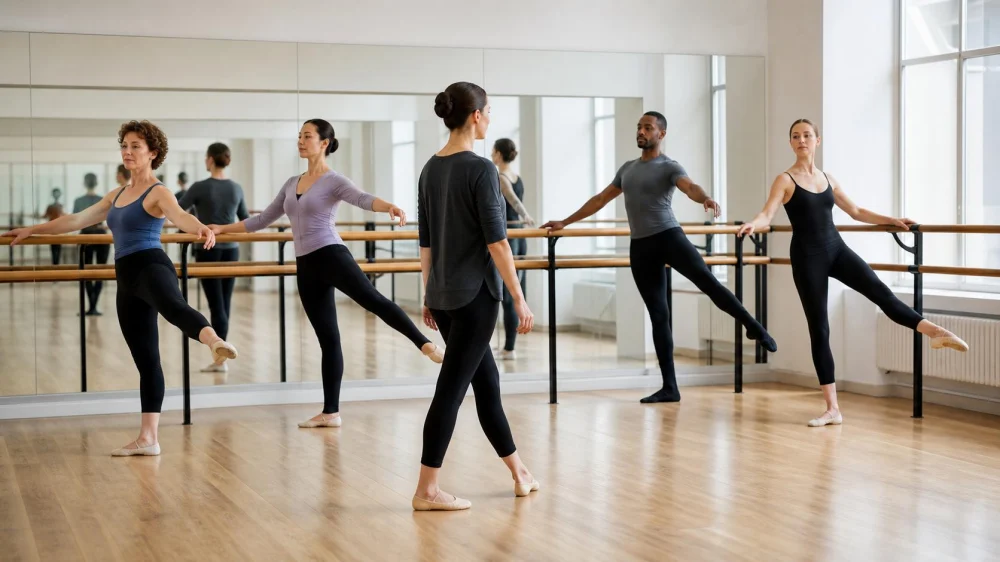
Estimate space with the actual movement, not shoulder width. A battement, rond de jambe, port de bras, or forward fold can extend farther than a standing position. Taller dancers may need greater reach, but every dancer needs a safe pathway.
Set a useful position
Stand close enough to touch the barre without leaning, reaching, lifting the shoulder, or twisting the torso. The supporting hand should rest lightly so balance develops from alignment and muscular control rather than pulling against the rail.
If the barre height is adjustable, follow the teacher’s direction. A typical useful height allows the shoulder to remain relaxed and the elbow soft. There is no single correct height for every body, exercise, or disability.
At a fixed barre, adapt distance rather than forcing the arm. Tell the teacher when height or position creates pain or instability. A lower barre, chair, wall, parallel rail, or another support may be more appropriate when approved.
Keep fingers and thumb in a natural, non-clamping position. Do not wrap the entire hand under a portable rail or place fingers where another dancer stepping close could trap them. Avoid jewelry or long nails that scratch the barre or create catching risk.
Square yourself to the exercise as instructed. In one-hand work, the body may be perpendicular to the barre; in two-hand work, it may face the barre. Do not drift diagonally into a neighbor’s line as fatigue increases.
Change sides without collisions
- Finish the combination. Hold the final position until the musical phrase and teacher’s cue end. Do not turn early while neighbors are still moving.
- Listen for instructions. Some teachers ask dancers to turn toward the barre, away from it, rotate in place, or move around an end. Use the class pattern.
- Check the space. Look behind, beside, and at the floor. Confirm that the neighboring dancer is also ready.
- Keep movements compact. Lower extended legs and arms before rotating. Avoid sweeping a foot or elbow through another person’s space.
- Do not climb under or over the rail. Walk around a portable barre only if instructed and if the path is clear.
- Reset the distance. Your safe spacing may change when the working leg changes. Recheck the wall, mirror, and neighbor.
- Resume quietly. Face the teacher, prepare the correct foot, and avoid side conversations that delay the group.
When two dancers face opposite directions on the same rail, their working legs may approach each other. Agree on a small stagger or ask the teacher to adjust positions. Do not silently shrink the combination into poor mechanics just to avoid contact.
Portable barres and crowded rooms
A portable barre can move or tip if dancers pull, hang, push sideways, sit, stretch a leg on it without permission, or load one end unevenly. Never relocate it alone unless the studio permits and you know the procedure.
Before use, the teacher or authorized person should place it on a suitable level surface with stable feet and enough clearance. Dancers should report wobbling, loose hardware, sharp edges, damaged feet, or sliding immediately.
In a crowded class, the solution is not automatically smaller unsafe movement. The instructor may stagger lines, alternate groups, change direction, limit travel, move some dancers to center, or modify the exercise. Wait for that direction.
At a wall-mounted barre, leave room near brackets and corners. A neighbor’s hand may need to move along the rail, so do not spread towels, phones, or accessories on it. Clean the barre only with products approved by the studio because residue can make it slippery or damage the finish.
Class habits that help everyone
- Arrive early enough to change shoes and place belongings before the warm-up.
- Do not reserve a long stretch of barre for absent friends unless the teacher assigns it.
- Keep corrections and self-practice compact during pauses.
- Ask before joining a spot after class has begun.
- Mark large movements when the teacher is demonstrating, then use full range only after spacing is set.
- Avoid correcting another student unless the teacher asks you to partner or give feedback.
- Tell a neighbor quietly before moving closer or changing a shared pattern.
- Wipe sweat from the floor promptly using the studio’s procedure.
- Report collisions, equipment movement, pain, dizziness, or floor hazards instead of dancing through them.
Mirrors are for information, not ownership of a sightline. If a taller dancer blocks your view, adjust only when safe and ask the teacher for help rather than crowding the rail.
Access needs and safety limits
Some dancers need a particular side, support height, orientation, visual cue, interpreter sightline, rest interval, or place near an exit. These are functional needs, not violations of etiquette. Studios can communicate assignments without requiring a dancer to disclose private medical details to the class.
Tell the teacher before class about a recent injury, balance issue, pregnancy-related modification, prosthesis, brace, mobility aid, hearing or vision need, or clinician-imposed restriction relevant to barre placement. The teacher can offer class-level modifications; medical clearance comes from an appropriate clinician.
Stop if the barre moves, the floor is wet, spacing becomes unsafe, or a movement causes sharp pain, sudden weakness, numbness, chest pain, breathing difficulty, or dizziness. Move out of the active pathway and alert the teacher.
Do not use the barre for unsupervised deep stretching, hanging, inversions, or acrobatics. Its presence does not mean it is rated for body weight in every direction.
Frequently asked questions
Which hand goes on the barre first?
The teacher usually sets the starting side. If not, follow the class formation and ask rather than guessing.
Can I take the front corner spot?
Only if spots are open and the teacher has no assignment. Corners can require extra awareness because of walls, mirrors, and brackets.
How far apart should dancers stand?
Far enough for the largest arm and leg pathway in the combination without contact. The exact distance depends on bodies, exercise, and room.
May I put my foot on the barre to stretch?
Only when the teacher directs it and the equipment and dancer are ready. Portable barres can tip or slide.
What if someone keeps entering my space?
Pause, communicate briefly and neutrally, and ask the teacher to reset spacing. Do not compete for the rail through larger movement.
Can I use a chair instead?
Often a stable approved chair or other support can be an accommodation, but the instructor should check its placement and suitability.
Sources and evidence notes
This article reflects common ballet class organization, shared-space principles, and general equipment safety. Barre direction and etiquette are not standardized across every method or studio.
Equipment load limits, cleaning methods, spacing, and accessible supports should come from the studio and manufacturer. Individual medical restrictions require advice from a qualified clinician.
Conclusion and next steps
Choose a spot by movement clearance, not preference alone. Keep the supporting hand light, belongings off the floor, and pathways clear. Listen before changing sides, check every direction, and reset your distance. When equipment, space, or access needs make the standard formation unsafe, pause and let the teacher redesign the setup.



 Drumcliffe Irish Arts5.0 (4 reviews)
 The Vickie Roberson Theatre4.0 (74 reviews)
 Let's Dance, Inc4.0 (26 reviews)
 Axé Capoeira Tucson at Studio Axé5.0 (50 reviews)
 All That Dance Co4.0 (250 reviews)
 Mountain Home Ballroom5.0 (17 reviews)
 Can Dance Schools Reopen in NJ? What Parents and Students Should Know
 Top 10 Ballet Moves Workout Benefits for Strength, Flexibility, and Balance
 The History of Swing Dance Tutorial
 Dance Notes After Class: Build a Useful Practice Log
 Do Colleges Have School Dances? Exploring Dance Life on Campus
 Top 10 Contemporary Dance Moves to Try in 2025