Dance Notes After Class: Build a Useful Practice Log
On this page
- Quick answer
- Capture details while fresh
- Use a repeatable note structure
- Write movement cues that work
- Turn notes into a practice plan
- Review without overloading yourself
- Privacy and studio boundaries
- Limitations and important notes
- Sources and evidence notes
- Frequently asked questions
- Conclusion and next steps
Quick answer
Within a few minutes after dance class, record the date, style, warm-up theme, new vocabulary, choreography counts, one correction, one question, and one next practice action. Use short cues you understand instead of transcribing everything. Before the next class, review the page and practice only the highest-priority items in a safe space. A useful dance log supports memory and decisions; it is not a scorecard.
A dance practice log is a private record of class material, physical observations, corrections, questions, and practice choices. It helps connect one class to the next without relying on memory alone.
Capture details while fresh
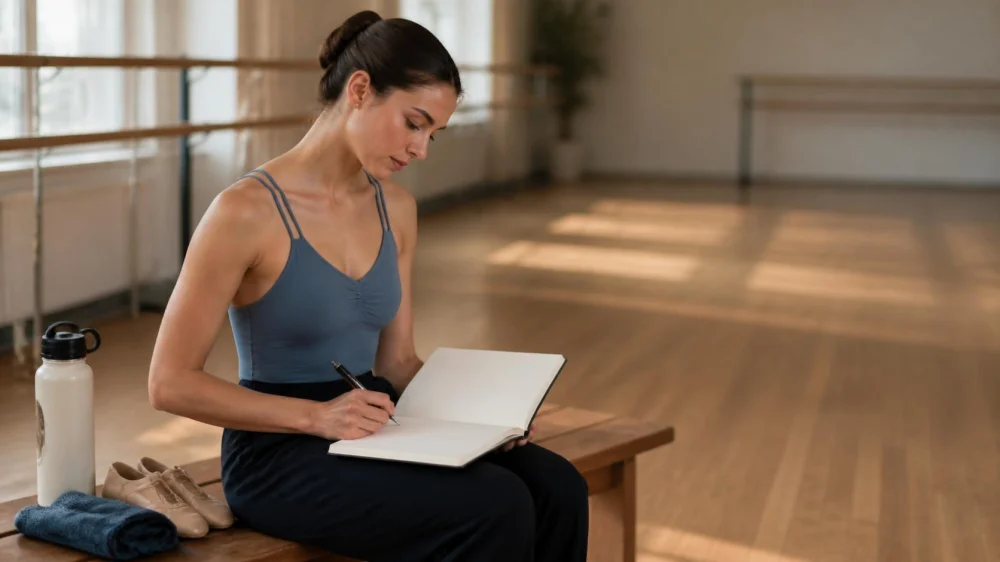
Write for three to five minutes after class or as soon as practical. Start with facts before interpretation:
- date, teacher, style, and class level;
- music or tempo description without copying protected material;
- new steps, combinations, or vocabulary;
- starting side, facing, count, and major direction changes;
- corrections addressed to you versus general class reminders;
- pain, unusual fatigue, dizziness, or equipment concerns.
Do not wait until the end of the week to reconstruct precise choreography. If phones are restricted, use a small paper notebook outside the studio.
Use a repeatable note structure
- Today’s focus: one sentence about the class goal.
- Material: names, sequence, counts, pathways, and formations.
- Correction: what happened, the teacher’s cue, and where to apply it.
- Question: one item to clarify rather than guess.
- Body check: energy, discomfort, and recovery needs without self-diagnosis.
- Next action: one short task before the next class.
Best for consistency: the same headings every time. Not ideal: a long narrative so dense that you never review it.
Write movement cues that work
Combine four kinds of information:
- Timing: “step on one, hold two, turn three-and-four.”
- Direction: “travel downstage right” or a plain-language room reference.
- Body action: “weight fully over left foot before release.”
- Quality: “sustained,” “sharp,” “heavy,” or the teacher’s exact image.
Use symbols sparingly and add a key. Avoid labeling a movement “bad.” Describe what happened and the change you want: “landing noisy; reduce height and organize feet.”
Turn notes into a practice plan
- Choose one memory task, one timing task, and one technique task.
- Warm up appropriately before full movement.
- Mark the sequence slowly in a clear space.
- Practice the difficult transition rather than repeating the whole phrase.
- Add music only after pathway and weight changes are clear.
- Stop when form deteriorates or pain appears, then note what needs teacher input.
A practice action should be small enough to finish: “walk counts one through eight three times” is more useful than “get better at the combination.”
Review without overloading yourself
Before the next class, scan the last entry and circle one cue. At the end of a month, look for patterns: repeated timing questions, one side that needs clarification, shoes or floors linked to discomfort, or corrections that are becoming automatic.
Do not turn the log into constant self-criticism. Include evidence of learning: a transition remembered, a question answered, or better pacing. Progress is not always linear.
Privacy and studio boundaries
Follow studio and teacher rules about choreography, music, photos, and recordings. Notes for personal learning do not grant permission to publish combinations, identify classmates, or share private corrections. Keep health details and other people’s information out of a publicly synced document.
If you need an accessibility accommodation for note-taking or memory, discuss a practical option with the studio before class.
Limitations and important notes
This guide is general educational information. Teachers and dance traditions use different terminology and notation. Confirm unclear material with the instructor rather than treating your notes as authoritative.
A log cannot diagnose injury or replace medical care. Stop for sharp or worsening pain, neurological symptoms, chest pain, fainting, or another urgent concern and seek appropriate help.
Sources and evidence notes
The method reflects common learning practice: retrieve information soon after class, organize cues, identify one next action, space review, and connect feedback to a specific context. The teacher and choreography are the primary sources for exact movement and intent.
Frequently asked questions
Should I take notes during class?
Only when the teacher permits it and it does not interrupt movement or safety. Brief notes after class are often easier.
Paper or phone?
Use the option allowed by the studio that you will review consistently. Paper reduces notification distraction; digital notes are easier to search.
How much should I write?
Enough to trigger accurate recall: a few headings, counts, corrections, and one action. More is not automatically better.
Can I draw floor patterns?
Yes. Simple arrows and room landmarks can clarify travel and formations. Add a key so the sketch remains understandable.
What if I remember a correction differently?
Mark it as a question and ask the teacher. Do not build repeated practice on an uncertain interpretation.
Conclusion and next steps
Create one page with six headings: focus, material, correction, question, body check, and next action. Complete it immediately after your next class, then review it before the following session. Keep only the cues that improve recall, safer practice, and useful questions.
 Balance Dance Center4.0 (13 reviews)
 Perkins School of the Arts5.0 (6 reviews)
 Dynamix Performing Arts Academy5.0 (5 reviews)
 Movers and Shakers Salsa and Bachata Dance Academy4.0 (335 reviews)
 Dance To EvOLvE at Carmel Valley Rec Center4.0 (10 reviews)
 The Performing Arts Connection5.0 (91 reviews)
 Top 10 Bachata Moves Fitness Routine for Beginners and Experts
 Are Dance Schools Considered Dance Halls? Exploring the Difference
 Top 10 Hip Hop Moves Explained
 How to Master Bollywood Dance Workout Benefits
 Do British Schools Have School Dances? A Cultural Look Inside UK Student Life
 Bollywood Dance Tutorial: Common Mistakes to Avoid for Better Performance