
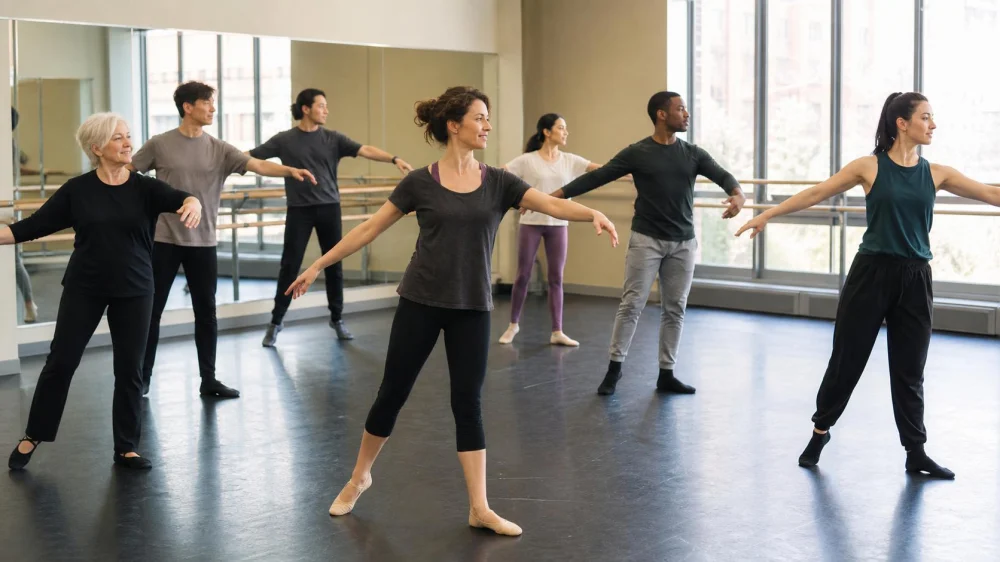
Returning to Dance After a Break: Choose the Right Class
On this page
Quick answer
After time away from dance, choose a class based on your current conditioning, coordination, mobility, and goals—not the level you once reached. Tell the teacher about the length of your break and relevant restrictions, observe or try a lower-impact class, and increase frequency gradually. Technical memory may return faster than tissue capacity, so treat pain, persistent fatigue, and loss of control as reasons to modify or pause.
Reassess your starting point
A break changes people differently. Someone may remember choreography but tire quickly, while another retains strength but needs time to recover balance or musical timing. Consider current daily activity, prior injuries, health changes, sleep, footwear, and the surfaces on which you have been moving.
Write one near-term goal such as rebuilding class stamina, reconnecting with a style, or moving comfortably twice a week. A specific goal helps a studio recommend a useful level without assuming you want competition or rapid advancement.
Choose a class
- Read the prerequisites. Level names differ by studio. Ask which skills, pace, and experience the class expects.
- Describe your break honestly. Include former style and level, time away, and what activity you do now.
- Ask about impact and repetition. Jumps, floor work, partnering, turns, and long combinations affect readiness differently.
- Consider an observation or trial. Confirm policy first, then watch pace, spacing, correction style, and available modifications.
- Start with margin. A slightly easier class can rebuild consistency while leaving energy for controlled technique.
- Confirm logistics. Check the floor, shoes, attire, schedule, accessibility, cancellation rules, and changing facilities.
Plan the first weeks
- Arrive early enough to discuss modifications without delaying class.
- Complete the teacher-led warm-up and avoid forcing old ranges of motion.
- Mark or reduce impact when control or alignment fades.
- Take water and rest as appropriate without standing in travel paths.
- Leave recovery time before the next demanding class.
- Note energy, soreness, pain, and which skills felt stable after each session.
Normal exertion and temporary muscle fatigue are different from sharp, worsening, or function-limiting pain. A teacher can modify class activity but cannot diagnose an injury.
Adjustment signals
Stay with the class when you can maintain safe control, understand most instructions, recover reasonably, and feel appropriately challenged. Reduce level, impact, or frequency when you repeatedly lose alignment, cannot recover between combinations, or soreness disrupts normal activity.
Seek qualified medical guidance for new or worsening pain, swelling, instability, numbness, breathing difficulty, faintness, or concerns related to a prior condition. Return-to-activity advice may be especially important after surgery, significant injury, pregnancy-related changes, or prolonged illness.
Limitations and safety notes
This article is general education, not medical clearance or individualized training. Class labels and dance demands vary. Follow the studio, teacher, and relevant healthcare professional, and do not use a former achievement as proof that a current movement is safe.
Sources and evidence notes
The approach reflects common return-to-activity principles: assess current capacity, begin below the maximum, progress one variable at a time, and monitor symptoms and recovery. Studio staff define class content; qualified clinicians address medical restrictions.
Frequently asked questions
Should I return to my old class level?
Not automatically. Compare current capacity with the actual prerequisites and pace, then adjust after a trial period.
How often should I dance at first?
There is no universal schedule. Choose a frequency that allows controlled participation and recovery, then add gradually.
Will technique come back quickly?
Some coordination may feel familiar early, but strength, endurance, range, and tissue tolerance may recover at different rates.
Should I tell the teacher about an old injury?
Share relevant limitations and approved modifications. Seek a clinician’s guidance when the injury remains symptomatic or restrictions are unclear.
Next steps
Contact the studio with your history, current activity, and goal. Ask for the actual class demands, try a level with margin, and track control and recovery for several sessions. Progress only when the current workload remains comfortable and consistent.




 Elite Dance Academy recital4.0 (8 reviews)
 Jordan School of Ballet5.0 (1 reviews)
 Elegance In Dance4.0 (15 reviews)
 Naad Studios0.0 (0 reviews)
 Strand Studios Learning Center for Music, Film and Acting4.0 (58 reviews)
 Suzannah Stage School0.0 (0 reviews)
 Zumba for Seniors: Tips from Experts | American Dance Academy
 Why K-Pop Dance Is Popular and How You Can Learn It
 Shuffle Dance for Seniors: Common Mistakes to Avoid and Tips for Success
 Waltz for Seniors – Everything You Should Know
 Bollywood Dance to Improve Flexibility – Complete Guide for Beginners
 Jazz Dance Step by Step Guide: Expert Tips and Techniques