
Late to Dance Class? Enter Safely Without Skipping Warm-Up
On this page
Quick answer
If you arrive late to dance class, follow the studio’s cutoff policy, check in quietly, and wait for the teacher to signal when and where to enter. Do not jump directly into full-range combinations. Use an approved side area for a gradual warm-up, watch one repetition if needed, and join only when you can do so without crossing moving dancers or increasing injury risk.
A late-entry dance plan is a studio-approved way to move from arrival to safe participation after the group warm-up has begun or ended. It balances the dancer’s preparation with class flow, spacing, supervision, and the teacher’s responsibility for the room.
Know the studio policy
Studios may close entry after a set time, especially for advanced technique, pointe, partnering, aerial, acrobatics, or classes with a progressive warm-up. The rule may reflect safety, insurance, building access, or respect for other students—not punishment.
Check registration terms and ask before the first class:
- How many minutes late can a student enter?
- Should a late student call, text, or use the front desk?
- Where can a student warm up without blocking class?
- May a student observe if participation is no longer allowed?
- Do youth pickup, locked-door, or attendance rules change the process?
Do not rely on what another teacher allowed in a different class. Each instructor can adjust entry based on that day’s material and room conditions.
Check in before entering
Finish parking, silence the phone, secure belongings, and change shoes before approaching the floor. Enter through the designated door and make brief eye contact with the teacher or front-desk staff. A small hand signal is better than calling across the room.
Wait at the edge until acknowledged. Do not walk through a traveling combination, between partners, behind a dancer moving backward, or across the teacher’s sightline. If the studio door opens directly onto the floor, watch the traffic pattern before stepping in.
Offer the explanation after class unless staff needs immediate information. A long apology can interrupt music and instruction. A concise “May I warm up and join?” is enough.
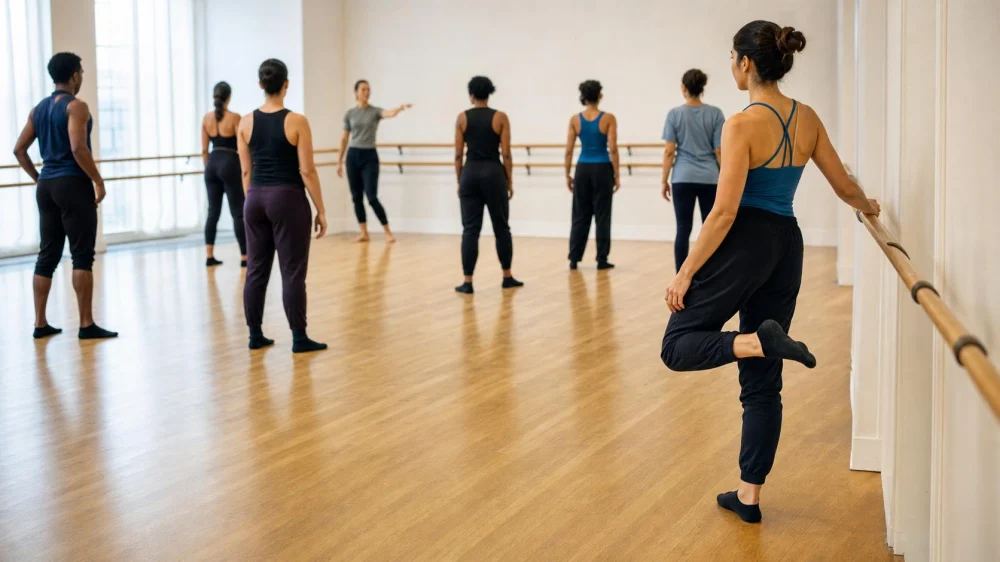
Warm up before joining fully
A warm-up gradually raises physical and mental readiness for the movement ahead. It should reflect the dancer, environment, style, and upcoming intensity. It is not simply stretching as far as possible.
- Begin with easy rhythmic movement that increases warmth without breathlessness.
- Move major joints through comfortable, controlled ranges.
- Add style-relevant basics at reduced range and speed.
- Progress toward balance, direction changes, or impact only when ready.
- Ask the teacher which exercise is the safest entry point.
Avoid deep static stretching, high kicks, jumps, drops, extreme backbends, or full-out turns as the first movement of the day. Do not improvise a large warm-up where it distracts the class or creates a collision zone.
Find your place without disruption
Join at a natural reset: after music stops, when lines rotate, or when the teacher assigns groups. Take an open edge position before moving toward a preferred spot. If combinations travel, observe the direction, starting point, ending point, and group order.
Mark unfamiliar material at lower intensity rather than copying full-out from a partial view. “Marking” means rehearsing the pattern with reduced range and effort while preserving timing and direction. It is not ideal when the teacher says the exercise must be done fully or when reduced movement would confuse a partner.
Tell a partner you arrived late and confirm the expected role before contact begins. Never enter a lift, weight-sharing task, or fast partnered sequence without instruction and mutual readiness.
Decide when to observe or leave
Observing is often the better choice when the class is near its end, the teacher cannot supervise a separate warm-up, the next section is technically demanding, or the room is too crowded for a late entry. Observation can still support learning if the studio permits it.
Sit out if you feel faint, ill, unusually short of breath, in sharp or increasing pain, or unable to control basic movement. Tell the teacher or staff rather than disappearing without explanation. Seek appropriate medical care for significant symptoms or injury.
If lateness becomes frequent, solve the schedule problem instead of normalizing incomplete preparation. A later class, closer studio, packed bag, transit buffer, or different workday may be safer and more sustainable.
Late-arrival checklist
- Confirm the class allows late entry.
- Park and prepare without rushing.
- Check in through the correct person or system.
- Wait at the edge and avoid active traffic paths.
- Ask where to warm up and when to join.
- Increase temperature and movement range gradually.
- Observe group order and direction before stepping in.
- Mark unfamiliar material when appropriate.
- Skip partnering or high-risk skills without full instruction.
- Accept observation or denied entry without disrupting class.
Important notes and limitations
Warm-up needs differ by age, training history, injury status, style, temperature, and class content. This article provides general participation guidance, not physical therapy, medical advice, or a prescribed exercise program.
Dancers returning from injury or managing a medical condition should follow the plan from their qualified healthcare professional and communicate relevant restrictions to the teacher. A rushed self-selected warm-up does not replace clearance or class modification.
The teacher and studio control entry, supervision, and floor use. If the policy says the class is closed, do not enter through another door, join from the back, or pressure a student to make space.
Frequently asked questions
How late is too late for dance class?
There is no universal number. The studio policy, class type, progression, room, and teacher’s assessment determine it. Ask ahead and follow the decision made that day.
Can I stretch in the hallway before entering?
Only if the studio permits it and the area is safe, visible, clean, and outside exits or traffic. A hallway may not provide supervision, appropriate flooring, or room for movement.
Should I explain why I am late?
Keep the arrival brief. Share necessary information with the front desk or teacher, then offer a fuller explanation after class if appropriate.
Can I join during a combination?
Wait for a natural break and the teacher’s signal. Entering mid-combination can disrupt spacing, timing, and group order even if you know the choreography.
Is watching class still useful?
Yes. Observe alignment cues, rhythm, pathways, transitions, corrections, and how the teacher builds difficulty. Take notes after class if devices are not allowed in the room.
Sources and evidence notes
This guide reflects common dance-teaching, group-class, and physical-preparation practice: warm up progressively, preserve traffic patterns, enter at a transition, reduce intensity while learning, and let the instructor control participation. The studio’s policy, teacher’s direction, and individualized healthcare guidance control a specific class.
Next steps
Ask your studio for its late-entry rule before the next class and save the front-desk contact. Pack early and add a realistic travel buffer. If delay still happens, arrive calmly, check in, request a safe warm-up and entry point, and accept observation when full participation would no longer be appropriate.
 The Difference Dance Company5.0 (8 reviews)
 New Jersey Dance Fusion4.0 (20 reviews)
 Southwest Ballet Theatre4.0 (15 reviews)
 Culkin School of Irish Dance0.0 (0 reviews)
 Ultra Dance Company5.0 (12 reviews)
 Rangeela Dance Company - Los Angeles, CA5.0 (24 reviews)
 Jazz Dance to Try in 2025 – Styles, Techniques & Trends
 How to Design a School Dance Poster That Students Remember
 How a School Program Dance Builds Confidence, Creativity, and Community
 Why Cha Cha Remains Popular Among Seniors and Its Benefits
 A Wonderful Life High School Dance Scene: Why It Still Dazzles
 Why Hip Hop Is Popular to Improve Flexibility: Benefits of Dance for Mobility and Health