
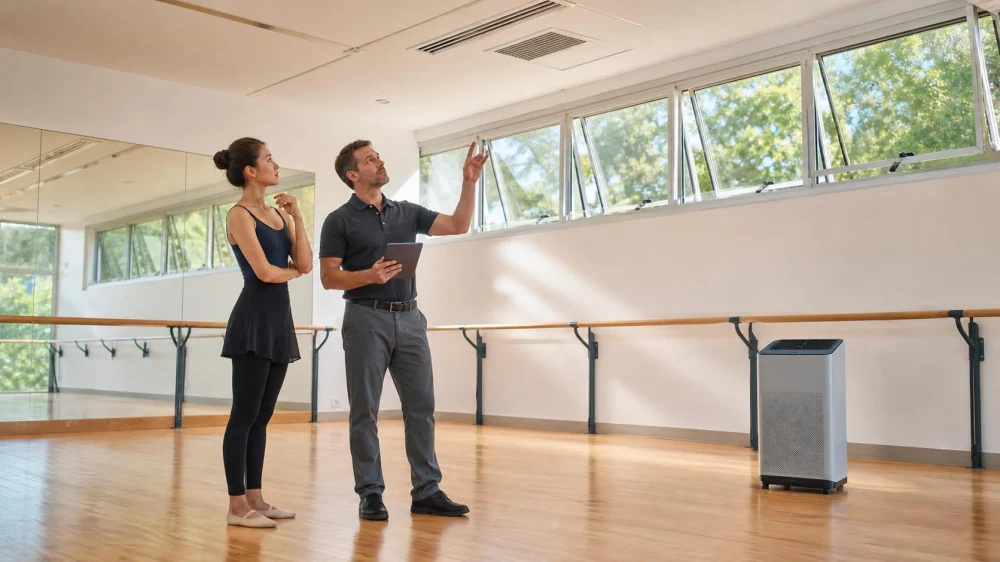
Dance Studio Ventilation: Questions to Ask Before Class
On this page
- Quick answer
- Why a dance studio needs an air plan
- Ask about outdoor air and HVAC
- Understand filtration and air cleaners
- Connect occupancy to the room
- Look beyond temperature
- Plan for smoke and poor outdoor air
- Illness policies and personal needs
- Limitations and professional triggers
- Sources and evidence notes
- Frequently asked questions
- Next steps
Quick answer
Before a high-activity dance class, ask how the studio brings in clean outdoor air, filters recirculated air, matches occupancy to the room, and responds when outdoor smoke or indoor equipment changes conditions. Look for an operational plan rather than one open window or a fan. Persistent musty odors, visible moisture, strong chemical fumes, blocked vents, or symptoms that improve after leaving deserve prompt attention and professional evaluation.
This guide helps U.S. dancers ask practical indoor-air questions. It cannot measure a building, certify code compliance, diagnose a health problem, or rank a studio. Building owners, HVAC professionals, industrial hygienists, public-health officials, and clinicians handle different parts of those decisions.
Why a dance studio needs an air plan
Ventilation introduces and distributes cleaner air while removing or diluting indoor contaminants. Filtration captures certain particles from air that passes through an HVAC filter or air cleaner. Source control reduces the pollutants released in the first place.
Dance classes combine physical activity, close spacing, long occupancy, music, cleaning products, floor materials, costumes, dust, and sometimes windows that remain closed for sound or climate control. The room can feel cool while still lacking enough clean air, or feel warm even when ventilation is working.
No single device manages every concern. A practical plan layers source control, clean outdoor air when appropriate, central filtration, supplemental room filtration when useful, maintenance, occupancy decisions, and a response for unusual events.
Ask about outdoor air and HVAC
You do not need to become a mechanical engineer to ask useful questions:
- Does the studio have mechanical ventilation, operable windows, or both?
- When the building is occupied, how is outdoor air brought into this room?
- Does the system run before and after class as well as during it?
- Who maintains the HVAC system and how are blocked vents or faults reported?
- Are supply and return vents kept open and clear of curtains, bags, scenery, or storage?
- What changes when the room is full, the weather is extreme, or outdoor air is polluted?
Opening windows can increase outdoor-air exchange in some rooms, but effectiveness depends on layout, weather, wind, security, noise, temperature, and outdoor air quality. A door propped open to a hallway is not necessarily an outdoor-air strategy.
Fans can improve mixing or comfort, but a fan that only moves the same air around is not a substitute for ventilation or filtration. Airflow should not create a trip hazard, lift dust from the floor, blow directly from one dancer toward another, or interfere with hearing instructions.
Understand filtration and air cleaners
Ask what filter level the HVAC equipment can safely use and how often filters are checked and replaced. A higher-efficiency filter is helpful only when it fits the system, airflow remains adequate, and maintenance is consistent.
A portable air cleaner can supplement central ventilation and filtration in a studio or waiting area. Useful questions include:
- Is the unit sized for this room and its intended air-cleaning target?
- Where is it placed, and are intake and outlet paths clear?
- At what speed does it run during class?
- Who tracks filter replacement and device faults?
- Does the noise interfere with music cues or verbal instruction?
- Does the device intentionally produce ozone or another reactive substance that should be avoided?
Visible equipment is not proof of performance. A small unit in a large, crowded room may have little effect, while a properly sized and maintained unit can add useful particle removal. Ask for the model and room plan rather than relying on marketing words.
Connect occupancy to the room
Ventilation needs and movement safety both change with the number of people, activity level, class length, and room size. A studio should know the lawful occupancy and may choose a lower class cap for spacing, teaching, heat, and clean-air goals.
Ask:
- What is the normal class cap for this room?
- Does a high-intensity class use a different cap from a low-movement rehearsal?
- How much time separates consecutive classes?
- Are waiting family members placed in the same air zone or a separate area?
- How does the studio handle workshops or events that fill the room beyond a normal class?
Carbon dioxide monitoring can help a qualified building team understand occupancy and ventilation patterns in some settings, but one reading is not a complete air-quality score and does not measure every pollutant or infection risk. Ask how the studio interprets and acts on data rather than treating a sensor color as a guarantee.
Look beyond temperature
Comfort matters, but temperature alone cannot confirm good indoor air. Notice conditions that deserve a question:
- persistent musty, sewage, fuel, exhaust, smoke, or strong chemical odors;
- visible water damage, condensation, damp materials, or suspected mold;
- dust buildup on vents or repeated dust clouds from the floor;
- blocked, damaged, unusually noisy, or inactive ventilation equipment;
- cleaning products sprayed while dancers occupy the room; or
- headache, eye or throat irritation, dizziness, breathing symptoms, or nausea that appears in the room.
An odor does not identify the source or concentration, and the absence of odor does not prove the air is safe. Report the time, room, activity, and condition to staff. Stop activity and move to fresh air when symptoms or an acute odor make continued class unsafe.
Do not investigate mechanical rooms, climb to vents, disturb suspected mold, mix cleaners, or use consumer meters to declare a building safe or unsafe.
Plan for smoke and poor outdoor air
Wildfire smoke, traffic pollution, construction dust, pollen, or an outdoor incident can make opening windows the wrong choice. Ask the studio how it checks current outdoor air and changes operations.
A smoke-day plan may include closing outdoor openings, adjusting HVAC intake according to professional guidance, using effective particle filtration, relocating or reducing activity, postponing class, or canceling when indoor conditions cannot be maintained. The correct response depends on the building and event.
People with asthma, heart or lung conditions, pregnancy, or other health concerns may need individualized guidance and a lower threshold for changing plans. Review the cancellation or credit policy before smoke season or another predictable hazard.
Illness policies and personal needs
Ventilation reduces some airborne exposure but does not replace staying home when sick, hygiene, cleaning, vaccination where appropriate, or other public-health measures. Ask how the studio communicates illness expectations and handles a teacher or student who becomes ill during class.
If you need a mask, breaks, a position near a door, lower-intensity participation, or another accommodation, discuss it before class. Do not block a required exit or ventilation path to create personal space.
Tell the instructor if you experience symptoms. Chest pain, severe breathing difficulty, fainting, confusion, blue or gray lips, or another emergency sign requires immediate help and 911 as appropriate. Recurring symptoms need clinical evaluation, not only a change in fan position.
Limitations and professional triggers
- Students cannot verify air changes, filter fit, exhaust balance, or code compliance by appearance alone.
- Portable air cleaners cannot remove every particle, gas, odor, or surface contaminant.
- Opening a window can worsen conditions when outdoor air is polluted or weather creates other hazards.
- Fragrance and odor sensitivity can occur even when a product is used as directed; source control and communication still matter.
- Water intrusion, suspected combustion gases, sewage odor, repeated HVAC failure, or widespread symptoms need qualified evaluation.
A directory can help locate studios, but confirm the current room, class cap, building practices, accessibility, and policies with the studio itself.
Sources and evidence notes
CDC workplace guidance describes ventilation as outdoor-air introduction, air movement and dilution, plus filtration through central systems or in-room air cleaners. EPA guidance emphasizes source control and clean outdoor air first, with filtration as a supplement rather than a complete solution.
The EPA air-cleaner guide focuses on homes, so commercial studio sizing and system decisions require appropriate building and HVAC expertise.
Frequently asked questions
Does an open window mean the studio has good ventilation?
Not necessarily. Air exchange depends on opening size, room layout, weather, wind, and mechanical systems. Ask about the complete plan.
Is a visible air purifier enough?
Only if it is appropriately sized, placed, operated, and maintained for the room, and even then it supplements rather than replaces other controls.
Can a fan replace fresh air?
No. A fan can move air and improve comfort, but it does not necessarily add outdoor air or remove particles.
Should windows stay open during wildfire smoke?
Often clean outdoor air is not available during smoke. Follow current public-health guidance and the building’s professionally informed smoke plan.
What should I do about a musty smell?
Report when and where you notice it. Avoid disturbing suspected mold. Leave the room if symptoms occur and ask what qualified inspection or correction is planned.
Next steps
Ask the studio four questions before class: how outdoor air enters, what filtration serves the room, what occupancy the plan supports, and what changes during smoke or HVAC problems. On arrival, note blocked vents, persistent odors, moisture, and room crowding. Report concerns early and choose another class or location when the studio cannot explain a workable response.




 PAN, Performing Arts Network and School4.0 (6 reviews)
 Dance with Glen5.0 (6 reviews)
 South County Dance4.0 (24 reviews)
 GeneRaTion DCD4.0 (14 reviews)
 Triplett Dance Academy4.0 (20 reviews)
 Summers Academy of Dance4.0 (13 reviews)
 The History of Line Dance Step by Step Guide
 Tango You Can Learn at Home: Master the Art of Tango with Simple Steps
 Can Dance Schools Open Yet? What You Need to Know in 2025
 Shuffle Dance for Couples – Complete Guide
 Can a High Schooler Choreograph a Dance? Skills, Tips, and Inspiration
 How to Master Line Dance for Beginners