
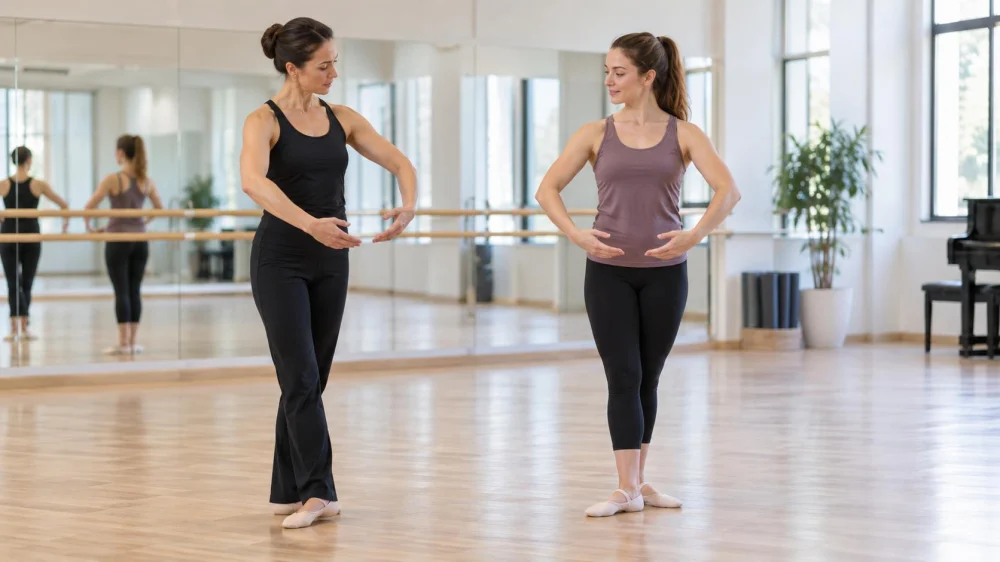
Dance Class Level Placement: Questions Before You Enroll
On this page
Quick answer
Choose a dance class level by comparing the studio description with your recent training, vocabulary, coordination, stamina, and ability to learn at the stated pace. Ask whether prerequisites are required and how placement is reviewed. When uncertain, take an assessment or a lower-pressure introductory session. The right level should be challenging without forcing you to guess constantly, ignore pain, or compromise other dancers.
Understand what level labels mean
Beginner, intermediate, advanced, open, and professional are not universal standards. One studio may use “beginner” for adults with no experience, while another uses it for dancers who already know basic positions and timing. Age group, dance style, class length, and performance goals also change the meaning.
Read the full class description for prerequisites, expected vocabulary, movement examples, years of training, and teacher approval. A numbered sequence may describe curriculum order rather than overall ability. “Open level” usually signals a mixed room, but it does not guarantee that every combination will be adapted for a first-time dancer.
Use the studio information as the source of truth for that program. Online comparisons can suggest questions, but they cannot assign an equivalent level across ballet, jazz, contemporary, ballroom, hip-hop, tap, or another style.
Make an honest experience check
List what you have practiced recently rather than relying only on the number of years since your first class. Include the style, frequency, length of any break, performance or competition experience, and whether you trained recreationally or in a graded syllabus.
- Can you follow the common terminology used in the class description?
- Can you reproduce a short sequence after demonstration and correction?
- Can you maintain timing, spacing, and directional changes around others?
- Do you understand basic alignment and know when to reduce range or stop?
- Can you sustain the class length while keeping safe technique?
- Are there movements you have not learned, even if your general fitness is strong?
Fitness from another activity may help stamina but does not replace dance-specific coordination, technique, or floor awareness. Likewise, past training can remain valuable after a break, but speed, balance, and movement tolerance may need gradual rebuilding.
Compare pace, content, and physical demands
A suitable class is not defined by whether you can complete one difficult step. Look at the whole session: warm-up knowledge, speed of instruction, length of combinations, use of turns or jumps, partner work, improvisation, floor work, and expected independent practice.
Ask whether the teacher explains foundational mechanics or mainly gives combinations. A class that moves quickly may offer few repetitions. Performance or audition classes may require rapid retention, while a technique class may spend more time on detail.
Health conditions, pregnancy, injury, disability, and recovery needs can change which movements are appropriate. Discuss relevant limits privately with the teacher or studio before class. Seek qualified medical advice when participation depends on a diagnosis or recovery plan; a level label is not a medical clearance.
Ask the studio useful placement questions
Contact the studio with specific information and questions. A concise message helps staff compare your experience with the actual curriculum.
- Describe your dance styles, most recent consistent training, and length of any break.
- Ask which skills or vocabulary students should already know.
- Confirm whether teacher approval, an audition, or an assessment is required.
- Ask about class pace, average experience range, and whether modifications are offered.
- Check footwear, clothing, floor, partner rotation, and attendance expectations.
- Ask how and when the teacher recommends moving up or down.
Do not pressure staff to guarantee a placement before they have seen you move. A thoughtful studio may make a provisional recommendation and refine it after the teacher observes your technique, learning pace, and safety awareness.
Test the placement and adjust safely
If the studio allows a trial or assessment, arrive early and tell the teacher that you are evaluating level. Place yourself where you can see without blocking established traffic. Follow corrections, reduce range when needed, and avoid attempting a skill you cannot enter or exit safely.
After class, separate normal learning challenge from a poor match. Useful challenge feels like focused work with understandable corrections. A class may be too high if most instructions are unfamiliar, you repeatedly lose the pathway around others, or fatigue makes basic alignment unreliable. It may be too low if the curriculum consistently offers no relevant practice after the teacher has assessed you.
One class can be affected by unfamiliar teaching style, travel fatigue, or a difficult combination. Ask the teacher what they observed and whether another session, a foundation class, or a different level would provide better evidence. Moving down is not failure; it can be the fastest route to stronger technique.
Frequently asked questions
How many years of dance make someone intermediate?
There is no universal number. Consistency, style, curriculum, movement quality, and current readiness matter more than elapsed years. Use the studio prerequisites and teacher assessment.
Should a fit adult skip the beginner level?
Not automatically. General fitness does not teach dance vocabulary, coordination, spacing, or style-specific technique. A foundation class can still be demanding and useful.
What does an open-level class mean?
It usually welcomes more than one experience level, but pace and modification vary. Ask who the class is designed for and whether complete beginners are supported.
Can I change levels after enrolling?
Policies differ. Ask about transfers, price differences, deadlines, and teacher approval before registering, then keep any written confirmation.
What should I tell the teacher about an injury?
Share the movement limits relevant to class and follow professional medical guidance. The teacher can explain class content but should not be expected to diagnose or clear an injury.
Conclusion and next steps
Read the studio-specific prerequisites, summarize your recent training, and ask how placement is evaluated. Use an assessment or trial when available, then judge the match by comprehension, technique, spacing, and sustainable effort—not by pride or a single difficult step. A class level is a starting point that can change as the teacher learns how you move.




 Psalms 150 Dance Studio5.0 (5 reviews)
 Mona Khan Company3.0 (12 reviews)
 Elite 92 Dance & Cheer Academy5.0 (2 reviews)
 8 Count Dance AZ5.0 (3 reviews)
 New Era Dance Co.5.0 (4 reviews)
 RS Beats Dance Group5.0 (2 reviews)
 Why Waltz Is a Popular Fitness Routine – Benefits of Waltzing for Health
 How to Master K-Pop Dance for Kids: Fun Tips and Techniques
 What Is a Ring Dance in High School and How to Prepare for It
 How to Master Bachata That Boost Confidence
 Foxtrot to Try in 2025 – What You Need to Know
 Samba You Can Learn at Home: Common Mistakes to Avoid