Dance Class Level Labels: How to Choose Without Guessing
On this page
Quick answer
Choose a dance class by its written prerequisites, pace, vocabulary, and expected independence—not by the level name alone. “Intro,” “basic,” “beginner,” “open,” and “all levels” can mean different things at different studios. Tell the studio your experience in that specific style, how recently you trained, and what skills you can do reliably. When uncertain, start one level lower or ask to observe before spending on a package.
This guide is for adult recreational dancers comparing U.S. classes. Youth placement, conservatory programs, competitive teams, pre-professional training, auditions, and adaptive classes may use formal age, curriculum, or teacher-placement rules that override a general self-selection process.
Why level labels vary
A dance class level is a local description of the knowledge, pace, and independence expected in that class. There is no single national dictionary that makes “beginner” identical across ballet, hip-hop, salsa, tap, jazz, contemporary, ballroom, or every studio.
A large drop-in center may divide one style into basic, beginner, advanced beginner, intermediate, and advanced sessions. A smaller studio may offer only beginner and mixed level. A class called beginner can be the first step in a progressive course or an ongoing drop-in class where regular students already know the teacher’s patterns.
The teacher, class format, and weekly attendance pattern matter too. A one-time workshop, six-week fundamentals series, technique class, choreography class, social-dance class, and performance rehearsal can all use the same level label while expecting different skills.
Decode common labels
Use these as questions to investigate, not fixed definitions:
- Intro or absolute beginner: often designed for someone with no experience in that style and more explanation of vocabulary, alignment, rhythm, and class flow.
- Basic or fundamentals: may focus on a smaller movement set and repeated skill-building; it can suit new dancers and experienced dancers reviewing technique.
- Beginner: may expect familiarity with the most common terms, positions, timing, or steps even when combinations remain short.
- Advanced beginner: usually adds faster transitions, longer combinations, directional changes, or less demonstration.
- Intermediate or advanced: commonly expects established technique, quicker learning, physical readiness, and the ability to apply corrections independently.
- Open level: describes access more than difficulty; the teacher may offer layers, but the base pace can still challenge a first-time dancer.
- All levels: may include modifications for a wide range, or it may assume everyone can follow a shared foundation.
If the studio provides a level guide, use that guide instead of this general list. Look for prerequisite classes, years of recent training, named steps, tempo, turns, jumps, partnering, floorwork, improvisation, or choreography-retention expectations.
Match experience to the style
General fitness and experience in another dance form can help, but they do not automatically transfer to the same class level. A strong runner may be new to rhythm changes and directional vocabulary. An advanced ballet dancer may still need an introductory tap class to learn sound production and weight shifts.
Describe experience precisely:
- style or technique studied;
- how long and how consistently you studied;
- how recently you attended class;
- whether training was recreational, social, competitive, or pre-professional;
- typical class length and pace; and
- skills you can perform with control rather than only recognize by name.
Partner dance adds role, timing, connection, and social-floor skills. Ask whether the level assumes experience as a lead, follow, or both; whether partners rotate; and whether the class teaches patterns from the beginning.
Use a practical self-check
Before booking, rate your readiness in five areas:
- Vocabulary: Can you respond to common terms in this style without watching every detail?
- Rhythm: Can you begin on the correct count and recover after losing the phrase?
- Learning pace: Can you retain several steps while new material is added?
- Control: Can you perform the required basics with stable alignment, spacing, and safe landings or weight transfers?
- Independence: Can you keep moving when the teacher stops demonstrating?
If most answers are “not yet,” choose intro, basic, or a fundamentals series. If you understand the material but need repeated practice, beginner may fit. If you can learn at pace while maintaining control, ask whether the next level is appropriate.
Do not use flexibility, body type, age, costume, or confidence alone as a level test. Technique readiness is demonstrated through repeatable movement and learning skills.
Questions to ask the studio
Send a concise message before buying a package:
- Is this class suitable for someone with no experience in this exact style?
- What vocabulary or steps should students already know?
- Is it a drop-in class or a progressive course that builds each week?
- How long are typical combinations, and how quickly are they taught?
- Does “open” mean open enrollment or mixed difficulty?
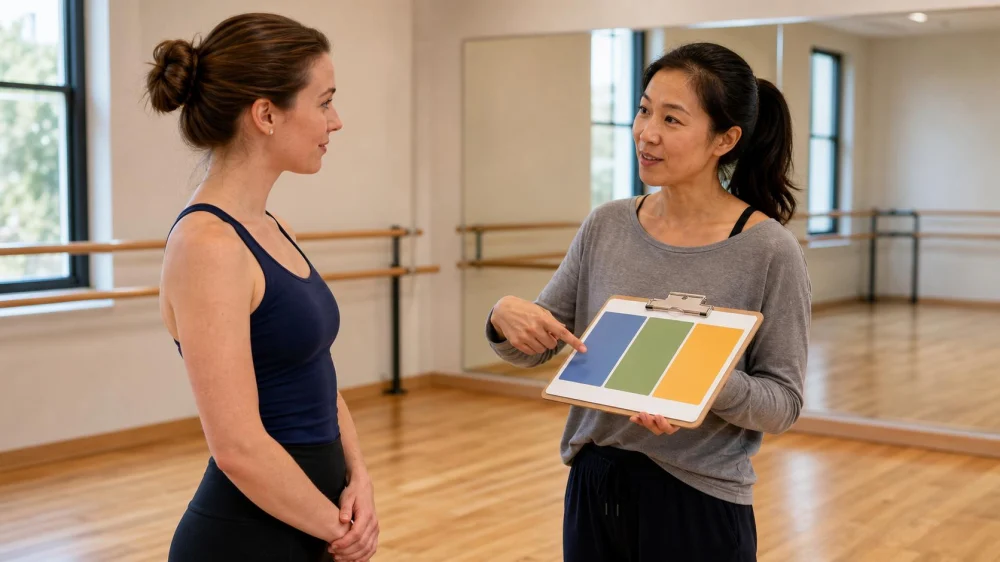
- Can I observe, take a trial, or ask the teacher for placement advice?
- What shoes, floor conditions, clothing, and physical requirements should I expect?
- What is the change, refund, or credit policy if the level is not a fit?
Include relevant access, mobility, sensory, injury, or return-to-activity needs when you want the studio to explain available adaptations. The person answering should describe the class and policy rather than diagnose whether an activity is medically appropriate.
Evaluate the first class
One difficult combination does not automatically mean the class is wrong. Look at the full experience.
The level may be workable when you can:
- follow the warm-up without unsafe guessing;
- understand most foundational instructions;
- complete a simplified version while preserving control;
- maintain spacing and directional awareness;
- recover after a mistake without freezing or colliding; and
- identify what to practice before returning.
The class may be too advanced when the pace prevents you from understanding the base movement, you repeatedly lose safe spacing, you cannot modify without disrupting others, or complexity forces uncontrolled jumps, turns, floorwork, or partnering.
A class may be too basic for your current goal when you consistently perform the full material with control, need little new explanation, and the teacher confirms that the next level’s prerequisites are met. Reviewing fundamentals can still be valuable, so “easy” is not the only reason to move.
When to move up or down
Ask the teacher for a specific readiness signal: “Which two or three skills should I demonstrate consistently before taking the next level?” That produces more useful guidance than asking whether you are “good enough.”
Move up when the current level is repeatably controlled, the teacher agrees, and you can meet the next class prerequisites without skipping foundational work. Try one higher-level class before buying a large package.
Move down or add a fundamentals class when you need more time with vocabulary, rhythm, alignment, balance, weight transfer, or learning pace. This is a training adjustment, not a failure. Mixing levels can work when the classes have different purposes—for example, fundamentals for technique and a beginner choreography class for application.
After a long break, injury, illness, pregnancy, or other major change, seek appropriate medical clearance when needed and ask the studio about a gradual return. Past level does not guarantee current readiness.
Limitations and important notes
- Level names do not certify teacher quality, class safety, or studio fit.
- A mixed-level class cannot always provide equal challenge or modification for every student.
- A teacher may recommend a different placement after observing you.
- Choreography speed and technical difficulty are related but not identical.
- Pain, dizziness, breathing difficulty, instability, or acute injury is a reason to stop and seek appropriate help, not a normal level-placement test.
A directory can help you discover studios, but confirm schedules, levels, prerequisites, accessibility, instructor information, and policies directly with the studio.
Sources and evidence notes
Prominent U.S. dance programs illustrate why local definitions matter. Ailey Extension offers classes spanning absolute beginner through professional experience, while Broadway Dance Center publishes its own multi-level guide for new students. Each organization defines classes within its curriculum and audience.
- Ailey Extension: Classes Across Experience Levels
- Broadway Dance Center: New Students and Class Levels
These examples support checking studio-specific descriptions; they are not a universal placement standard.
Frequently asked questions
Is “open level” good for a first class?
Maybe. “Open” can mean anyone may enroll, not that the material starts from zero. Ask about the base pace, prerequisites, and modifications.
Does “beginner” mean no experience?
Not always. Some studios use “absolute beginner,” “intro,” or “basic” for first-time dancers and reserve beginner for students who know foundational vocabulary.
Can experience in one style move me up in another?
It can help with coordination, musicality, and learning, but style-specific vocabulary and technique still matter. Describe both transferable experience and what is new.
Should I buy a class package before I know the level?
A single class, trial, observation, or short series is usually a lower-risk way to test placement. Review refund and level-change policies first.
What if the teacher gives several versions?
Choose the version you can perform with control, timing, and spacing. More turns, height, speed, or complexity is not automatically the appropriate option.
Next steps
Read the studio’s level description, identify your recent experience in that style, and ask about prerequisites, pace, format, and change policies. Start with a trial or the more foundational option when uncertain. After class, assess vocabulary, timing, control, spacing, and learning pace, then request a specific placement recommendation from the teacher.




 PAN, Performing Arts Network and School4.0 (6 reviews)
 Dance with Glen5.0 (6 reviews)
 South County Dance4.0 (24 reviews)
 GeneRaTion DCD4.0 (14 reviews)
 Triplett Dance Academy4.0 (20 reviews)
 Summers Academy of Dance4.0 (13 reviews)
 The History of Line Dance Step by Step Guide
 Tango You Can Learn at Home: Master the Art of Tango with Simple Steps
 Can Dance Schools Open Yet? What You Need to Know in 2025
 Shuffle Dance for Couples – Complete Guide
 Can a High Schooler Choreograph a Dance? Skills, Tips, and Inspiration
 How to Master Line Dance for Beginners