
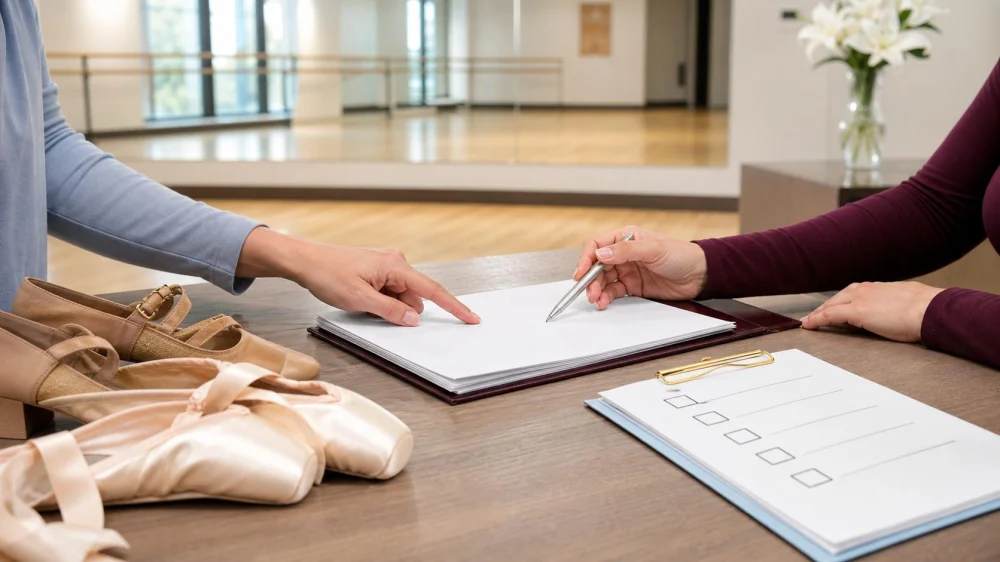
What to Check Before Signing a Dance Studio Contract
On this page
- Quick answer
- Identify what you are buying
- Calculate the total cost
- Check term, renewal, and cancellation
- Understand attendance and makeups
- Review recital and competition commitments
- Safety, conduct, and privacy
- Verify the studio and instructors
- A contract decision checklist
- Sources and evidence notes
- Frequently asked questions
- Conclusion and next steps
Quick answer
Before signing a dance studio contract, confirm the class, level, schedule, term, total fees, automatic renewal, cancellation method, makeup rules, recital costs, dress requirements, injury policies, photo consent, and refund terms. Get verbal promises added in writing, keep a complete copy, and do not rush because a discount expires. For legal questions, use qualified local advice.
Identify what you are buying
A dance studio agreement may cover a single class, monthly membership, fixed session, class package, private lessons, performance program, or competition team. These products carry different time and cost commitments.
Match the contract to the schedule you discussed. Confirm the dance style, age group, level, instructor or instructor policy, class length, day, location, start date, end date, and expected progression. Ask what happens if enrollment is too low, the instructor changes, or the studio cancels a class.
This guide is for U.S. students and families comparing nonprofessional studio enrollment. Contract and consumer-protection laws vary by state and locality. Read the actual agreement and seek qualified legal help for a specific dispute or unclear obligation.
Calculate the total cost
Tuition may be only one part of the price. Build a full-season estimate before comparing studios:
- Registration, membership, or annual administrative fee.
- Weekly, monthly, session, or per-class tuition.
- Required uniform, shoes, costumes, hair, and makeup supplies.
- Recital, theater, media, ticket, and rehearsal charges.
- Competition, convention, choreography, coaching, and travel fees.
- Private lessons or extra rehearsals required for participation.
- Late-payment, returned-payment, cancellation, or account fees.
Ask which charges are estimates and which are fixed. Confirm due dates, accepted payment methods, taxes where applicable, and whether fees are refundable or transferable. A low monthly tuition can become a larger commitment when performances are required.
Check term, renewal, and cancellation
Find the exact contract term. “Monthly payments” does not always mean month-to-month enrollment; payments may divide a full seasonal commitment into installments.
Look for automatic renewal and the deadline and method for opting out. Ask whether notice must be submitted through a portal, email, form, certified mail, or in person. Put the deadline on your calendar and save confirmation.
Review cancellation for moving, schedule changes, dissatisfaction, injury, illness, studio closure, or prolonged absence. Check required notice, early-termination charges, outstanding costume or performance fees, and whether medical documentation changes the policy.
Do not rely on “we are flexible” unless the agreement states how flexibility works. Ask the studio to clarify conflicting terms in writing before you sign.
Understand attendance and makeups
Confirm how absences are reported and whether makeup classes, credits, or freezes are offered. Policies may distinguish a student absence from a studio cancellation. Makeup availability can depend on level, space, age, or the remaining session.
Ask what happens during severe weather, building closure, instructor illness, public-health restrictions, holidays, and schedule changes. A studio may provide an online class, substitute instructor, makeup date, account credit, or no replacement under the agreement.
For progressive or performance classes, attendance may affect casting or recital participation. Understand this before enrolling around known travel, work, school, custody, or medical schedules.
Review recital and competition commitments
A recreational class can include an optional or required recital. Verify participation, rehearsal dates, location, costume process, ticket rules, photography, video, transportation, and supervision. Ask when costume measurements and payments become nonrefundable.
Competition teams can require a substantially larger commitment. Request a calendar and realistic budget for rehearsals, choreography, entry fees, conventions, uniforms, travel, lodging, and private coaching. Ask how events are selected and what happens when a dancer cannot attend.
Understand ownership and use of choreography, music edits, costumes, and performance recordings. Do not assume your tuition includes every performance-related item.
Safety, conduct, and privacy
Read injury, emergency, and assumption-of-risk language. Ask how instructors modify movement, handle injuries, document incidents, and contact guardians. A waiver does not tell you whether a class is appropriately taught or whether all legal rights are waived.
Review codes of conduct, anti-harassment policies, changing-area rules, pickup procedures for minors, background-check practices where stated, and communication boundaries between staff and students. Ask how concerns are reported and escalated.
Photo and video consent may cover studio websites, advertising, social media, livestreams, or third parties. Look for a separate opt-in or opt-out and ask how a dancer who declines is accommodated. Check what student and payment data the studio stores.
Verify the studio and instructors
Confirm the legal business name, physical location, contact information, and any registration or license required locally. Ask about instructor education, dance experience, teaching experience, first-aid preparation, and supervision appropriate to the students.
Credentials and awards can be useful context, but they do not guarantee a safe or supportive class. Observe communication, class organization, flooring, spacing, and whether instructors provide age- and level-appropriate corrections.
Read reviews for repeated operational patterns such as billing, schedule changes, communication, safety, and costume charges. Do not treat one review as proof. A trial class can help evaluate fit, but contract terms still require a separate review.
A contract decision checklist
- Take the agreement home or download a complete copy.
- Match the class and schedule to what was discussed.
- Calculate the full term cost, including required extras.
- Highlight renewal, cancellation, freeze, and refund rules.
- Add all payment and notice deadlines to a calendar.
- Review attendance, makeup, closure, and instructor-change policies.
- Confirm recital or competition commitments in writing.
- Choose photo, privacy, and communication permissions deliberately.
- Ask for written clarification of blanks, conflicts, or verbal promises.
- Keep the signed agreement, policies, receipts, and correspondence.
Sources and evidence notes
This article applies common consumer contract practices: identify the service, total the full cost, check duration and automatic renewal, understand cancellation and refunds, document promises, and retain records. Dance enrollment adds performance, safety, conduct, and image-consent considerations.
Enforceability and required disclosures vary. Use current state and local consumer-protection information and qualified legal advice for your agreement. This general guide is not legal advice.
Frequently asked questions
Does monthly tuition mean I can cancel anytime?
Not necessarily. It may be an installment on a fixed-term agreement. Read the term and cancellation sections.
Are recital costumes usually included?
Policies vary. Ask whether costume, alterations, tights, shoes, media, tickets, and rehearsal costs are separate.
What if the instructor changes?
The contract may allow substitutions without cancellation. Ask about the written policy before enrolling when a specific instructor is important.
Can I decline studio photos?
Review the consent language and ask about alternatives. Privacy and publicity rights vary, especially for minors.
Should I sign during the trial class?
Only after reviewing the full terms and total cost. A same-day promotion should not prevent careful reading.
Conclusion and next steps
Request the complete agreement and a current fee sheet. Mark the class, term, total cost, renewal, cancellation, makeup, performance, privacy, and safety sections. Write down questions and get material answers added to the contract or confirmed in writing. The right studio should fit both the dancer and the obligations that continue after the first exciting class.



 Firebeat Ballroom Studios4.0 (55 reviews)
 Taylor&Co. Dance Studio3.0 (3 reviews)
 KoolBoy's Boxing Camp and Dance Academy4.0 (23 reviews)
 RAVE Dance Complex4.0 (14 reviews)
 Cafe Citron4.0 (1430 reviews)
 One Reason Dance Studio5.0 (64 reviews)
 Train Like a Pro: The Benefits of a Professional Hip Hop Dance Videos School
 How to Master Ballet Near Me in the USA – A Complete Guide for Beginners and Advanced Dancers
 Why Contemporary Dance Is Popular Tutorial
 What Is Homecoming Dance in High School and Why It Matters
 Jazz Dance for Kids – Complete Guide to Learning and Enjoying Jazz Dance
 Shuffle Dance Cultural Origins – Complete Guide