
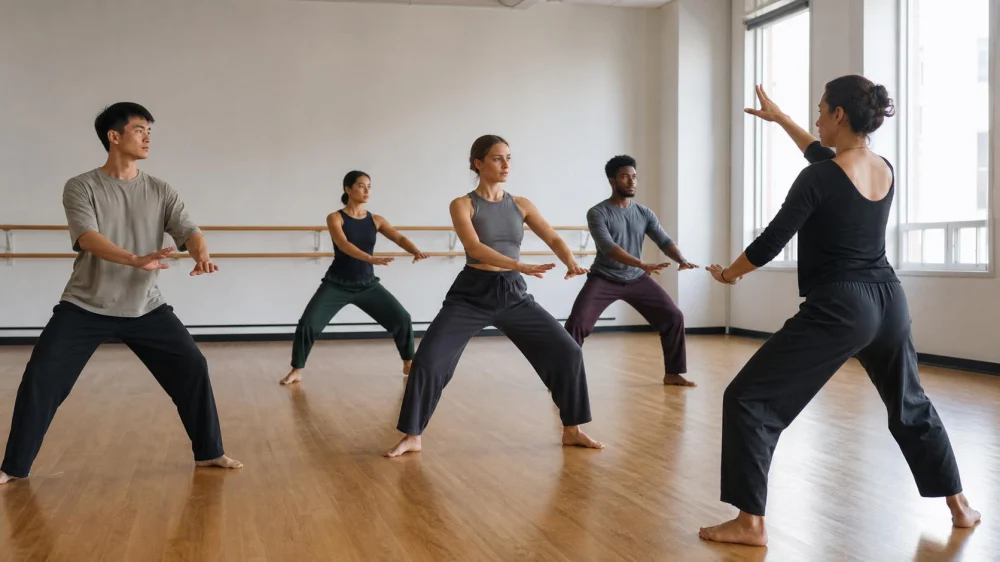
How to Break Down Dance Choreography for Practice
On this page
Quick answer
Break choreography into short sections with clear start and end points, learn the pathway and timing of one section, then connect it to the next. Practice the transition in both directions, add music at a manageable speed, and finish by running larger combinations without stopping. Keep notes on one or two priorities instead of trying to correct every detail at once.
This method is for dancers learning class combinations, recital choreography, or personal practice material. It supports memory and organization but does not replace instruction, feedback, appropriate flooring, or movement modifications from a qualified teacher.
Why sectioning works
Sectioning choreography means dividing a longer dance into small, meaningful units that can be learned and connected. A useful section might be one phrase, a change of direction, a formation change, or a movement idea—not automatically the same number of counts every time.
Short units reduce the number of decisions made at once. They let you answer separate questions: Where does the movement travel? Which foot starts? What is the rhythm? Where is the focus? Once the basic sequence is reliable, you can add dynamics, style, spacing, and performance intent.
Map the choreography first
- Watch or recall the full phrase. Identify the beginning, major changes, and ending before drilling details.
- Choose landmarks. Use a direction change, level change, pause, repeated motif, formation, or musical phrase as a boundary.
- Name each section. A short neutral label such as “travel,” “turn and reach,” or “floor phrase” is easier to remember than a long description.
- Write the starting shape. Note facing, weight-bearing foot, arm position, and the cue that begins the section.
- Write the ending shape. The end of one section is the setup for the next. Record weight, direction, level, and available space.
- Confirm with the source. Use the teacher's demonstration, approved rehearsal video, or choreography notes. Do not reinforce a guess when the detail can be checked.
Keep the map compact. It is a retrieval aid, not a full movement transcription. If notation becomes harder to read than the dance, simplify it.
Use a repeatable practice loop
For each section, use the same sequence:
- Place the body. Begin from the correct starting position without rushing into motion.
- Walk the pathway. Learn feet, direction, level, and weight transfer with reduced range when appropriate.
- Add the upper body. Coordinate arms, focus, torso, and head only after the lower-body pathway is clear.
- Speak the rhythm or cue. Use counts, lyrics only when authorized and helpful, or neutral sounds that represent timing.
- Repeat successfully. Aim for several attentive repetitions, pausing when the same error returns. More repetitions do not help when the underlying choice is unclear.
- Test recall. Look away from notes or demonstration and start the section from its opening shape.
If a section repeatedly fails, make it smaller. Isolate the two movements around the problem, verify the weight change, then rebuild the original unit.
Practice transitions, not just chunks
Dancers often know section A and section B but hesitate between them. Treat the connection as its own practice unit. Start near the end of A, continue through the first part of B, and repeat that overlap. Then reverse the test: begin from the start of B and identify exactly what shape A must create.
Use overlapping groups such as A+B, then B+C, before running A+B+C. When the choreography changes direction or formation, confirm the physical space and other dancers' pathways with the teacher. Do not practice full-speed traffic patterns in a small home space.
Add music and speed gradually
First establish sequence and weight transfer without relying on the recording to carry you. Then use the instructor's count or an authorized music source at a manageable tempo when possible. Keep the intended relationship to the music; slowing a track can reveal timing, but it can also change how accents feel.
Increase speed only when you can begin from the correct place, finish in control, and repeat without accumulating tension. If form collapses, reduce the tempo or movement size and ask the teacher which details should remain non-negotiable.
At full tempo, alternate between detail runs and performance runs. A detail run may stop to correct one transition. A performance run continues through small mistakes so you practice recovery, phrasing, and endurance.
A focused practice-session checklist
- Clear an appropriate space and use a surface suitable for the movement.
- Complete the teacher-approved warm-up before demanding movement.
- Select one section and one quality goal for the session.
- Verify the starting and ending shapes.
- Walk the pathway, add timing, then add upper-body detail.
- Practice the overlap into the next section.
- Run a larger phrase once or twice without stopping.
- Record a brief note about what improved and what needs clarification.
- Stop before fatigue makes technique or the practice environment unsafe.
Limitations and important notes
- Do not add jumps, turns, lifts, floorwork, pointe work, or high-impact movement in a space or on a surface not designed for it.
- Practice footage and choreography may be protected or private. Follow the teacher's recording and sharing rules.
- Pain, dizziness, instability, or unusual shortness of breath is a reason to stop and seek appropriate guidance.
- Sectioning can make movement accurate but mechanical. Reconnect breath, musical phrasing, intention, and group awareness before performance.
- Different dance forms use counts, cues, weight, and terminology differently. Let the instructor's method control the final interpretation.
Frequently asked questions
How long should a choreography section be?
Use the shortest unit you can understand and recall, then combine it with the next. For one dancer that may be two movements; for another it may be a full musical phrase.
Should I always learn the feet first?
Feet and weight transfer often provide a useful foundation, but some styles organize movement from the torso, rhythm, gesture, or partner connection. Follow the choreography and teacher's priorities.
What if I can do the dance only when following someone?
Practice retrieval by facing a different direction, starting from section landmarks, and trying a short unit without the demonstrator. Return to the source to correct errors, then test again.
How many times should I repeat a difficult part?
Repeat only while attention and technique remain useful. When the same mistake persists, pause, reduce the section, verify the information, or ask a specific question rather than drilling the error.
How do I remember choreography after several days?
Review the section map soon after class, test recall in short sessions, and revisit transitions. Spacing practice across days is generally more useful than relying on one long session immediately before rehearsal.
Evidence notes
This approach reflects broad motor-learning and rehearsal practice: reduce task complexity, identify stable cues, retrieve from memory, connect overlapping units, adjust speed, and use focused feedback. Exact teaching methods and safe movement limits depend on the dance form, choreography, dancer, and studio.
Next steps
Choose one difficult phrase, mark three natural section boundaries, and write the start and end shape of each. Practice the first unit with the loop, connect it to the second through an overlap, then finish with one continuous run and one question to take back to class.
 Royal Pointe Dance Academy4.0 (25 reviews)
 Salsa Mia4.0 (132 reviews)
 Stage Door Dance, Inc.5.0 (1 reviews)
 San Gorgonio Ballet5.0 (6 reviews)
 Bee Music Art Culture Center5.0 (36 reviews)
 Boys & Girls Club of San Pedro4.0 (20 reviews)
 Top 10 Bachata Moves That Boost Confidence for Beginners
 Why Ballroom Dance Is Popular for Burning Calories: A Fun and Effective Workout
 Why Waltz Is Popular to Burn Calories
 Ballroom Dance to Burn Calories: Complete Fitness Guide
 How to Master Waltz Fitness Routine for Better Balance and Grace
 How to Master K-Pop Dance Near Me in the USA: A Complete Guide for Beginners