What to Wear to Your First Adult Dance Class
On this page
Quick answer
For a first adult dance class, wear clean, comfortable clothing that lets you bend, reach, turn, and see your alignment. Choose secure shoes allowed by the studio and appropriate for the floor; if the dress code is unclear, ask before class. Bring water, a small towel, required shoes, hair ties, and any personal medical essentials. Avoid loose jewelry, outdoor grit, sticky rubber, unstable heels, and clothing that needs constant adjustment.
Dance class attire is clothing and footwear selected to support the movement, floor, safety rules, and teaching needs of a specific class—not a costume or test of personal style.
Check the studio rules first
Read the class description and confirmation email, then ask the studio three questions:
- Is there a required dress code?
- Which shoe types and soles are permitted on the studio floor?
- Can first-time students use socks, bare feet, or clean indoor sneakers?
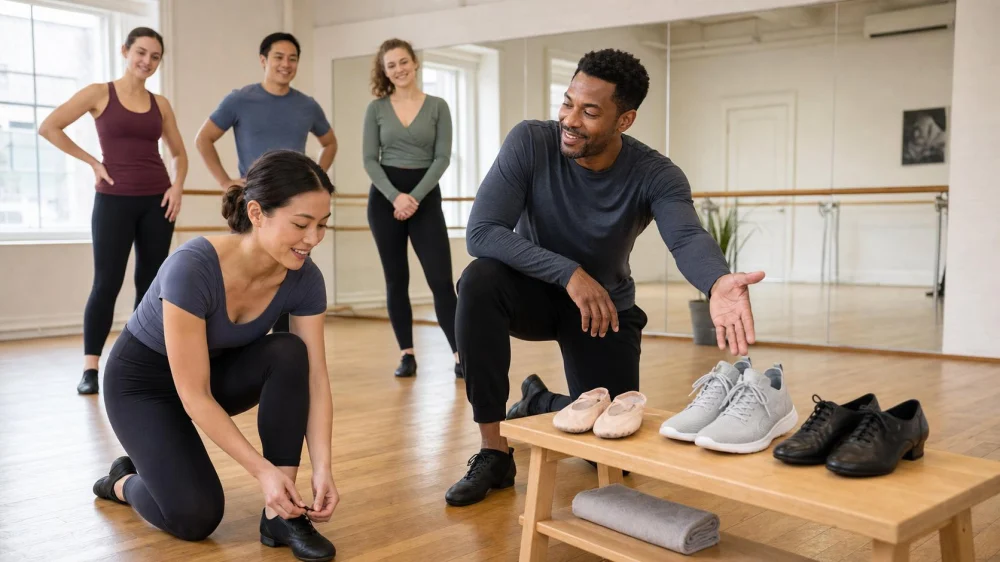
Policies protect specialized floors and help instructors teach safely. A ballroom studio may prefer smooth, secure shoes; a hip-hop class may require clean nonmarking sneakers; ballet may specify fitted attire and ballet slippers. Do not buy expensive shoes until the studio confirms the class and fit expectations.
Choose movement-friendly clothing
Use the “move, see, stay” test:
- Move: you can squat, lunge, lift arms, rotate, and step widely without restriction.
- See: the instructor—and you—can observe basic posture, knees, hips, shoulders, and foot placement when the class requires it.
- Stay: waistbands, straps, hems, and layers remain secure through repeated movement.
Breathable leggings, joggers, dance pants, fitted shorts with appropriate coverage, T-shirts, fitted athletic tops, or layered activewear often work for introductory classes. Select coverage and support that let you focus on instruction. If you wear a skirt, check whether turns, floorwork, or partnering require shorts or another layer underneath.
Match shoes to the class
Footwear changes traction, balance, and how force travels through the body. “Comfortable” alone is not enough.
- The shoe should stay on the heel without gripping with your toes.
- The sole should allow the class's turns without slipping unexpectedly or sticking aggressively.
- The shoe must be clean and free of rocks, mud, and moisture.
- The heel should be stable and within your current skill and comfort level.
- The toe box should not compress or numb the foot.
Do not wear outdoor shoes onto a dance floor unless the studio permits them. Do not apply powder, oil, water, rosin, or adhesive to shoes or flooring without staff approval.
Suggestions by dance style
- Ballet: fitted clothing and ballet slippers are commonly requested so alignment is visible. Ask about tights, leotards, socks, and hair policy.
- Jazz or contemporary: flexible fitted activewear; bare feet, socks, jazz shoes, or foot coverings may be specified.
- Hip-hop: clean indoor sneakers with secure laces and comfortable street-inspired activewear that does not obstruct movement.
- Ballroom or Latin: clothes that allow stride and rotation; secure shoes with a studio-approved sole. Beginners need not start in high heels.
- Tap: actual tap shoes may be required, but studios can restrict tap plates or floor areas. Confirm before arrival.
- Heels class: use only the heel type required by the instructor; ankle support, sole, heel placement, and prior experience matter.
- Dance fitness: supportive athletic wear and clean shoes suitable for repeated impact and lateral movement.
These are starting points, not universal dress codes. The specific instructor and studio determine what works on their floor.
What to put in your bag
- clean class shoes in a separate shoe bag;
- water bottle with a secure lid;
- small towel and an extra dry shirt;
- hair ties, clips, or head covering needed to keep vision clear;
- blister care and any personal medical items you normally carry;
- a light layer for warm-up and travel;
- studio confirmation, access instructions, and payment method if needed.
Label personal items discreetly. Leave valuables at home when secure storage is not available, and keep walkways clear of bags and bottles.
Five-minute fit and safety check
- Raise both arms and bend forward; confirm clothing stays secure.
- Take a wide side step and shallow squat without pulling fabric.
- Walk, pivot gently, and stop; note slipping or excessive grip.
- Check laces, straps, buckles, and heel security.
- Remove dangling jewelry and empty unstable pockets.
- Inspect soles for debris and moisture.
- Tell the instructor about relevant movement restrictions before class.
Arrive early enough to change and ask questions. A rushed shoe decision is more likely to create distraction or unsafe traction.
What to avoid
- shoes that fall off, pinch, wobble, or have damaged soles;
- street shoes carrying grit onto a sprung or finished floor;
- very baggy hems that hide or catch the feet;
- long necklaces, large hoops, sharp accessories, or unsecured watches;
- heavy perfume in a shared exercise space;
- new high heels or pointe shoes without instructor approval and preparation;
- anything that requires you to stop repeatedly to adjust it.
Do not dance through sharp pain, new numbness, dizziness, chest pain, or an unstable joint. Stop and tell the instructor; seek appropriate medical care when symptoms are significant.
Limitations and important notes
Dress codes differ across U.S. studios, teachers, levels, ages, cultural settings, and performances. Accessibility, religious clothing, sensory needs, compression garments, braces, and mobility devices deserve a direct conversation with the studio before class.
This guide does not diagnose injury or prescribe footwear. A qualified clinician can advise on medical restrictions; an experienced fitter and instructor can help with dance-specific shoe fit.
Frequently asked questions
Can I wear socks for my first class?
Only if the studio and class allow them. Socks can slide unpredictably on some floors and grip too much on others.
Do adults need a leotard for beginner ballet?
Some studios require one; others accept fitted activewear. Check the posted adult dress code before buying.
Can I wear running shoes to hip-hop?
Ask the instructor. Some running soles are designed for forward motion and may grip during pivots; a clean indoor shoe suited to lateral movement may be preferred.
Should I buy ballroom heels before the first lesson?
Usually wait for studio guidance. A secure low heel or approved flat option may be better while you learn posture and weight transfer.
What if I feel self-conscious in fitted clothes?
Choose comfortable layers that still allow safe movement and enough alignment visibility for the class. Ask the instructor privately about acceptable alternatives.
Sources and evidence notes
Attire rules are studio- and floor-specific, so the authoritative sources are the current class description, registration email, posted floor policy, and instructor guidance. The recommendations here reflect common dance-teaching and movement-safety practice without claiming one universal dress code.
No brand or product is recommended. Fit, secure attachment, appropriate traction, and studio permission are more useful selection criteria than price or fashion.
Conclusion and next steps
Message the studio for its exact dress and shoe policy, then choose clothing that moves, shows useful alignment, and stays secure. Bring clean approved footwear, water, and a small backup layer. Test the outfit at home, arrive early, and ask before stepping onto the floor if traction or fit feels wrong.
 Just For Kix5.0 (7 reviews)
 Step Country Swing & Dance Co.5.0 (241 reviews)
 Erickson Academy of Irish Dance5.0 (3 reviews)
 Manda's Studio5.0 (6 reviews)
 Just Dance Studio in Little Falls, NY4.0 (15 reviews)
 Betty Smith School of Dance4.0 (7 reviews)
 How to Master Samba to Try in 2025
 Discovering the Cultural Origins of Line Dance and Its Global Impact
 Do Schools Still Have Dances? Exploring Modern Trends and Traditions
 Do Schools Have Dances in Japan? A Deep Look into Student Culture and Social Life
 A School Dance Movie: Why These Stories Still Inspire
 Can a Homeschooler Go to Public School Dances? | Tips for Parents