
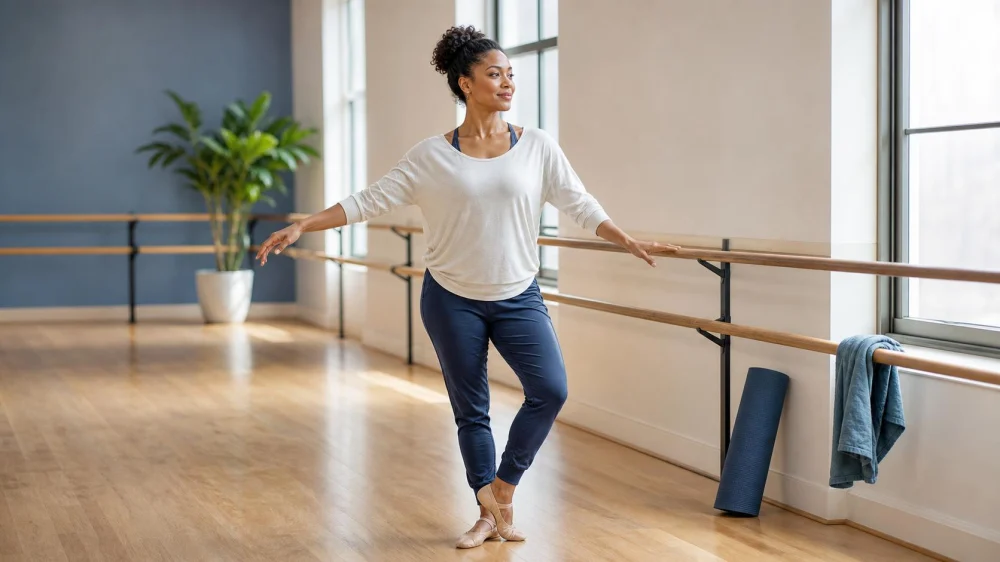
Returning to Dance After a Long Break: A Safe First Month
On this page
Quick answer
After a long break from dance, return at a lower level or lower intensity than you remember, attend one or two classes a week at first, and leave some effort in reserve. Tell the instructor you are returning, rebuild basic movement quality before jumps or deep ranges, and judge progress by how you feel during the following 24 to 48 hours—not by what you can force on day one.
A return-to-dance plan is a gradual rebuilding period in which class frequency, movement range, speed, impact, and complexity increase only when the body is tolerating the current workload. This approach is useful for adults returning to ballet, jazz, contemporary, ballroom, tap, hip-hop, or other studio classes across the United States. It is general education, not medical advice or a rehabilitation prescription.
Check your readiness before class
Start by separating a normal training break from a medical recovery. If you stopped because of an injury, surgery, pregnancy, significant illness, fainting, chest symptoms, or a clinician’s restriction, ask the relevant licensed professional what movements and intensity are appropriate. A studio teacher can modify choreography, but should not be expected to diagnose pain or clear an injury.
For a routine break, test a few everyday basics several days before class. Can you walk briskly, climb stairs, balance briefly on each leg, and perform comfortable body-weight bends without sharp pain or unusual shortness of breath? These are not dance qualifications; they are simple clues about whether a gentle class is a reasonable next step.
- Write down the length of your break. A few weeks away differs from several years away.
- Note current symptoms. Location, timing, swelling, instability, and movements that provoke discomfort are more useful than saying something “feels off.”
- Review relevant health changes. New medication, balance problems, or reduced activity can affect how class feels.
- Check your equipment. Old shoes may have hardened, stretched, or lost support while stored.
- Plan transport and food. Arrive hydrated, allow time for a light pre-class meal if needed, and avoid rushing straight into movement.
Choose the right starting point
Your former class label is a reference, not a promise. Technique recall may return faster than strength, balance, foot tolerance, or cardiovascular capacity. That mismatch is why a familiar combination can feel mentally easy while placing an unexpectedly high load on the body.
Best starting choice: a fundamentals, beginner, open-level, or returning-adult class where the instructor welcomes modifications. This is especially useful when the break lasted many months, the style is new, or the class includes impact and fast direction changes.
When an intermediate class may work: the break was short, you have remained active, the teacher can describe the pace in advance, and you are willing to mark or skip sections. Choose a class below your old level if you feel pressure to prove that you still belong there.
Not ideal for the first session: audition classes, rehearsal-heavy classes, advanced pointe work, repeated large jumps, acrobatics, partner lifts, or a double class. These formats reduce room for self-pacing. Returning through a private lesson can help when you need individual feedback, but it is not required for most healthy adults.
Contact the studio before enrolling and ask concrete questions: How long is the warm-up? Does the class include jumps, floorwork, partner rotation, or performance combinations? Can a returning student observe, mark, or step out? Is the floor designed for dance and appropriate footwear? Clear answers help you match the class to your present capacity rather than its name alone.
A four-week return plan
This sample plan assumes a healthy adult returning after a non-medical break. Adjust the pace to the style, schedule, age, and previous training. Repeat a week instead of progressing if soreness changes your normal walking or daily activity.
- Week 1: Relearn the room. Take one lower-intensity class. Use a comfortable range, keep jumps small or replace them with rises, and focus on alignment, timing, and breathing. Stop before fatigue changes your technique.
- Week 2: Repeat before adding. Take one or two classes with recovery days between them. Keep the same level so you can compare how your body responds. Add only a little range or speed, not both.
- Week 3: Build consistency. If the first two weeks caused only manageable, improving soreness, maintain two classes or add a short independent basics session. Practice simple foot articulation, balance, rhythm, or mobility rather than full-out choreography.
- Week 4: Review and choose. Decide whether to stay at the current workload, add one small challenge, or reduce it. A reasonable addition might be a few more repetitions, modestly larger movement, or one harder combination—not a sudden jump in frequency, impact, and difficulty together.
Use a simple progression rule: change one workload variable at a time. Class frequency, class length, impact, movement range, speed, resistance, and technical complexity all count. When several rise together, it becomes difficult to identify what caused pain or excessive fatigue.
How to adjust during class
Tell the instructor before class, briefly and privately, that you are returning after a break and will modify as needed. You do not need to provide personal medical details. Ask where you can stand so stepping out will not disrupt other dancers.
- Begin smaller. Reduce depth in pliés, lunges, backbends, and floor transitions until control is reliable.
- Mark complex sequences. Walk the pattern or use the arms lightly before adding full speed and power.
- Lower impact. Replace jumps with rises, steps, or weight shifts when landings become noisy or uncontrolled.
- Protect partner safety. Decline lifts, dips, or fast partnered figures if grip, timing, or balance is uncertain.
- Take a real break. Move to the side, breathe, drink water, and rejoin at a clear transition.
Ordinary effort, warmth, and mild muscle fatigue can be expected. Sharp pain, a sudden pull, joint instability, dizziness, chest pressure, unusual breathlessness, confusion, or numbness are reasons to stop. Seek urgent care for severe or rapidly worsening symptoms. Persistent pain, repeated swelling, or symptoms that affect walking or sleep deserve assessment by an appropriate licensed healthcare professional.
Between-class recovery checklist
The next day provides better information than the excitement of class. Mild muscle soreness that improves with ordinary movement can occur when training resumes. Soreness is not a score, however, and more pain does not mean more progress.
- Record the class type, duration, and any modifications.
- Check whether discomfort is muscular or centered in a joint.
- Notice whether stairs, walking, work, or sleep are meaningfully affected.
- Allow recovery time before repeating high-impact or high-load movement.
- Eat regular meals, hydrate according to your needs, and prioritize sleep.
- Use gentle everyday movement if comfortable; do not force intense stretching into sore tissue.
- Bring recurring concerns to the instructor before the next class.
A useful decision boundary is simple: if your response is mild and clearly settling, repeat the same workload before increasing it. If symptoms are stronger, last longer than expected, or interfere with normal function, reduce the next session and consider professional advice. If each class feels easier at the same workload, you have evidence that adaptation is occurring.
Limitations and important notes
No universal four-week schedule fits every dancer. Pointe work, breakdance power moves, aerial work, acrobatics, deep backbends, lifts, and repeated jumping have technique-specific demands that may require longer preparation and direct coaching. Floors, footwear, heat, class length, and teaching pace also change the load.
The guidance here reflects broad training principles commonly used in gradual return to physical activity: start below maximum capacity, monitor the response, and progress one variable at a time. It does not rely on a claim that soreness prevents injury or that a single warm-up makes any movement safe. Studio-specific rules and manufacturer guidance for footwear or equipment should take priority when they are more precise.
Do not copy another dancer’s timeline. Previous experience helps with vocabulary and coordination, but it does not eliminate the need to rebuild capacity. Progress can also vary with sleep, stress, work demands, age, health, and time away.
Frequently asked questions
Should I stretch before returning to dance class?
Prepare with gradual, active movement that raises temperature and rehearses the ranges used in class. Avoid forcing long, deep stretches while cold. The class teacher may have a style-specific warm-up; ask how early you should arrive rather than inventing a tiring routine immediately beforehand.
How many dance classes should I take in the first week?
One lower-intensity class is a sensible starting point for many adults after a long break. A second may be reasonable if you remained active and recovered well, but spacing sessions gives you time to evaluate the response. Your safest number depends on class load and individual health, not enthusiasm alone.
Do I need to return as a complete beginner?
Not always. Choose the setting where you can control range, speed, and impact without pressure. A fundamentals class is often the easiest place to rebuild, while an open-level class with modification options may suit an experienced returning dancer. Ask the teacher about actual class content.
When can I start jumping again?
There is no fixed date. First establish comfortable walking, basic bends and rises, balance, and controlled low-impact classwork. Begin with a small number of low jumps on an appropriate dance floor, and stop when landings become heavy, painful, or poorly aligned. Injury history warrants individual professional guidance.
What if I remember the choreography but tire quickly?
That is a common mismatch after time away. Mark parts of the combination, reduce arm intensity, make travel steps smaller, or skip a repetition. Preserving coordination while lowering physical demand is more useful than pushing until technique collapses.
Next steps
Choose one welcoming class, contact the studio about pace and modification options, and set a deliberately modest goal for the first month. After each session, use the 24-to-48-hour response to decide whether to repeat, reduce, or slightly increase the workload. The goal is not to recover your old level in one class; it is to build a return you can sustain.



 Galveston Ballet3.0 (15 reviews)
 I Praise Productions Performing Arts & Modeling Academy0.0 (0 reviews)
 Ricochet Dance Company0.0 (0 reviews)
 Destiny Dance Studio4.0 (17 reviews)
 Wright's 360° Movement Academy4.0 (209 reviews)
 Closet Poler5.0 (41 reviews)
 Zumba Every Dancer Should Know – Everything You Should Know
 Ballet to Improve Flexibility: Expert Tips for a Better Range of Motion
 A Step Above School of Dance LLC in Moore, OK – Your Go-To Dance Academy
 Are There Middle School Dances? What Students and Parents Should Know
 Jazz Dance Cultural Origins: A Complete Guide to Its Roots and Evolution
 Do 6th Graders Have School Dances? What Students & Parents Should Know