How to Prepare for a Guest-Teacher Dance Workshop
On this page
Quick answer
Prepare for a guest dance workshop by confirming the style, level, length, footwear, floor, and recording policy; arrive early with water and appropriate layers; and choose one learning goal. During class, follow the guest teacher's vocabulary, mark unfamiliar material when needed, and respect your physical limits. Afterward, write three useful notes and practice one short section before details fade.
This guide is for adult dancers attending workshops in the United States. A workshop is a concentrated learning experience, not a test of worth. Health needs, physical capacity, studio rules, and teacher expectations vary.
Research the workshop format
A workshop can be a technique class, repertory session, choreography lab, audition-style combination, improvisation class, lecture-demonstration, or social-dance intensive. The title alone may not reveal the pace or physical demands.
Before registering, check:
- Dance style and specific focus
- Advertised level and prerequisites
- Class length, breaks, and total schedule
- Floor type and required or prohibited footwear
- Partnering, floor work, jumps, turns, or improvisation
- Age limits, accessibility, and observation options
- Photography, recording, cancellation, and refund policies
If a requirement is unclear, contact the host studio. Ask a concrete question such as whether “intermediate” assumes a particular vocabulary or whether dancers may modify jumps.
Choose the right session
Match the workshop to your current experience, not the level you hope to reach soon. Guest classes often move quickly because the teacher has limited time and may not know each participant's background.
A lower-level session can be valuable when the style or teaching language is new. An advanced class is not ideal when you would need to copy movements without understanding safe preparation. If several sessions run in one day, consider fatigue rather than registering for every available hour.
Ask whether observation is permitted if injury, illness, pregnancy, disability, or another circumstance changes how you can participate. A qualified healthcare or dance-medicine professional can advise on individual medical limits; the guest teacher cannot diagnose them during a crowded class.
Prepare your body and bag
Keep the day before ordinary. An unfamiliar intense workout, severe food restriction, or inadequate sleep is not useful preparation. Eat and hydrate according to your normal needs, and follow individual medical guidance.
Pack only what the workshop requires:
- Approved dance shoes plus a permitted backup
- Movement clothing and a removable warm layer
- Water and any necessary personal snack
- Small towel and basic personal care items
- Notebook and pen for after-class notes
- Required medicines and supports you already know how to use
- Registration confirmation and studio access details
Label belongings and keep them outside movement paths. Do not debut untested shoes, braces, tape methods, or supplements at a long workshop.
Learn in an unfamiliar style
Choose one primary goal: musicality, a movement quality, a technical idea, repertory context, or experience with the teacher's process. A narrow goal helps when the class contains more information than you can retain.
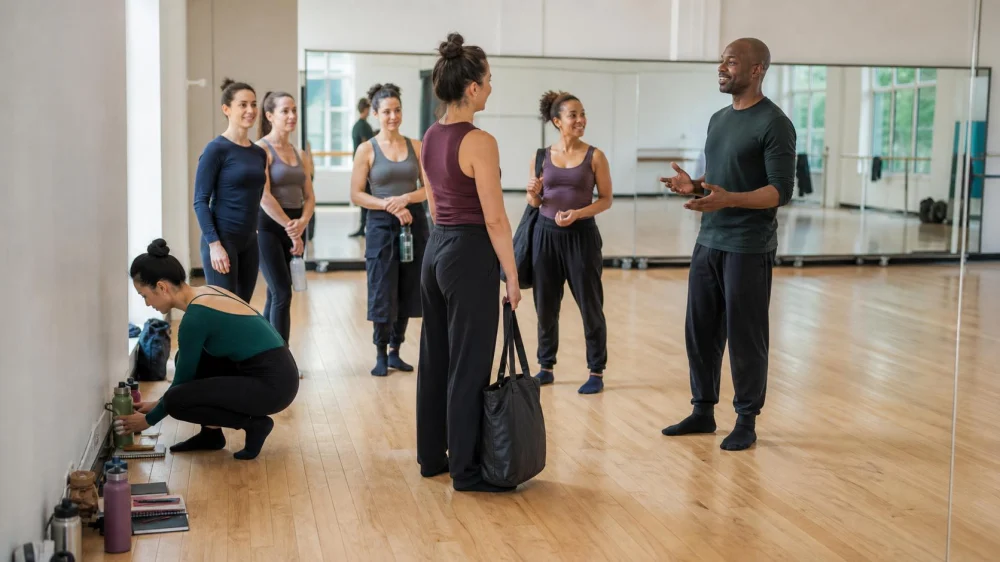
Stand where you can see without crowding. Listen through the complete explanation before moving into someone else's space. If the teacher uses unfamiliar terms, connect them to the demonstrated direction, timing, and body part rather than guessing from a familiar style.
Marking means performing a smaller or lower-effort version to understand sequence and timing. It is useful while learning, when the teacher permits it, but it is not a substitute for knowing which movement can be safely reduced. Do not mark a partnered or weight-bearing action in a way that surprises another dancer.
When the room rotates lines, move promptly and give others a clear view. Avoid treating the front as a permanent position or the back as a place to stop paying attention.
Ask useful questions
Ask after attempting the instruction, and make the question observable. “On count six, should the weight finish over the standing leg or remain between both feet?” gives the teacher something precise to answer.
Questions about injury diagnosis, career access, or lengthy personal history may not fit a group workshop. Ask the host about another appropriate channel. Do not record a demonstration, correction, or Q&A unless the teacher and studio explicitly allow it.
Review afterward
Within an hour, write three items: one idea you understood, one detail you want to test, and one question that remains. Use your own words instead of trying to reconstruct the entire class.
Later, practice a short approved section at low intensity with adequate space. Focus on the learning goal rather than repeating the full workshop while fatigued. If soreness is unusual, pain is sharp, or function is reduced, stop and seek appropriate professional guidance.
If you post about the event, follow the host's policy for names, images, music, choreography, and other dancers. Gratitude does not require publishing class material.
Workshop checklist
- Confirm level, style, duration, floor, and footwear.
- Read policies for cancellation, observation, recording, and belongings.
- Choose one learning goal.
- Pack tested gear, water, a layer, and a notebook.
- Arrive early enough to check in and orient yourself.
- Tell the teacher only essential participation information at an appropriate time.
- Write three notes and schedule one short review afterward.
Limitations and safety notes
- A workshop description cannot guarantee that every movement suits every participant.
- Do not push through sharp, escalating, or function-changing pain to keep up with a guest teacher.
- Partnering requires clear consent, communication, and appropriate matching; anyone may decline.
- Teachers may restrict modifications when they would create collision or partnering risk.
- Emergency exits, bags, tripods, and water bottles must remain clear of movement paths.
Frequently asked questions
Should I take a workshop above my usual level?
Only when the prerequisites, pace, and host guidance make it appropriate. A slightly easier session in a new style often produces more usable learning than an advanced class spent copying.
Is it acceptable to stand at the back?
Yes, if you can see and remain engaged. Follow line rotations and do not hide behind others when the teacher needs to assess spacing or safety.
Can I ask for modifications?
Ask whether a safer or lower-impact option is compatible with the exercise. The teacher may offer one, ask you to observe a section, or explain that a partnered task cannot be changed safely in that format.
May I record the final combination?
Only with explicit permission from the teacher, studio, and identifiable dancers, including agreement on whether the file is private or shareable.
How much should I remember?
You do not need to retain everything. One durable correction, movement quality, or practice question can make the workshop worthwhile.
Next steps
Before registering, verify the format and prerequisites and choose one goal that matches your current dancing. Pack tested gear, arrive early, learn within your limits, and capture three written takeaways while the experience is fresh.
Sources and evidence note: This article applies general dance education, studio etiquette, consent, and load-management principles. The host studio's current policies and qualified individual health guidance govern a specific workshop.
 All Soles Dance Studio5.0 (1 reviews)
 Village Dance Arts4.0 (9 reviews)
 On The Edge Dance Company2.0 (5 reviews)
 S&S dance4.0 (28 reviews)
 Rhythm Roots Dance5.0 (35 reviews)
 Ancient City Gymnastics4.0 (44 reviews)
 The History of Pole Dance Near Me in the USA | Cultural Evolution & Modern Studios
 Top 10 Bachata Moves for Couples to Improve Partner Dance Skills
 Discover Foxtrot in 2025: Why You Should Learn and Enjoy This Timeless Dance
 Why A Step Above School of Dance LLC OK Is a Top Choice for Young Dancers
 Are School Dances Cheesy? Why They Might Be—and Why That’s Okay
 Bachata Explained: Common Mistakes to Avoid for Better Dancing