
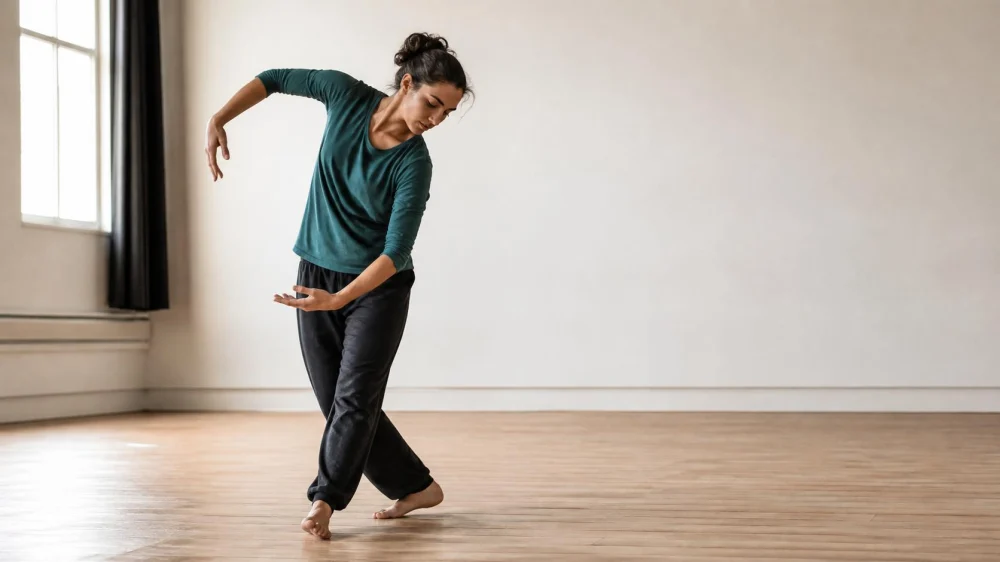
Freestyle Dance Practice: Use Simple Constraints to Start
On this page
Quick answer
When freestyle dance feels too open-ended, limit one variable for a short round. Move only on selected beats, lead with one body part, stay within one floor pathway, or alternate two energy qualities. A useful constraint reduces choices without dictating the result. After each round, keep one discovery and change only one condition for the next attempt.
Why constraints help
“Move however you want” can create so many possibilities that a dancer repeats familiar patterns or freezes. A constraint narrows attention. Instead of inventing everything at once, you explore a specific question: How many ways can the elbow initiate? What changes when movement pauses between phrases?
A constraint is not a rule for what good dancing must look like. It is a temporary creative tool. The value comes from noticing choices, not from completing a trick or filling every beat.
This approach can serve beginners who need a starting point and experienced dancers looking for unfamiliar pathways. Adapt the movement vocabulary and intensity to your training and physical needs.
Choose one movement variable
- Time: sustained, sudden, delayed, repeated, or silent moments.
- Space: direct or curved pathways, small or broad reach, one facing, or one defined area.
- Level: high, middle, low, or a gradual transition between two safe levels.
- Body initiation: begin each phrase with a hand, shoulder, ribs, knee, eyes, or another chosen point.
- Energy: light, heavy, smooth, sharp, suspended, or bound.
- Relationship to sound: follow the pulse, move against it, answer one instrument, or use silence.
- Repetition: return to one gesture and alter its size, direction, timing, or emphasis.
Pick one category per round. Combining five restrictions immediately can make the exercise another memory test. Add complexity only after the first variable produces clear choices.
A short practice session
- Prepare the space. Clear obstacles, check the floor, choose suitable footwear, and set a comfortable volume.
- Warm up for the task. Gradually prepare the joints, movement ranges, and intensity you intend to use.
- Name one constraint. Make it observable, such as “pause after every third movement,” not “be more interesting.”
- Explore briefly. Use a short music section or timer so you can stay curious instead of judging endurance.
- Pause and notice. Identify one surprising pathway, rhythm, transition, or sensation.
- Repeat with one change. Keep the discovery and adjust only time, space, body initiation, or music.
- Finish with free choice. Remove the rule and see whether the new option appears naturally.
Constraint prompts to try
One pathway: Travel only along a curve, then repeat the phrase using straight lines. Notice how transitions and facing change.
Three sizes: Perform one gesture small, medium, and large without speeding it up. Then change the timing while preserving the shape.
Call and response: Make a short movement statement, pause, and answer it with a different body part. The answer can echo rhythm, direction, or energy.
Selective listening: Follow one sound layer for a phrase, then switch to another. If the music becomes distracting, use a steady pulse or silence.
Return and vary: Choose one simple motif and bring it back several times with one feature changed. Repetition makes the variation visible.
Negative space: Imagine an object beside or around you and move in relation to the empty area. Avoid forcing extreme ranges to make the idea obvious.
Reflect without judging
Replace “Was it good?” with questions you can answer: Which choice surprised me? When did I repeat a habit? Which transition felt clear? What happened when I waited? This turns reflection into information.
If recording is permitted and does not disrupt others, review only a short section for the chosen variable. Look for evidence of the task rather than comparing appearance with another dancer. You can also write three words describing what you noticed.
Keep discoveries as options, not obligations. A useful improvisation practice expands the vocabulary you can choose from; it does not erase your natural movement preferences.
Safety and limitations
Freestyle does not mean movement without boundaries. Check space, floor, footwear, nearby dancers, and fatigue. Do not attempt unfamiliar inversions, lifts, drops, extreme ranges, or high-impact skills without appropriate instruction and preparation.
Stop for pain, dizziness, loss of control, or concerning symptoms. A qualified dance teacher can adapt prompts to your level, and a healthcare professional can advise on injury or medical limitations. This article is a creative practice framework, not technique or rehabilitation instruction.
Sources and evidence notes
The method reflects broad creative-learning practice: reducing the choice field directs attention, repetition reveals variation, and focused reflection helps retain discoveries. Dance styles and teaching approaches use different names and structures for these ideas.
No prompt is universally appropriate. The teacher, studio rules, dancer's training, and current physical condition determine safe scope.
Frequently asked questions
Do I need music to practice freestyle?
No. Silence can make breath, weight shift, and internal timing easier to notice. A pulse, ambient sound, or music can each create a different task.
How long should one round last?
Use a duration short enough to maintain attention and safe technique. Beginners may prefer a brief phrase; trained dancers may explore longer. Quality of focus matters more than a fixed time.
What if I keep repeating the same moves?
Change one variable rather than banning the moves. Reverse their direction, alter size, begin with another body part, or insert a pause.
Can this create choreography?
Yes. Save a motif or transition you discover, then develop it intentionally. Improvisation can generate material without requiring every moment to become choreography.
Should I watch myself in a mirror?
Use it selectively. Visual feedback can help with space, but constant watching may pull attention away from sensation and sound. Alternate mirrored and non-mirrored rounds.
Next steps
Clear a safe space and choose one observable constraint from time, space, body initiation, energy, or sound. Explore it briefly, name one discovery, and repeat with one change. End by removing the rule and notice which new option remains available.
 Flip Me Dip Me - Dance Performance, Choreography, and Instruction5.0 (1 reviews)
 Chanhassen Recreation Center4.0 (117 reviews)
 KC Dance5.0 (1 reviews)
 Bollywood/Hip Hop Dance Classes for Boys & Girls3.0 (4 reviews)
 Gotta Dance Studio5.0 (7 reviews)
 Studio 12 Dance Center5.0 (7 reviews)
 A School K-pop Club Is Learning a New Dance: Tips and Insights for Success
 K-Pop Dance for Beginners – What You Need to Know
 Can’t Stop the Feeling School Dance: Why It Works and How to Make It Shine
 Pole Dance Step by Step Guide for Beginners: Learn the Basics and More
 Ballet to Improve Flexibility: Expert Tips for Enhancing Your Stretching Routine
 Do They Have Mother-Son Dances in School? A Complete Guide for Parents