Dance Studio Mirrors: Use Them Without Losing Awareness
On this page
- Quick answer
- What mirrors can and cannot do
- Build a safe sightline
- A practical mirror-use method
- Mirrors and group spacing
- Practice without the mirror
- Combine reflection with feedback
- Studio and dancer checklist
- Limitations and important notes
- Sources and evidence notes
- Frequently asked questions
- Conclusion and next steps
Quick answer
Use a dance-studio mirror for brief visual checks, not as your only guide. Keep your head and neck aligned for the movement, scan the reflection without staring, and maintain awareness of dancers outside the reflected view. Alternate mirrored and non-mirrored practice so direction, balance, and choreography do not depend on facing one wall. Stop if mirror use causes dizziness, disorientation, or unsafe spacing.
This guide is for dancers and teachers in U.S. studios. Styles and teaching methods differ, and a qualified instructor should adapt visual feedback to the movement, level, and dancer.
What mirrors can and cannot do
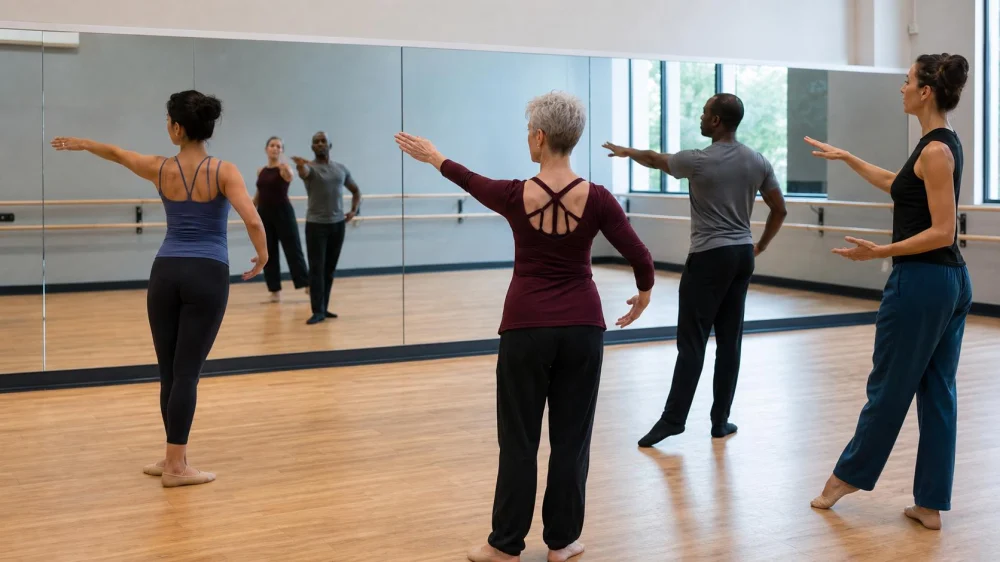
A mirror provides immediate information about shape, line, timing, spacing, and group alignment. It can help a dancer notice a lifted shoulder, uneven arm path, or distance from a neighbor.
But the image is reversed, limited to one angle, and dependent on where the dancer stands. It does not show force, internal sensation, joint load, or every plane of movement. A shape that looks similar in reflection may still be produced with a different and potentially uncomfortable strategy.
Mirrors are best for specific questions such as “Are our arm heights matching?” They are not ideal as a constant source of approval or a replacement for instruction, proprioception, and spatial awareness.
Build a safe sightline
Choose a position where you can see the teacher and your own general outline without twisting the neck or stepping into another dancer’s lane. If the view is blocked, adjust at a natural pause rather than weaving through moving dancers.
Remember that the reflection does not show everything behind or beside you. Pillars, curtains, seams, portable mirrors, and other dancers create blind areas. Before traveling backward, turning, jumping, or changing formation, use direct vision and the class’s spacing cues.
Do not dance close enough to touch the mirror. Maintain the studio’s required buffer, especially during kicks, floorwork, turns, and traveling phrases. Treat cracked, loose, unprotected, or unstable mirror panels as a facility hazard and tell staff.
A practical mirror-use method
- Name one question. Decide whether you are checking timing, level, arm path, spacing, or another specific feature.
- Mark the movement. Use a lower-intensity version when appropriate to find the sightline and spacing.
- Observe briefly. Glance at the relevant feature without fixing the gaze for the entire phrase.
- Make one change. Apply a teacher-approved correction rather than adjusting several body parts at once.
- Repeat without watching. Notice how the movement feels when the visual check is removed.
- Turn away from the mirror. Test orientation, memory, and balance in another direction.
- Ask for feedback. Confirm that the change serves the technique and choreography.
This observe-adjust-feel cycle turns the mirror into a tool rather than a continuous dependency.
Mirrors and group spacing
Reflections can make distance difficult to judge. Two dancers who look separated in the mirror may be on intersecting paths. Use floor landmarks, assigned lines, and peripheral awareness in addition to the image.
Do not move sideways solely to improve your reflected view. That can close another dancer’s space. If several people cannot see, the class may need staggered lines, rotation, smaller groups, or a changed teaching position.
When correcting formation, look directly toward the travel path before moving. During partner work, use agreed cues and direct awareness rather than watching the partner only through the mirror.
Practice without the mirror
Choreography may be performed on a stage, outdoors, in a different studio, or facing an audience. Regular non-mirrored practice helps reveal whether the dancer knows directions and transitions independently.
- Face a side or back wall for a familiar phrase.
- Use counts, music, and spatial landmarks rather than reflected copying.
- Practice entrances and exits from the actual performance orientation.
- Change lines so dancers experience different visual positions.
- Close or cover mirrors only when the teacher and facility can do so safely.
Do not introduce a no-mirror challenge during a complex traveling combination without appropriate progression. Reduce speed or range and restore full spotting and spacing cues.
Combine reflection with feedback
A teacher sees angles the dancer cannot. Ask a focused question: whether the pelvis remains organized, a landing is quiet and aligned, or a group shape matches the choreography. Visual appearance should not override pain, numbness, instability, or a teacher’s safety correction.
Video can provide another angle when recording is permitted and everyone’s consent and privacy are respected. It still shows only the captured view and should not be used to diagnose injury.
For dancers with low vision, vestibular conditions, body-image concerns, sensory needs, or other access requirements, teachers can use verbal cues, tactile markers where appropriate and consented, orientation practice, or alternative positions. The solution should be individualized.
Studio and dancer checklist
- Mirror panels appear secure, intact, clean enough to see, and protected as required.
- The dancing zone maintains a clear buffer from glass and walls.
- Lines are staggered so dancers do not shift unpredictably for a view.
- Teachers can pause class when reflections create a spacing problem.
- Dancers practice at least some material in another orientation.
- Corrections focus on movement goals rather than appearance-based judgment.
- Dizziness, headache, visual strain, pain, and disorientation are taken seriously.
Limitations and important notes
- A reflection reverses left and right and may complicate choreography learning.
- Mirrors cannot verify safe joint loading or diagnose a movement problem.
- Staring at the mirror during turns can interfere with the spotting method taught for the style.
- Portable or freestanding mirrors require appropriate anchoring and facility controls.
- Persistent dizziness, vision change, balance difficulty, or pain warrants appropriate professional evaluation.
Sources and evidence notes
This article reflects general motor-learning and dance-safety principles: external visual feedback is useful when focused, but learners also need internal sensation, direct spatial awareness, varied orientation, and qualified feedback.
Use the studio’s safety procedures and instruction from qualified dance, medical, vision, or vestibular professionals for individual concerns. No teaching method or mirror setup is guaranteed suitable for every dancer.
Frequently asked questions
Should beginners always stand where they can see themselves?
A useful view can help, but beginners also need a clear teacher sightline and safe spacing. The instructor should place dancers for the exercise.
Why do I forget choreography when facing away from the mirror?
You may have learned by copying the reflection rather than encoding counts, direction, and sensation. Practice familiar material gradually in different orientations.
Can a mirror show whether my alignment is safe?
It can provide a visual clue from one angle, but it cannot assess all forces or sensations. Use instructor feedback and stop for pain or instability.
What if another dancer blocks my view?
Do not drift into their lane. Ask the teacher to stagger lines, rotate positions, or divide the group.
Why do mirrors make me dizzy?
Moving visual information can affect some people. Stop, move to a stable view, tell the teacher, and seek appropriate evaluation if dizziness persists or recurs.
Conclusion and next steps
Use the mirror to answer one movement question at a time. Keep direct awareness of the room, make a specific adjustment, then repeat without watching. Practice in more than one orientation and combine reflection with teacher feedback. Safe spacing, stable sightlines, and symptom awareness always come before getting a perfect view.
 Drop Everything & Dance Studio4.0 (19 reviews)
 Ballet Austin's Butler Center for Dance & Fitness5.0 (24 reviews)
 Blitz Bhangra Academy5.0 (12 reviews)
 Belly Dance with Barushka0.0 (0 reviews)
 VYB Dance Studio4.0 (57 reviews)
 City Ballet San Francisco5.0 (12 reviews)
 Why Hip Hop Is Popular to Improve Flexibility: Benefits of Dance for Mobility and Health
 Why K-Pop Dance Is Popular for Couples
 Zumba Trending on TikTok: The Ultimate Guide to Get Moving
 Can Dance Schools Reopen in NJ? What Parents and Students Should Know
 Shuffle Dance Cultural Origins – Complete Guide | American Dance Academy
 Top 10 Salsa Moves for College Students to Master Quickly