
First Dance Recital: A Backstage Checklist for Adults
On this page
Quick answer
For a first adult dance recital, confirm arrival, check-in, rehearsal, costume, footwear, hair, makeup, photography, and exit instructions in advance. Pack each look in a labeled garment bag, bring approved backup supplies, eat and hydrate normally, and arrive early. Backstage, follow the stage manager, keep pathways quiet and clear, warm up gradually, and avoid last-minute choreography changes.
Confirm the event plan
A recital call time is the time a performer must be checked in and ready for event procedures; it is not the curtain time. Read the studio packet rather than estimating from when the audience arrives.
- Venue address, performer entrance, parking, and accessibility route
- Call time, spacing or dress rehearsal, performance block, and release procedure
- Costume, tights, undergarments, shoes, accessories, hair, and makeup requirements
- Changing-room assignment and whether valuables can be secured
- Food, drink, phone, photography, and guest policies
- Who makes decisions backstage and how to report a problem
Ask about accommodations early. A studio may need time to arrange an accessible route, private changing option, interpreter, medication plan, or other reasonable support.
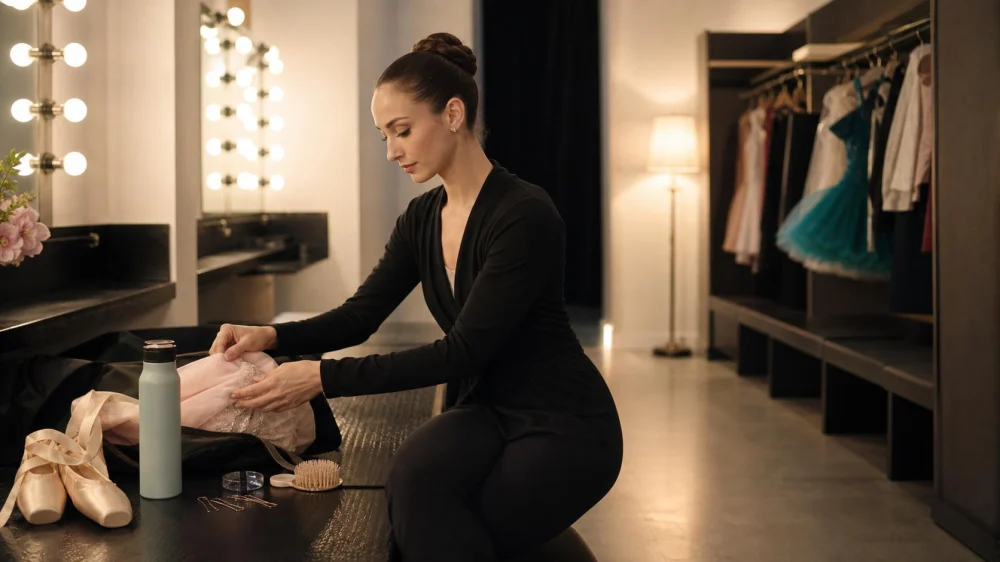
Pack costume and essentials
- Try on the complete costume before show day and practice the choreography in the exact approved shoes.
- Check closures, hems, straps, fasteners, and accessory security without making unapproved alterations.
- Put each look, its accessories, and a checklist together in performance order.
- Pack skin-tone or required underlayers, hair supplies, approved makeup, water, simple food if permitted, and warm layers.
- Bring a small repair kit only if allowed: safety pins, fashion tape, thread, bandages, and spare shoe items appropriate to the costume.
- Mark personal items discreetly and leave expensive jewelry or unnecessary valuables at home.
Best for quick changes: a visual packing order and easy-off warmups. Not ideal: loose glitter, aerosol products, strong fragrance, messy food, or new footwear that has never been tested.
Use a calm backstage routine
Check in first, locate the changing area, then identify the path to the stage and the designated warm-up space. Keep bags under control and never block fire exits, curtains, prop tables, stairs, or crossover routes.
Warm up progressively within the available space: raise body temperature, move major joints, activate the dance’s key patterns, and mark difficult transitions. Save full-energy jumps, lifts, or traveling sequences for an approved area with adequate floor and supervision.
Listen for cues and be ready before your assigned group. Treat curtains, rigging, scenery, microphones, props, and backstage controls as work equipment. Do not touch or move them unless the production team directs you.
Show-day checklist
- Schedule and studio contact saved offline
- Costume pieces counted and packed in order
- Approved footwear and backups checked
- Hair and makeup requirements reviewed
- Water, permitted snack, and warm layers packed
- Medication and health needs handled according to personal guidance
- Phone silenced and photography policy understood
- Stage entrance, exit, and final pose reviewed
- Pickup or departure plan confirmed
If a mistake happens onstage, keep time, maintain spatial awareness, and rejoin at a familiar cue when possible. Do not stop abruptly in another dancer’s travel path. Discuss the studio’s recovery strategy during rehearsal.
Limitations and important notes
Every studio, venue, costume, dance style, and production uses different rules. The studio director, stage manager, venue safety instructions, choreographer, and healthcare guidance take priority over a general checklist.
Report a slippery floor, loose costume piece, damaged shoe, blocked exit, unsafe prop, dizziness, chest pain, breathing difficulty, or acute injury immediately. Do not dance through a condition that makes control unsafe. For an emergency, follow venue procedures and contact appropriate emergency services.
Sources and evidence notes
This article reflects common live-performance practice: performers arrive by call time, organize costumes in show order, follow backstage authority, preserve clear pathways, warm up progressively, and use rehearsed recovery cues. Specific policies are production-dependent.
Frequently asked questions
How early should I arrive?
Use the published call time. Add travel and parking margin, but do not enter restricted areas before the venue permits access.
Should I practice full-out backstage?
Only in a designated space with adequate floor and clearance. Marking and a focused warm-up are safer in crowded areas.
What if a costume breaks?
Tell the assigned costume helper, teacher, or stage manager. Do not make a rushed repair that changes fit, movement, or quick-change timing without approval.
Can family come backstage?
Only if the production allows it. Access limits protect performers, privacy, security, and show operations.
What should I do after my number?
Exit by the rehearsed route, clear the wing, follow change or finale instructions, and remain until formally released.
Next steps
Turn the studio packet into a one-page timeline and pack by costume look, not by item type. Run the entry, final pose, and exit once at rehearsal, then use show day for calm execution rather than new corrections.




 Aftershock Dance Studio4.0 (10 reviews)
 Dance Academy of State College4.0 (8 reviews)
 The Little Gym of Frisco West, TX4.0 (35 reviews)
 Shivaay Dance Academy0.0 (0 reviews)
 North Shore Dance4.0 (31 reviews)
 Inspire Dance5.0 (3 reviews)
 Pole Dance Step by Step Guide for Beginners: Learn the Basics and More
 Why Did US Schools Teach Square Dancing in the 20th Century?
 Top 10 Tango Moves for College Students
 Top 10 Waltz Moves Tutorial: Learn Elegant Dancing Steps
 Ballet for College Students – Complete Guide
 Why Dance Schooling Matters for Growth, Confidence, and Future Paths