Dance Class Music Volume: Protect Hearing and Keep the Beat
On this page
Quick answer
Dance music does not need to be painfully loud to create energy. Measure the room, reduce speaker output first, keep dancers away from the loudest speaker zones, use quiet teaching breaks, and shorten exposure as sound rises. If you must raise your voice to speak to someone an arm’s length away, treat that as a warning to check the level and adjust.
This article is for U.S. dance students, instructors, and studio managers. It offers general hearing-conservation practices, not an acoustic survey, workplace compliance opinion, or individual medical advice.
Why level and time both matter
Sound exposure is a combination of intensity and duration. A louder class can reach a risky dose faster than a quieter class, and exposure accumulates across rehearsals, performances, headphones, commuting, and other parts of the day.
The National Institute for Occupational Safety and Health treats repeated workplace exposure at or above 85 A-weighted decibels over an eight-hour day as hazardous. Under its recommended approach, each 3 dBA increase halves the recommended exposure time. This is an occupational framework, not a guarantee that every person below one number has zero risk.
Noise-induced hearing loss is permanent but largely preventable. Early effects may include temporary muffling, ringing, or difficulty understanding speech in background noise. A class that routinely leaves ears ringing is not simply “immersive.” It is a reason to reduce exposure and evaluate the sound system.
Screen the room before class
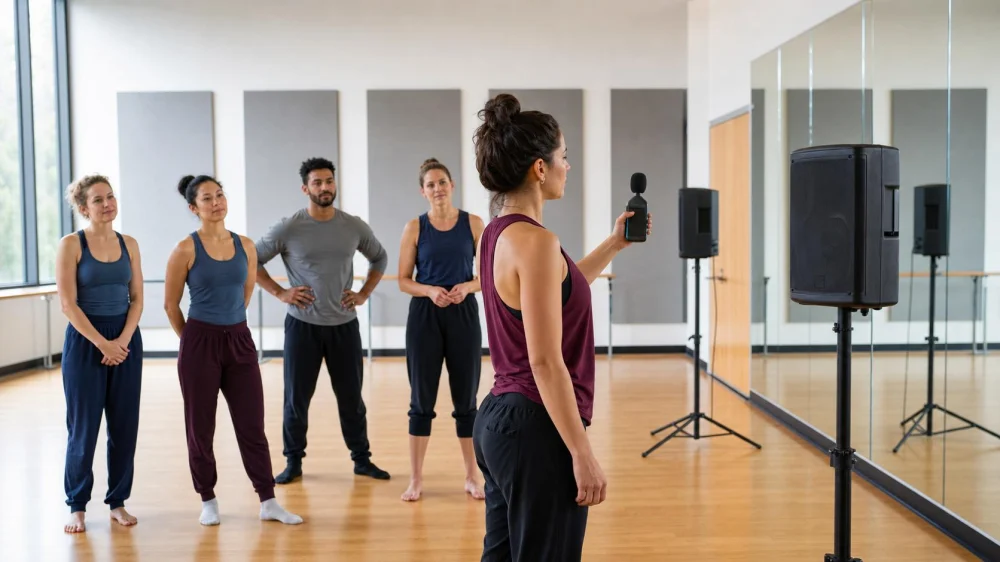
A phone app can be useful for preliminary awareness, but microphone quality, settings, calibration, placement, and room reflections affect results. For reliable decisions—especially for employees—use an appropriate sound level meter or personal dosimeter and qualified guidance.
Check multiple locations:
- Where the instructor normally stands.
- The front row and corners near speakers.
- The center and back of the dance floor.
- Behind or beside directional speakers.
- Adjacent rooms where staff may be exposed for long periods.
Measure representative parts of warm-up, across-the-floor work, full-out combinations, rehearsals, and repeated run-throughs. A brief peak does not describe the whole class, while a simple average can hide the loudest repeated segment.
The voice test is a quick screen: if two people must raise their voices to communicate at arm’s length, measure the sound and reduce it. Do not use the test as the only record for a studio program.
Lower sound at the source
Hearing protection is useful when needed, but the first goal is a quieter, more even room.
- Set a starting limit. Mark a tested mixer or amplifier position rather than letting each class begin from maximum volume.
- Balance the system. Use multiple properly placed speakers at moderate output instead of one loud source when the room and equipment support it.
- Change placement. Keep speaker horns away from head height and avoid placing students directly in front of them.
- Address room reflections. Hard walls, mirrors, floors, and ceilings can create harsh zones. A qualified acoustic professional can recommend treatment without compromising the floor or fire requirements.
- Maintain equipment. Distortion, failing components, and poor equalization can reduce clarity and tempt instructors to increase the master level.
- Measure again. Verify that changes reduced exposure across the occupied floor, not only at the control point.
Teach clearly without turning music up
Clarity and musical timing can improve even when the master volume comes down.
- Pause or fade music for verbal correction instead of talking over it.
- Mark counts at a moderate level before a full-energy run.
- Use clear visual cues, gestures, mirrors, and consistent count language.
- Run short sections, then stop for feedback in quiet.
- Avoid repeated full-volume playback while dancers wait for one group.
- Give the instructor a monitoring position that reflects what students hear.
- Keep emergency instructions and room communication audible.
Very loud music can mask verbal corrections and environmental warnings. A balanced system should support rhythm without forcing everyone to shout.
Give students practical options
Tell dancers how the studio manages sound and how to report discomfort without being labeled uncommitted. Provide a quieter position that does not disadvantage the student’s view or participation when possible.
When engineering and scheduling controls cannot reduce exposure enough, properly selected and fitted hearing protection may help. Musicians’ or filtered earplugs are designed to reduce level while preserving more frequency balance than some basic plugs, but performance varies by fit and product.
A hearing protector should provide enough reduction without isolating the dancer from instructions, partners, traffic, alarms, or other safety cues. Instructors and staff with repeated exposure may need a formal selection, training, and fit-testing process rather than choosing a product by marketing alone.
Do not share reusable earplugs without appropriate cleaning and hygiene. Replace damaged or poorly fitting products.
Symptoms that deserve attention
Notice:
- Ringing, buzzing, or rushing sounds after class.
- Muffled hearing or a feeling that ears are “full.”
- Difficulty following conversation in a noisy lobby.
- Needing higher media volume than before.
- Sound sensitivity, ear pain, dizziness, or balance changes.
Stop further loud exposure and seek medical guidance when symptoms are new, severe, persistent, one-sided, or associated with dizziness, pain, drainage, or a sudden change in hearing. Sudden hearing loss can require urgent evaluation; do not wait for the next class to see whether it resolves.
Instructors and other workers with routine hazardous exposure should discuss a hearing-conservation program and professional hearing tests with the responsible employer and occupational-health resources.
A studio hearing-safety checklist
- Measure representative classes and rehearsals across room locations.
- Document speaker positions, system settings, class length, and measurement method.
- Set and communicate a practical sound-level policy.
- Use quiet instruction and recovery periods.
- Rotate staff or adjust schedules when repeated exposure is high.
- Provide a clear way for students and staff to report ringing or excessive volume.
- Recheck after equipment, acoustic, or room-layout changes.
- Consult qualified professionals when exposure may exceed occupational guidance.
- Keep music low enough that safety cues and emergency communication remain effective.
A policy works only when it applies to auditions, rehearsals, private lessons, rentals, performances, and special events—not just routine classes.
Evidence and limitations
CDC/NIOSH explains that repeated occupational exposure at or above 85 dBA can cause permanent hearing loss and recommends reducing sound at the source before relying on personal protection. Its exposure guidance also uses the arm’s-length voice test as a screening clue and emphasizes accurate measurement of level and time.
NIOSH limits are designed for occupational exposure and require competent interpretation. A studio with employees may also have legal duties not summarized here. An industrial hygienist, audiologist, acoustical consultant, or occupational-safety professional can address the specific room and schedule.
Frequently asked questions
Is 85 dBA safe for every dance class?
No single number guarantees no risk. The NIOSH 85 dBA value is an occupational recommended exposure limit averaged across eight hours, and louder exposure reduces recommended time. Total daily exposure and individual factors matter.
Can a phone app measure the room?
It can help screen for a problem, but phone microphones and app settings vary. Use suitable calibrated equipment and professional methods for reliable exposure decisions.
Will earplugs make it impossible to hear counts?
Not necessarily. The correct filtered protector and fit may reduce level while preserving useful sound. Overprotection or poor fit can interfere with instructions, so selection should match the measured exposure and task.
Does ringing after class mean permanent damage?
It does not diagnose the extent of injury, but it is a warning that exposure was too high for that person. Reduce further exposure and seek medical or audiology advice if it persists, recurs, or comes with other symptoms.
Should the instructor stand beside the speaker?
Usually not. The instructor needs a position that reflects student exposure without spending the entire class in a high-level zone. Measure the actual room to choose speaker and teaching positions.
Next steps
Start with one representative class: measure several floor locations and document the music level and duration. Lower the source, improve speaker placement, add quiet teaching breaks, and measure again. Invite students and staff to report symptoms. If exposure remains high or hearing changes occur, involve a qualified hearing or occupational-safety professional rather than turning the volume back up.

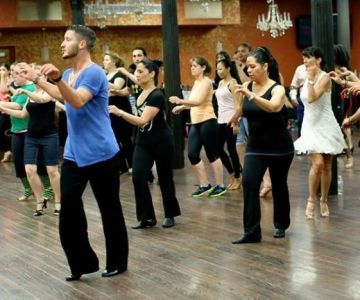

 Just Dance Inc5.0 (2 reviews)
 Clermont Salsa5.0 (8 reviews)
 The Dunbar Pavilion4.0 (79 reviews)
 Dancer's Studio5.0 (7 reviews)
 Philadelphia Dance Theatre5.0 (24 reviews)
 Flamenco 4 Kids!5.0 (7 reviews)
 Bollywood Dance Styles to Try in 2025 – A Complete Guide
 Did the Girls on Dance Moms Go to School? The Truth Behind the Scenes
 Do High School Dances Still Exist? Exploring the Evolution of School Dances
 Why Is Square Dancing Taught in Schools
 Foxtrot for College Students: Expert Tips to Get Started
 Top 10 Ballet Moves for Beginners: A Complete Guide