Dance Class Music Too Loud? Protect Your Hearing
On this page
- Quick answer
- Why volume and duration matter
- Signs the sound needs attention
- What to do during class
- How to talk with the teacher or studio
- Consider hearing protection
- A practical studio checklist
- When to seek professional help
- Limitations and important notes
- Sources and evidence notes
- Frequently asked questions
- Conclusion and next steps
Quick answer
If dance-class music feels painfully loud, makes speech hard to understand at close range, or leaves ringing or muffled hearing afterward, move farther from the speaker, tell the instructor, and take a quiet break. Do not push through ear pain. Ask the studio how it manages sound levels and consider well-fitted hearing protection with guidance appropriate to your needs.
This guide is for dancers, families, teachers, and studio visitors in the United States. It offers general hearing-safety planning, not a hearing test, diagnosis, legal limit, or room-specific sound assessment.
Why volume and duration matter
Sound exposure depends on both intensity and time. A level that seems tolerable for a short demonstration may become uncomfortable or risky during repeated classes, rehearsals, or events. Distance from a speaker, room reflections, speaker direction, breaks, and individual sensitivity also affect the experience.
Dance studios can have hard floors, mirrors, and walls that reflect sound. Music must be clear enough for timing, but loudness is not the same as clarity. Better speaker placement and balanced sound can make rhythm audible without simply turning the system higher.
People with tinnitus, hearing loss, migraine, sensory sensitivity, ear conditions, or certain medical histories may need an individual plan. Children may not describe sound discomfort clearly, so adults should watch for behavior and ask direct questions.
Signs the sound needs attention
- Ear pain, pressure, or physical discomfort during playback
- Ringing, buzzing, or muffled hearing during or after class
- Needing to shout to a nearby person during ordinary instruction
- Difficulty hearing the teacher’s safety cues over music
- Headache, dizziness, distress, or inability to concentrate around the sound
- A child covering their ears, withdrawing, crying, or repeatedly asking to leave
These signs do not diagnose hearing damage. They are reasons to reduce exposure, communicate, and seek evaluation when symptoms persist or are sudden.
What to do during class
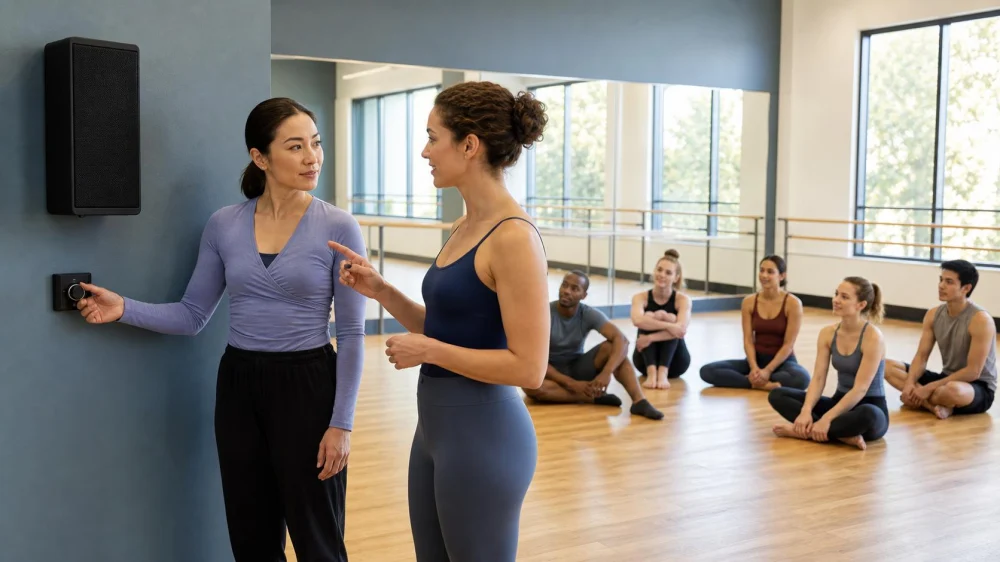
- Move away from speakers. Choose a position that preserves safe dance spacing and the teacher’s sightline.
- Tell the instructor promptly. Use a clear statement such as, “The music is causing ear discomfort; can we lower it or move the speaker?”
- Take a quiet break. Step into an approved safe area without crossing active dancers unexpectedly.
- Do not block your ears while moving. Sudden changes in balance, awareness, or cue perception can create another hazard.
- Stop for concerning symptoms. Do not continue through pain, marked dizziness, sudden hearing change, or intense ringing.
- Record the context. Note room, speaker position, class length, symptoms, and how long they lasted.
If a teacher needs loud music briefly for performance simulation, ask for advance notice and a plan for protection, spacing, and quiet recovery. Participation should not require concealing symptoms.
How to talk with the teacher or studio
Describe the specific situation rather than saying only that the class is “too loud.” Identify where you stood, when discomfort began, whether speech cues were masked, and whether symptoms continued afterward.
Useful questions include:
- Who controls the sound system during class?
- Can speakers be aimed or repositioned away from dancers?
- Is there a quieter standing zone that still supports safe participation?
- How are performance-volume rehearsals announced?
- Can the teacher pause music when giving corrections or safety instructions?
- Does the studio have a process for accessibility or sensory accommodations?
A phone sound app can help describe differences between positions, but it may not be calibrated. Formal assessment requires appropriate equipment and expertise. Avoid treating an app reading as a diagnosis or definitive compliance finding.
Consider hearing protection
Hearing protection can reduce exposure, but it must still allow the dancer to understand instructions, hear important cues, and maintain awareness. Options differ in fit and how they change music. Generic foam plugs, filtered musician-style plugs, and custom devices do not provide the same experience.
Practice with protection in a low-risk setting before using it during complex movement. Make sure it stays secure and does not create distraction. Never share in-ear protection.
An audiologist or other appropriate hearing professional can help with fit and individual needs, especially for existing hearing conditions, recurrent symptoms, or a demanding training schedule. Protection is not a substitute for reasonable room volume and speaker placement.
A practical studio checklist
- Speakers are stable, protected from impact, and not aimed directly at a close standing zone.
- Teachers can control volume quickly without leaving dancers unsupervised.
- Spoken safety instructions are understandable when music is paused or lowered.
- Dancers have a safe way to request lower volume or a break.
- Performance-level sound is planned rather than introduced without warning.
- Parents and students know whom to contact about persistent concerns.
- Any measurement program uses appropriate guidance, equipment, and competent interpretation.
When to seek professional help
Seek prompt medical evaluation for sudden hearing loss, severe ear pain, discharge, significant dizziness, a head injury, or other acute symptoms. Sudden hearing change can be time-sensitive.
Arrange a non-emergency hearing evaluation when ringing, muffled hearing, discomfort, or difficulty understanding speech persists, returns after classes, or affects daily life. Bring the exposure notes and explain any hearing protection used.
For a studio-wide concern, a qualified occupational, acoustical, or hearing-conservation professional can assess the room and recommend controls. Legal and workplace requirements depend on the setting and should not be inferred from this general article.
Limitations and important notes
- Comfort varies, but pain and lasting symptoms should never be dismissed.
- Distance, duration, room acoustics, and speaker placement matter alongside the volume control setting.
- Earbuds with music are not hearing protection and can add exposure.
- Hearing protection must not prevent dancers from receiving safety cues.
- Studio policies and applicable rules vary; ask for site-specific assessment when needed.
Sources and evidence notes
This guide reflects broad hearing-conservation principles: reduce level or duration, increase distance from the source, use appropriate protection, and respond to symptoms. It intentionally does not state a room-specific exposure limit because accurate assessment depends on measurement method, duration, and setting.
Use current public-health guidance and advice from qualified hearing, medical, occupational, or acoustical professionals for individual or studio-specific decisions.
Frequently asked questions
Is loud music necessary for a good dance class?
No. Music must be clear enough to support timing, but teaching quality does not require physical discomfort or masked safety cues.
Can I use ordinary foam earplugs?
They may reduce sound, but they can change music and speech clarity. Fit matters. Test safely and seek professional advice for regular use or existing hearing needs.
Is a phone decibel app accurate?
It can help compare moments informally, but device microphones and apps may not be calibrated. Do not use it as the only basis for a health or compliance conclusion.
What if only one part of the room feels loud?
Speaker direction and reflections can create uneven sound. Move to a safe position and tell the teacher so placement or level can be reviewed.
Should ringing after class be ignored if it stops?
No. Reduce future exposure and mention it to an appropriate professional, especially if it recurs, lasts, or comes with hearing change or dizziness.
Conclusion and next steps
Music should support dance without causing pain or obscuring instruction. Move away from speakers, communicate early, use quiet breaks, and document recurring symptoms. Ask the studio about sound management and consider appropriate hearing protection. Seek prompt care for sudden hearing change and professional assessment for persistent concerns.


 Drop Everything & Dance Studio4.0 (19 reviews)
 Ballet Austin's Butler Center for Dance & Fitness5.0 (24 reviews)
 Blitz Bhangra Academy5.0 (12 reviews)
 Belly Dance with Barushka0.0 (0 reviews)
 VYB Dance Studio4.0 (57 reviews)
 City Ballet San Francisco5.0 (12 reviews)
 Why Hip Hop Is Popular to Improve Flexibility: Benefits of Dance for Mobility and Health
 Why K-Pop Dance Is Popular for Couples
 Zumba Trending on TikTok: The Ultimate Guide to Get Moving
 Can Dance Schools Reopen in NJ? What Parents and Students Should Know
 Shuffle Dance Cultural Origins – Complete Guide | American Dance Academy
 Top 10 Salsa Moves for College Students to Master Quickly