Record Dance Practice Without Disrupting the Studio
On this page
Quick answer
Record dance practice only with studio and instructor permission and the informed agreement of everyone who may appear or be heard. Keep the phone and tripod outside all movement paths, capture one clear purpose rather than the whole class, and stop if filming changes participation. Review for one or two technical cues, then secure, share, or delete the file as agreed.
Get permission first
A dance practice recording is a video made to review choreography, timing, spacing, or technique. The camera changes the room: it can capture faces, voices, original choreography, music, corrections, minors, mirrors, and people who did not expect to be recorded.
Ask before setting up, even if other students sometimes film. Confirm:
- whether recording is allowed during class, only after class, or not at all;
- which combination or section may be filmed;
- whether the teacher demonstrates in the recording;
- whether audio should be muted;
- whether the file is for private review only;
- how long it may be stored and whether it must be deleted;
- who owns or controls choreography and instructional material.
Permission for one session is not permanent permission. A substitute teacher, guest choreographer, rehearsal, recital work, or different class group may follow another rule. If the answer is no, take written notes or ask for an approved reference instead.
Protect other people’s privacy
Studio approval does not replace each person’s consent. Ask everyone who could appear, including through mirrors. A person should be able to decline without having to explain.
The cleanest setup is a solo recording in an empty or reserved part of the studio. If others are present:
- frame tightly enough to exclude them;
- check mirrors and glass for reflections;
- avoid changing areas, entrances, office screens, and personal belongings;
- do not capture private conversations or teacher feedback to another student;
- pause immediately when someone enters the frame;
- never film a child without the required parent or guardian and studio permissions.
Do not assume blurring later solves the problem. Audio, clothing, movement, location, and reflections can identify someone. Prevent the capture when possible.
Set up the phone safely
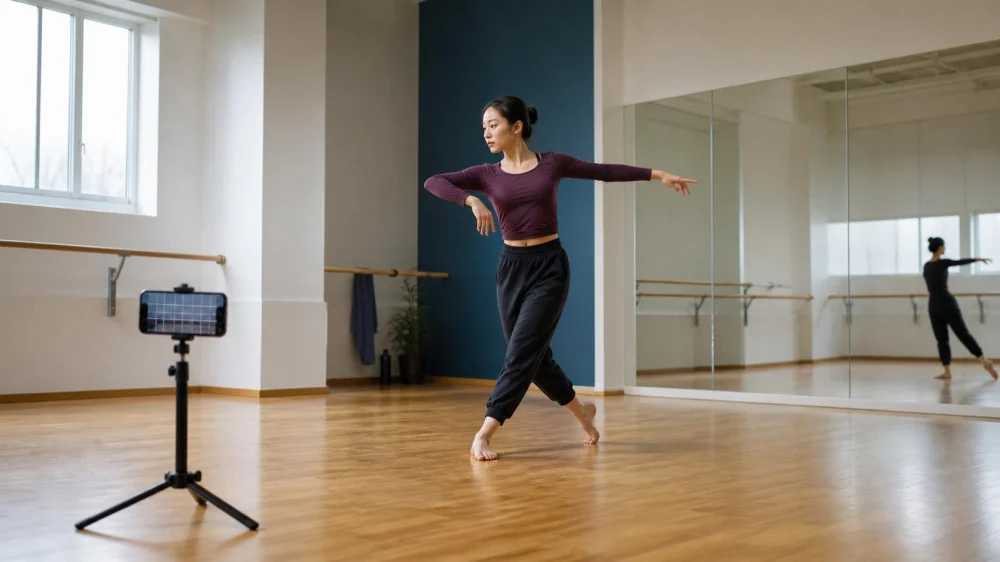
Place the device before movement begins. A tripod must sit against a wall or in another approved area outside entrances, exits, barres, teacher walkways, travel lanes, and landing zones. Do not place a phone on the dance floor where it can slide or be stepped on.
- Clean the lens and enable airplane or focus mode if appropriate.
- Use a stable stand rated for the phone.
- Frame the full movement area, including hands and feet when technique review requires them.
- Check that mirrors do not reveal others or create confusing duplicate views.
- Record a brief test while walking the pathway at low intensity.
- Confirm the device cannot tip when the floor vibrates or air moves.
- Keep cables off the floor; use a charged battery instead of a charging cord across a path.
Never interrupt a combination to retrieve a falling phone. Stop the music and movement first. If no safe location captures the full phrase, change the framing or do not record.
Record a useful take
Choose one purpose: remember sequence, check timing, compare spacing, or examine one technical detail. A specific goal makes a short recording more useful than an entire class archive.
Mark the choreography once to verify the frame. Then record one or two full takes at the effort level approved by the teacher. Repeating a demanding phrase solely for a perfect video can add fatigue and change technique.
Use a wide, fixed view for pathways and group spacing. Use a closer view for a stationary detail only when it still shows the body relationships needed. Avoid dramatic angles, digital zoom, filters, and slow motion until you have reviewed normal speed; those choices can distort alignment and timing.
If the music cannot be recorded or shared, use counts, a metronome permitted by the teacher, or silent video. Do not post copyrighted music or choreography merely because your phone captured it in class.
Review without overcorrecting
Watch once for the overall phrase, then review the single goal. Note an observable moment such as “arrives on count after the group,” not a judgment such as “looks bad.” Compare the video with the teacher’s instruction rather than inventing a correction from appearance alone.
Use this review loop:
- Name the goal before playback.
- Watch at normal speed without pausing.
- Select one successful moment and one question.
- Check the relevant section once more.
- Write a short practice cue.
- Ask the teacher when the cue involves technique, pain, or safety.
Mirrored video can reverse right and left. Camera angle and lens perspective can also make lines appear different. Use video as one source of feedback, not an objective verdict about the dancer’s body or ability.
Store and share carefully
Keep practice files in a secured device or account. Turn off automatic cloud sharing or social-media upload if it conflicts with the agreement. Use neutral filenames and avoid attaching another student’s full name.
Before sharing, confirm permission again and define the audience. Sending a file to a private class group is still distribution. Cropping a teacher or dancer out may not remove their voice, reflection, choreography, or identifying context.
Delete unusable takes promptly. Delete all copies when consent is withdrawn or the agreed period ends, including recently deleted folders and shared links where you control them. A posted file can be copied by others, so public posting requires a higher threshold than private review.
Limitations and important notes
Studio policy, privacy law, publicity rights, music rights, choreography ownership, and rules for minors vary. Obtain qualified guidance for legal questions. This article does not establish permission to record or publish.
Recording should not reduce warm-up time, block feedback, distract classmates, or create pressure to perform through pain or fatigue. Stop if equipment becomes a hazard or the dancer’s attention shifts from safe movement to the camera.
Video cannot diagnose an injury or determine whether a movement is medically safe. Pain, instability, dizziness, or a suspected injury requires stopping and appropriate professional assessment.
Sources and evidence notes
This method follows broad privacy, consent, and movement-safety principles: obtain permission before capture, minimize the people and information recorded, keep equipment out of pathways, and use the file only for its stated purpose.
The studio and instructor are the sources for recording policy and choreography use. Applicable authorities and qualified professionals are the sources for privacy and intellectual-property requirements. The teacher is the source for technique corrections within class scope.
Frequently asked questions
Can I record if no one objects?
Silence is not informed permission. Ask the studio, teacher, and each person who may appear or be heard.
Where should I put the phone?
Use a stable stand in an approved location completely outside movement, entrance, and exit paths. Test the framing at low intensity.
Can I post my practice video?
Only if all required permissions cover public posting, including people, music, choreography, and the studio setting.
Should I film every run?
No. Record a limited number for a defined question. Constant filming can add fatigue, distraction, and excessive files.
Is slow motion best for technique?
Review normal speed first. Slow motion can help locate timing details, but it can also encourage overanalysis and does not replace teacher feedback.
Conclusion and next steps
Respectful dance recording begins with explicit permission, a clear purpose, and a safe frame that excludes others. Short, focused takes are easier to review and easier to manage responsibly.
Your next step is to ask the instructor for the exact recording rule and select one practice question. Set the phone outside the movement path, capture no more than needed, write one useful cue, and secure or delete the file according to the agreement.
 Dance Beast Club4.0 (20 reviews)
 Performing Arts Workshop5.0 (11 reviews)
 Center Stage Dance Studio4.0 (8 reviews)
 Salsa Sabrosa4.0 (277 reviews)
 The Madison Studio - Dance Education4.0 (14 reviews)
 North Georgia Aerials (Dallas)0.0 (0 reviews)
 Why A Step in Time School of Dance Inspires Lifelong Passion
 Do They Have Mother-Son Dances in Schools? Understanding the Tradition and Its Meaning
 How to Master Foxtrot to Try in 2025 - American Dance Academy
 Did the Dance Moms Girls Go to School? Behind the Scenes of Their Education
 How to Choose Between Manual and Automatic Transmission
 Why Bollywood Dance Is Popular and Its Cultural Origins