
How to Practice Spotting for Turns Without Overdoing It
On this page
Quick answer
To practice spotting, choose one eye-level target, keep looking at it as your body begins to rotate, then turn your head quickly to find the same target before the body finishes. Start with slow quarter and half turns, pause between repetitions, and stop before dizziness builds. Spotting supports orientation, but alignment, turn preparation, footwear, and instruction still matter.
What is spotting?
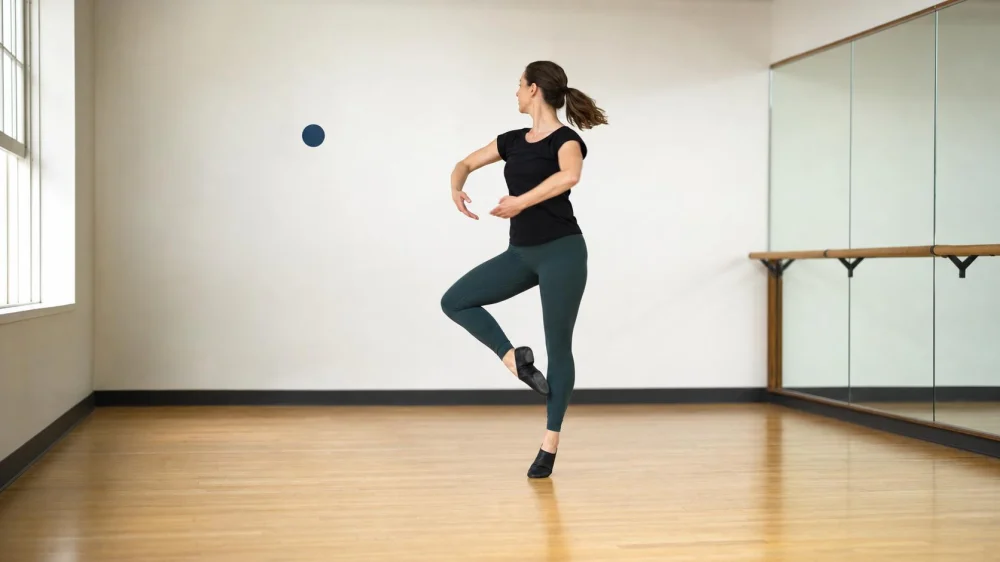
Spotting is a dance technique in which the dancer delays the head’s rotation, then rapidly brings the eyes back to a consistent visual reference during a turn. It can help with direction and timing, but it does not guarantee that a dancer will never feel dizzy.
The target should be small enough to recognize, fixed rather than moving, near eye level, and visible in safe practice space. A door-frame corner, piece of plain tape, or other neutral studio marker can work. Do not stare at another dancer who may move.
Prepare before turning
- Use a clear floor with no bags, furniture, wet areas, or traffic.
- Wear secure footwear appropriate for the dance style and surface.
- Warm up gradually and include ankle, knee, hip, trunk, and neck movement within a comfortable range.
- Stand tall without lifting the chin or forcing the neck backward.
- Choose a target directly in front and establish stable breathing.
- Have a wall or barre nearby for stationary drills, without gripping during free turns.
Practice progression
- Eyes only: stand still and shift focus from the target to one side and back without moving the head.
- Head timing: rotate the shoulders slightly while keeping eyes on the target, then let the head follow and refocus.
- Quarter turns: step through four controlled quarter turns, locating a new front or the instructor’s prescribed spot each time.
- Half turns: use a clear preparation, controlled weight transfer, and one deliberate head action.
- Single full turn: add only when the setup and landing remain consistent. Reset completely between attempts.
- Style application: work with a qualified teacher on the spotting choice used in ballet, jazz, ballroom, contemporary, or another form.
Best for learning: a few accurate repetitions with rest and feedback. Not ideal: rapid repeated spinning until the body “gets used to it,” especially when balance or nausea is already changing.
Common problems and adjustments
- Target blurs early: slow the body and keep the eyes steady longer before the head releases.
- Head arrives late: practice the head action without a full turn and refocus sooner.
- Chin lifts: choose an eye-level target and keep the back of the neck long.
- Landing travels: reduce rotation and review the supporting foot, core organization, arms, and weight transfer.
- Dizziness increases: stop, sit or stand securely, focus on a stable object, and recover fully before deciding whether to continue.
When to choose a different approach: some choreography intentionally uses a soft focus, changing fronts, or no conventional spot. Follow the teacher’s artistic direction only after building safe control.
Practice checklist
- Clear, suitable floor and enough space
- Fixed eye-level target selected
- Warm-up completed
- Quarter or half-turn dose chosen
- Full reset between repetitions
- Both directions trained as appropriate
- Stop point decided before dizziness
- Teacher feedback scheduled before adding speed
Limitations and safety notes
This is general dance education, not medical advice. Spotting technique cannot diagnose or treat vertigo, vestibular conditions, concussion, migraine, vision problems, medication effects, or other causes of dizziness.
Stop immediately for severe or persistent dizziness, fainting, new headache, chest pain, weakness, numbness, hearing change, double vision, confusion, vomiting, recent head injury, or difficulty walking. Seek urgent medical help for sudden serious symptoms. If ordinary practice repeatedly causes disproportionate symptoms, consult an appropriate healthcare professional before further turning.
Sources and evidence notes
This guide reflects common dance-teaching practice: use a consistent visual reference, progress from slow components to full turns, limit repetitions, and pair head timing with whole-body technique. Individual vestibular responses and style conventions vary.
Frequently asked questions
Should I snap my neck as hard as possible?
No. The head action is quick but controlled. Forcing speed or range can create tension and does not replace accurate timing.
Why am I still dizzy when I spot?
Spotting can support orientation but does not eliminate the sensory effects of rotation. Dose, breathing, fatigue, health, and technique may contribute.
Can I practice on carpet?
Carpet may grip, shift, or make rotation unpredictable. Use a floor approved for the movement and footwear by a qualified instructor.
Should beginners practice multiple turns?
Usually not before a stable single turn. More rotation magnifies problems in preparation, axis, head timing, and landing.
Do ballroom dancers spot the same way as ballet dancers?
Not always. Partner connection, traveling direction, frame, and style affect visual focus and head action. Learn the convention for the specific dance.
Next steps
Place one clear target, film or observe a few slow quarter turns, and check when the eyes leave and return. Take the result to a teacher, then add rotation only when your setup, focus, and landing remain calm and repeatable.

 Studio A Dance Center0.0 (0 reviews)
 Nika Ballet Studio4.0 (24 reviews)
 5678 Dance Studio4.0 (5 reviews)
 Moving and Grooving Dance and Movement Studio for Kids5.0 (9 reviews)
 Dance with Miss Alicia5.0 (10 reviews)
 Just Dance Studio5.0 (2 reviews)
 Foxtrot Near Me in the USA – What You Need to Know
 Why Bollywood Dance Is Popular: Cultural Origins Explained
 Are There School Dances in 7th Grade? Everything Parents & Students Should Know
 Top 10 Hip Hop Moves Explained for Beginners and Dancers
 Can Dance Teachers Teach in a School? What You Need to Know
 Top 10 Bachata Moves That Boost Confidence