Dance Recital Day: A Backstage Preparation Checklist
On this page
- Quick answer
- Confirm details one week before
- Build a labeled costume kit
- Plan arrival and check-in
- Use backstage space responsibly
- Warm up without wearing yourself out
- Prepare for quick changes
- Confirm supervision and pickup
- Limitations and important notes
- Frequently asked questions
- Sources and evidence notes
- Conclusion and next steps
Quick answer
A smooth dance recital day starts with the studio’s written schedule. Confirm call time, venue entrance, costume order, hair and makeup rules, allowed food, recording policy, and pickup procedure. Pack each costume in a labeled bag with its accessories and shoes, arrive ready for check-in, follow backstage supervision, and save extra practice for another day—performance preparation should protect energy and focus.
This guide is for dancers and caregivers preparing for a United States studio recital. The studio, venue, instructor, and production team’s current instructions take priority.
Confirm details one week before
Create one master schedule from official communications rather than memory or group-chat fragments. Record:
- performance date, curtain time, dancer call time, and expected release time;
- venue address, dancer entrance, parking plan, and accessibility details;
- dress rehearsal date and which costumes are required;
- dance order, costume order, and estimated quick-change time;
- hair, makeup, tights, shoe, and undergarment requirements;
- food, drink, photography, recording, and device policies;
- check-in, supervision, emergency contact, and authorized pickup procedures.
Ask questions before recital day. Production staff may be unavailable to resolve non-urgent costume or ticket questions during check-in.
Build a labeled costume kit
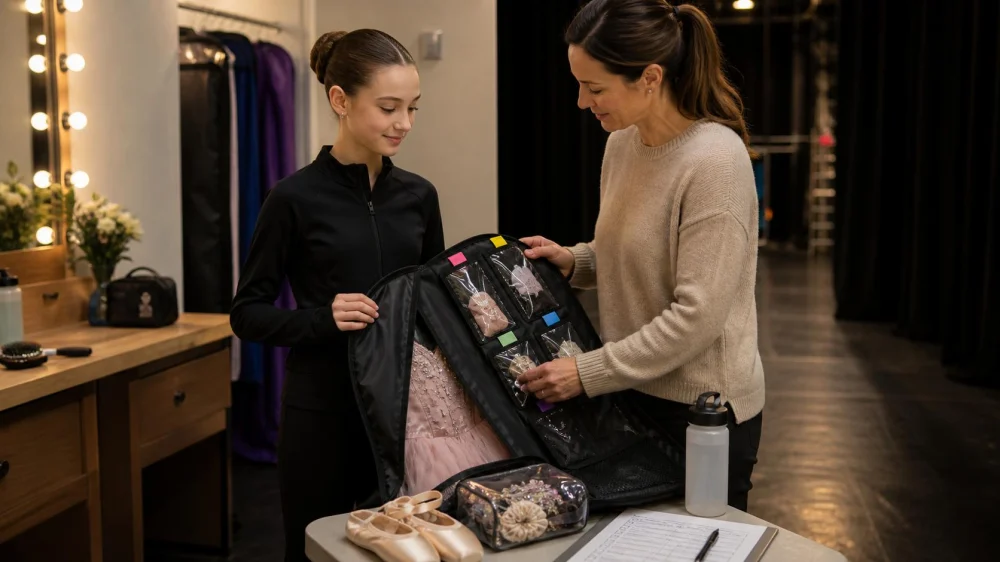
- Use one garment bag per routine. Label it with the dancer’s name and routine in the method permitted by the studio.
- Attach small accessories. Place hair pieces, gloves, belts, and jewelry in a closed labeled pouch inside the correct bag.
- Separate shoes. Protect costumes from street dirt and confirm every shoe is present.
- Pack required base layers. Follow studio rules for tights, leotards, and modest changing layers.
- Add a small repair kit. Include only permitted items such as safety pins, fashion tape, a basic sewing kit, bandages, and spare hair supplies.
- Photograph each complete look. A reference image can help restore accessory placement during a quick change.
Do not make last-minute costume alterations without approval. Changes can affect group uniformity, movement, safety, and lighting.
Plan arrival and check-in
Work backward from call time and include parking, walking, building entry, security, restroom needs, and costume check. Call time is generally when the dancer must be present and ready for production instructions—not when the car should enter the parking lot.
Eat a familiar meal early enough to feel comfortable, following any studio food restrictions. Bring a closed water bottle if permitted. Avoid trying unfamiliar products, foods, cosmetics, or costume solutions on performance day.
At check-in, report attendance, submit any required medication or emergency information through the approved process, and learn where the dancer and caregiver should go next. Do not bypass controlled entrances.
Use backstage space responsibly
- Keep aisles, exits, wings, and access to technical equipment clear.
- Store every item in the assigned area and close bags after use.
- Keep food away from costumes, floors, and allergy-sensitive shared spaces.
- Use phones, cameras, and social media only where the policy permits.
- Respect other dancers’ privacy while changing.
- Listen for lineup calls without gathering in doorways.
- Tell the assigned adult or stage manager before leaving the supervised area.
Backstage is a working environment. Quiet, predictable movement helps dancers hear cues and helps staff manage transitions.
Warm up without wearing yourself out
Follow the instructor-led warm-up and use familiar movements. A performance warm-up should prepare joints, muscles, balance, and attention for the choreography. It is not the time to force a deeper stretch, attempt a new trick, or repeat the full dance until fatigued.
Stay warm between numbers with approved layers that are easy to remove without disturbing hair or makeup. Sip water according to personal needs and the production plan. Report pain, dizziness, breathing difficulty, or an injury to the responsible adult rather than hiding it to stay in the show.
Prepare for quick changes
Lay out the next costume in dressing order. Open fasteners, place shoes together, and position accessories in sequence. Assign approved helpers before the show; do not rely on finding someone at the last moment.
Practice the change calmly at home while protecting costume pieces. Identify the minimum steps, the private changing location, and what to do if a zipper, shoe, or accessory fails. The backup plan might be a production-approved adjustment or skipping a nonessential accessory—not delaying an entrance without communication.
After changing, place the removed costume directly back into its bag. Loose pieces become harder to find with every transition.
Confirm supervision and pickup
Studios and venues may restrict backstage access and release minors only to authorized adults. Confirm the exact pickup location, identification requirements, and procedure for a different caregiver. Do not ask a child to leave the controlled area alone or arrange an informal hallway handoff.
Make sure staff have the correct emergency contact and know about time-sensitive medical needs through the studio’s approved system. Keep the authorized adult’s phone available but avoid calling the dancer repeatedly during the show.
Limitations and important notes
Recital procedures differ by age group, dance style, venue, production scale, and local policy. Some venues prohibit aerosol products, outside food, tripods, flash, or recording. Verify rules rather than assuming another recital’s process applies.
Performance should not override health or safety. A dancer with concerning injury symptoms, severe illness, or inability to perform safely needs appropriate adult and professional assessment. Follow emergency instructions at the venue.
Frequently asked questions
How early should a dancer arrive?
Use the official call time and arrive early enough to be checked in and ready then. Do not substitute a generic arrival rule for the production schedule.
Should costumes be worn in the car?
Follow studio instructions. Wearing a costume during travel can wrinkle, stain, or damage it and may interfere with safe restraint fit. Never alter seat-belt use for a costume.
What should stay out of the backstage bag?
Leave valuables, unnecessary electronics, messy food, unapproved cosmetics, and extra loose items at home. Pack only what the studio permits and the dancer can track.
What if an accessory goes missing?
Tell the assigned helper or instructor, check the labeled pouch and change area, and follow the production decision. Do not delay a cue or take another dancer’s item.
Sources and evidence notes
This checklist reflects common live-performance and youth-supervision practice: written schedules, labeled costume systems, controlled backstage access, clear cues, familiar warm-ups, and documented pickup plans reduce avoidable confusion. Exact rules come from the producing studio and venue.
Conclusion and next steps
Turn the studio’s instructions into one master schedule, pack each routine as a complete labeled unit, and rehearse only the transitions that need practice. On recital day, arrive ready at call time, protect energy, follow backstage supervision, and use the authorized release process. Organization should make the performance feel simpler—not add more tasks for the dancer.




 Bobbie Ann's Dance Studio4.0 (21 reviews)
 Exhibit 3 Dance Company5.0 (18 reviews)
 Cucala Dance Company - Astoria - Salsa Classes0.0 (0 reviews)
 Graceful Moves Dance Inc4.0 (15 reviews)
 East Tennessee Ballet Academy4.0 (12 reviews)
 Clearwater Dance Depot5.0 (38 reviews)
 Why Is Square Dancing Taught in Schools
 Ballroom Dance to Burn Calories – Effective Tips and Dance Styles
 Top 10 Pole Dance Moves to Improve Flexibility: Beginner to Advanced Guide
 Do Schools Still Have Dances? Understanding the Tradition of School Socials
 Hip Hop for Beginners: Common Mistakes to Avoid
 Top 10 Ballet Moves Trending on TikTok and How to Master Them