
Partner Rotation in Dance Class: Etiquette and Safety
On this page
Quick answer
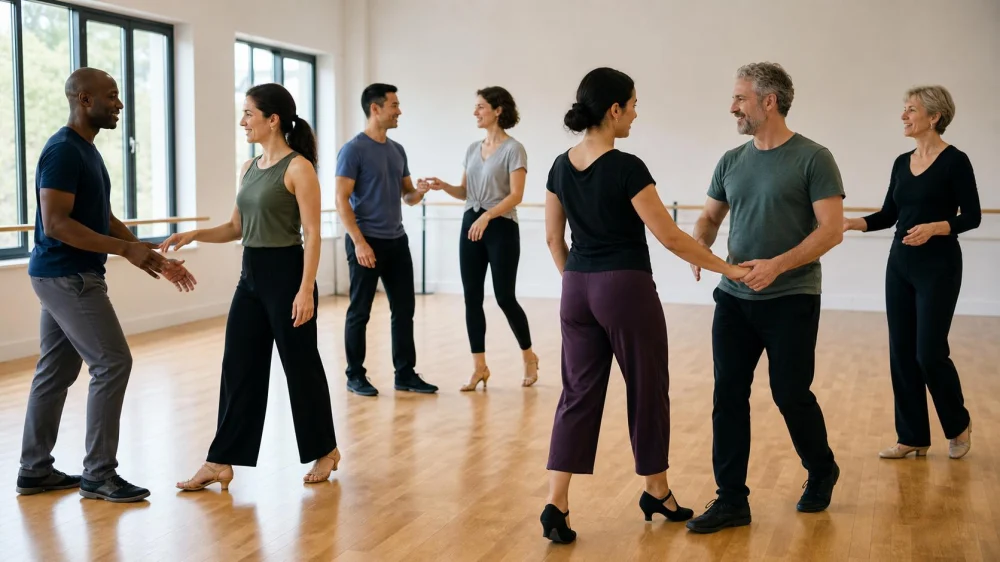
Partner rotation means changing dance partners at planned intervals during a group class. Follow the instructor's direction, thank the person you are leaving, move along the stated route, introduce yourself briefly, and establish a comfortable connection before dancing. Rotation should remain optional: a student can decline a partner or choose not to rotate without being pressured to explain personal details.
How partner rotation works
Partner rotation is a class-management method that lets students practice the same material with several people instead of remaining in one pair. It is common in some ballroom, swing, salsa, bachata, social dance, and partner-based classes, but it is not universal. The teacher might ask one role to move clockwise, send an outside circle to the next person, or call changes after a set number of repetitions.
The purpose is usually instructional. Each partner offers slightly different timing, reach, frame, communication, and movement habits. Changing partners can show whether a student understands the pattern itself or has simply adapted to one familiar person. It can also help a group class continue when the numbers of leaders and followers are uneven.
Rotation does not mean everyone must dance with everyone. Class format, contact expectations, opt-out choices, and role labels should be clear before the exercise begins. Students should be able to participate without assumptions about gender, dating, skill status, or willingness to use a particular hold.
What to ask before class
If partner rotation affects whether a class feels right for you, contact the studio or ask the instructor before the lesson begins. Useful questions include:
- Does this class rotate partners, use fixed partners, or offer both options?
- Can a student attend without bringing a partner?
- How are lead, follow, or other roles assigned, and can students choose or switch roles?
- What kinds of hand, arm, shoulder, back, or torso contact are used?
- How can someone opt out of a rotation or modify the connection?
- Does the class include lifts, dips, close embrace, fast turns, or other elements that require extra preparation?
- How does the instructor handle an uneven number of participants?
In the United States, studio customs vary widely by dance form, level, and instructor. A website label such as “partner class” or “no partner needed” does not answer every question. Confirm the actual format for the specific session rather than assuming all classes at a studio operate alike.
A clear rotation checklist
- Listen for the route. Identify who moves, who stays, and which direction the line or circle travels.
- Finish the current repetition. Return to a stable position instead of letting go during a turn, dip, or traveling action.
- Acknowledge your partner. A simple “thank you” closes the exchange without evaluating their ability.
- Move promptly and look where you are going. Follow the designated path and avoid crossing through pairs that are still dancing.
- Greet the next person. Share names if practical and confirm the dance role rather than guessing.
- Offer, do not impose, connection. Present a hand or frame position and allow the other person to meet it. Adjust if they request a different hold.
- Reset spacing. Check the direction of travel and the distance from neighboring pairs before the music starts.
- Practice the assigned material. Keep the class pattern and tempo; do not add a surprise dip, lift, trick, or extra turn.
If you miss a partner because of confusion, stay visible at the edge of the rotation and signal the instructor. Walking against the route or grabbing the nearest person usually creates more disruption than waiting for a reset.
Consent and personal boundaries
Partner dancing involves shared movement, not automatic permission for every type of contact. Consent should be specific to the activity and can change. A person who accepted an open handhold may not want a close position, dip, lift, or prolonged off-topic contact. Use the hold taught by the instructor and ask before changing it.
Brief, neutral phrases keep boundaries clear:
- “I'd like to keep an open hold.”
- “No dips or extra turns for me.”
- “I'm sitting out this rotation.”
- “Could we use a lighter connection?”
- “I'm going to ask the instructor for a modification.”
A respectful response is simple: acknowledge the request and adjust. Do not demand a medical, religious, personal, or emotional explanation. If someone declines to dance with you, move on without argument. If a boundary is repeatedly ignored, stop the exercise and speak with the instructor or studio staff.
How rotation can support learning
Rotation is best for checking transferable partner skills. A clear lead or follow should depend on agreed technique, timing, and attention rather than memorizing one person's reactions. Working with different people can reveal an overly strong grip, late weight change, unclear preparation, or habit of compensating for a familiar partner.
Use each short partnership to observe one practical cue:
- Can both people find the beat before starting?
- Is the connection present without squeezing, pulling, or holding the other person in place?
- Do both partners maintain their own balance?
- Does the pair follow the class pattern and direction of travel?
- Can either person ask for less range, speed, or contact and receive an immediate adjustment?
During a rotation exercise, avoid teaching your partner unless the instructor has created a peer-feedback task. Use a short factual clarification when needed, then ask the teacher if the pattern remains unclear. Unsolicited coaching can consume the limited practice time and may contradict the lesson.
When a fixed partner may fit better
A fixed partner can be a reasonable choice when a pair is preparing specific choreography, adapting material to access needs, building competition or performance timing, or following a teacher's progression that requires continuity. It may also suit students who prefer limited contact changes or who have agreed to attend only with each other.
Fixed partners are not automatically easier or safer. The pair still needs clear roles, appropriate technique, personal boundaries, and enough room. They should not block the rotation path or practice unassigned material while the rest of the class changes partners.
When choosing between formats, select a rotating class for varied social-dance practice and transferable communication. Choose a fixed-partner option when continuity is central to the goal. Neither format is universally better; the useful choice is the one that matches the lesson and the participants' needs.
Safety and important notes
Before each repetition, both partners should control their own balance and know the intended movement. Keep steps within the available space, protect the shared line of dance, and stop if the floor becomes crowded or another pair enters the pathway. Never use a partner as a support rail or force a range they are not prepared to perform.
Lifts, drops, aerials, deep dips, and fast unsupported leans require specific instruction, adequate space, and willing, prepared partners. Do not introduce them casually during rotation. If the class material conflicts with an injury restriction, mobility need, sensory preference, pregnancy-related consideration, or other health concern, request an appropriate modification from the instructor and follow qualified professional guidance where needed.
General etiquette cannot resolve every behavior or access issue. Review the studio's participation and conduct policies, identify whom to contact, and leave an interaction that feels unsafe. For an immediate hazard, stop dancing and alert the instructor rather than waiting for the next partner change.
Frequently asked questions
Do I have to rotate partners in dance class?
Not necessarily. Ask about the class format and opt-out process. Some lessons are built around rotation, while others permit fixed partners or solo observation. A studio should be able to explain the practical effect of opting out so you can decide whether the session fits.
Is it rude to decline a dance partner?
No. Decline briefly and respectfully; you do not owe personal details. The other person should accept the answer and continue with the class process. If the instructor needs to reorganize numbers, let them handle the arrangement.
What if I came with my own partner?
Tell the instructor before class that you prefer to remain together. Confirm whether that works with the lesson plan. If the class requires rotation and offers no fixed option, another session may be a better fit.
Should partners correct each other?
Only when the instructor invites peer feedback or a safety issue requires an immediate stop. Otherwise, describe your own need—such as less pressure—without diagnosing the other dancer's technique. Ask the instructor to clarify choreography or mechanics.
What happens when class numbers are uneven?
The instructor may join the rotation, create a brief observation station, use a three-person learning group, or let one person pause for a cycle. Follow the stated system and avoid treating the unpaired student as responsible for solving it.
Evidence and practice notes
This guidance reflects common group-class and social-dance practices: organized rotations, role confirmation, controlled connection, individual balance, clear consent, and teacher-led technical correction. Customs differ among dance communities and studios, so the instructor's stated route, vocabulary, technique, and safety rules govern the session.
No claim is made that rotation prevents injury or suits every participant. Training level, dance style, floor conditions, movement content, and individual circumstances all affect risk and accessibility. This article does not replace style-specific teaching, medical advice, or a studio's conduct procedures.
Next steps
Before booking a partner class, verify whether rotation is expected, what contact the lesson uses, whether roles can be chosen, and how students opt out. At the first change, use a four-part routine: finish safely, thank your partner, follow the route, and confirm the next connection.
After class, evaluate the format rather than judging a single partner. Were instructions clear? Could people set boundaries? Did the floor remain organized? Did the teacher intervene when pairs were confused or unsafe? Those observations can help you decide whether the class and studio support the way you want to learn.



 MHLV Dance5.0 (16 reviews)
 Flaunt Entertainment5.0 (50 reviews)
 Natural Wedding Dance5.0 (11 reviews)
 Twist & Shout Norman - Cheerleading and Tumbling4.0 (23 reviews)
 Ballet Theatre of Maryland4.0 (16 reviews)
 Shivaay Dance Academy0.0 (0 reviews)
 Samba for Beginners – Complete Guide to Learning Samba
 Are There School Dances in 6th Grade? A Complete Guide
 Bollywood Dance for Couples: Expert Tips for Romantic and Confident Partner Dancing
 Jazz Dance Workout Benefits – What You Need to Know
 Are There Middle School Dances? What Students and Parents Should Know
 Bachata Explained: Common Mistakes to Avoid