
Dance Studio Floors: What to Check Before High-Impact Class
On this page
Quick answer
Before a high-impact dance class, check more than the floor's appearance. Ask what supports the surface, whether it is designed for dance, and how it is maintained. Look for moisture, dust, uneven seams, loose edges, excessive grip or slip, and hard transitions. Report hazards and reduce jumps or traveling work until conditions are corrected.
This guide is for adult dancers, parents, instructors, and studio shoppers in the United States. It supports practical observation but does not certify a floor, diagnose an injury, or replace a qualified facility inspection.
Understand the full floor system
A dance floor is a system: the structural base, any shock-absorbing or sprung layer, the top surface, installation, transitions, and maintenance all affect how it feels and performs.
- Subfloor or support: The hidden layer can influence impact response. A surface placed directly over rigid concrete may look professional while feeling unforgiving.
- Sprung construction: A properly designed resilient system allows controlled movement across the floor. “Sprung” is a construction description, not simply a soft mat.
- Top surface: Wood and professional vinyl dance surfaces can support different styles depending on finish, upkeep, footwear, and installation.
- Transitions: Edges, thresholds, seams, ramps, and changes between surfaces can create trips or unstable landings.
Ask the studio what the floor was built for, what lies beneath it, when it was installed, and how damage is handled. A confident answer is more useful than a vague claim that the room has a “dance floor.”
Inspect the visible surface
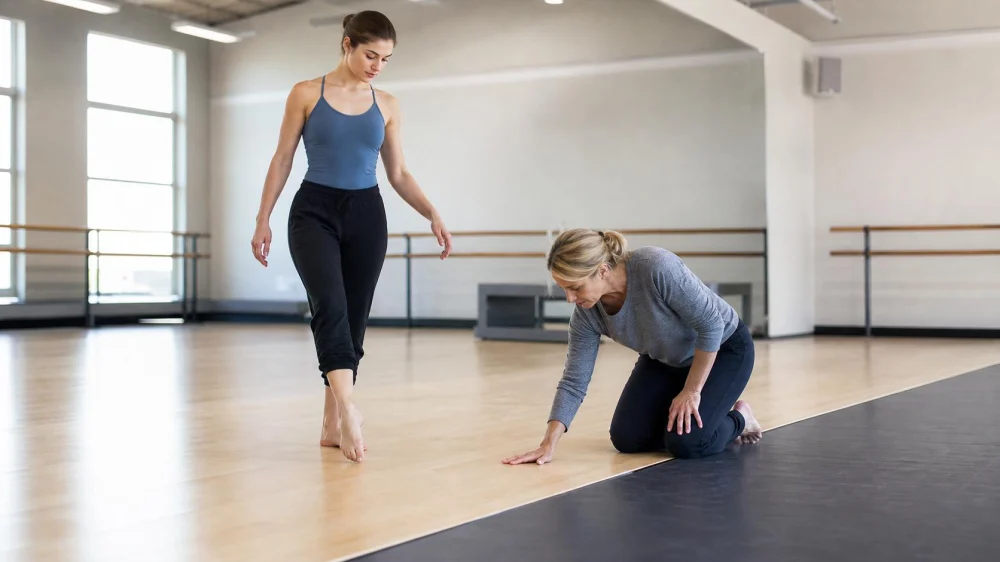
Walk the room before warm-up and look across the floor from several angles.
- Check moisture: Stop activity around wet spots, condensation, roof leaks, cleaning residue, or tracked-in rain.
- Check traction: Notice sudden sticky or slippery zones rather than testing with a full turn or jump.
- Check seams and edges: Look for lifting vinyl, gaps, curling tape, splinters, loose boards, exposed fasteners, and frayed transitions.
- Check debris: Remove grit, rosin clumps, hairpins, jewelry, tape scraps, and other small objects using the studio's approved process.
- Check level changes: Mark or avoid unexpected steps, platforms, ramps, and damaged areas.
- Check space: Confirm that barres, mirrors, speakers, bags, and portable equipment do not obstruct traveling paths.
Do not improvise with household cleaners, wax, oils, water, or extra rosin. An unapproved product can change traction, damage the surface, or create inconsistent patches.
Match the floor to the dance style
Different dance forms need different relationships among slide, grip, sound, footwear, and impact.
- Ballet and contemporary: Need predictable traction for turns and directional changes without grabbing the foot or allowing uncontrolled slip.
- Jazz and commercial styles: Need stable travel, turns, and landings across the full room.
- Tap: Needs an approved surface and construction that tolerate metal taps and support clear sound without damaging the facility.
- Ballroom and social dance: Need smooth, consistent travel appropriate to the selected shoe and style.
- Hip-hop and street styles: Need suitable traction and resilience for direction changes, floorwork, and impact; sticky or abrasive surfaces can be problematic.
- Barefoot work: Requires a clean surface without splinters, sharp debris, excessive abrasion, or unsafe residue.
The same room may not be ideal for every class. Ask which shoes are required, whether tap or outdoor footwear is allowed, and whether the surface changes between rooms or performances.
Adjust class when conditions are poor
An instructor should have a clear response when the floor changes.
- Block off wet, damaged, or uneven areas.
- Report the condition to studio management and document it.
- Move to another suitable room when available.
- Reduce or remove jumps, lifts, fast turns, floorwork, and large traveling combinations when the surface cannot support them safely.
- Use stationary technique, rhythm, musicality, or low-impact review only when the remaining activity is appropriate.
- Cancel or postpone when the hazard cannot be isolated.
Dancers should speak up about a newly slick, sticky, wet, loose, or painful area. Do not rely on “being careful” while performing the same high-risk material over a known hazard.
Studio floor checklist
- What is the top surface and what supports it?
- Was the system designed and installed for dance use?
- Which styles and shoes are allowed in this room?
- How is the floor cleaned, and which products are prohibited?
- Who checks the floor before each class?
- How are spills, leaks, seams, splinters, and damaged boards reported?
- Are hazards blocked immediately?
- Is there a backup room or modified lesson plan?
- Does the surface feel consistent across the full travel path?
- Can the studio explain recent repair or maintenance concerns?
Best for frequent jumping and athletic choreography: a purpose-built, consistently maintained system appropriate to the style. Not ideal: a hard multipurpose room with unknown construction and changing traction.
Limitations and important notes
No floor eliminates injury risk. Technique, fatigue, strength, progression, footwear, spacing, choreography, health history, and supervision also matter. A visual check cannot confirm hidden construction or structural integrity.
Stop dancing and seek appropriate medical evaluation for acute injury, inability to bear weight, significant swelling, deformity, numbness, severe pain, or symptoms that persist or worsen. General floor advice cannot determine whether pain came from the surface.
Studios should follow manufacturer cleaning, installation, inspection, and repair guidance. Facility owners may need qualified flooring or building professionals to assess recurring moisture, movement, delamination, or structural concerns.
Frequently asked questions
Is wood automatically a good dance floor?
No. Wood species, finish, support, installation, condition, traction, and style all matter. A wood surface directly over a rigid base may behave differently from a purpose-built system.
What does “sprung floor” mean?
It generally describes a floor system built to provide controlled resilience rather than a surface placed directly on a rigid base. Ask about actual construction and installation, not only the label.
Should dancers use rosin on a slippery floor?
Only if the studio and flooring manufacturer explicitly permit it for that surface and style. Rosin can create buildup and inconsistent traction, so it is not a universal fix.
Can a yoga mat make a hard floor safe for jumps?
No. A portable mat can shift, grab the foot, or create an uneven landing area and does not convert the underlying floor into a dance system.
What should I do if one area feels different?
Stop using it, tell the instructor, and mark or block the area. The studio should inspect the surface and underlying cause before restoring high-impact activity.
Sources and evidence notes
This guide reflects common dance-facility and flooring practice: evaluate the entire floor system, maintain consistent traction, use approved cleaning methods, match surfaces to footwear and dance style, isolate damage, and modify high-impact activity when conditions are uncertain. Manufacturer and facility-specific guidance remains controlling.
Conclusion and next steps
Before enrolling or starting class, ask what lies beneath the visible surface and which styles it supports. Walk the room, check moisture, traction, seams, edges, debris, and transitions, and report concerns before warm-up. If a hazard cannot be corrected or isolated, move, modify, or postpone high-impact work.


 Tracie's School of Dance4.0 (21 reviews)
 Dream Dance4.0 (38 reviews)
![Indigo Bollywood Dance Academy [Outreach- Brier Creek]](https://img.theamericandanceacademy.com/d7/2507/99051573252270_150x150.webp) Indigo Bollywood Dance Academy [Outreach- Brier Creek]5.0 (1 reviews)
Indigo Bollywood Dance Academy [Outreach- Brier Creek]5.0 (1 reviews) Creative Dance Arts4.0 (29 reviews)
 Anderson Young Ballet Theatre4.0 (10 reviews)
 Charlotte Cirque & Dance Center5.0 (23 reviews)
 Top 10 Swing Dance Moves Fitness Routine – Improve Your Fitness with Dance
 Can We Film in the Kaufman School of Dance at USC?
 Ballet to Improve Flexibility: Expert Tips for Enhancing Your Stretching Routine
 Ballet for College Students – Everything You Should Know
 Swing Dance Near Me in the USA: Step by Step Guide to Getting Started
 Can You Compete at Oireachtas Without Being Affiliated with a Dance School?