
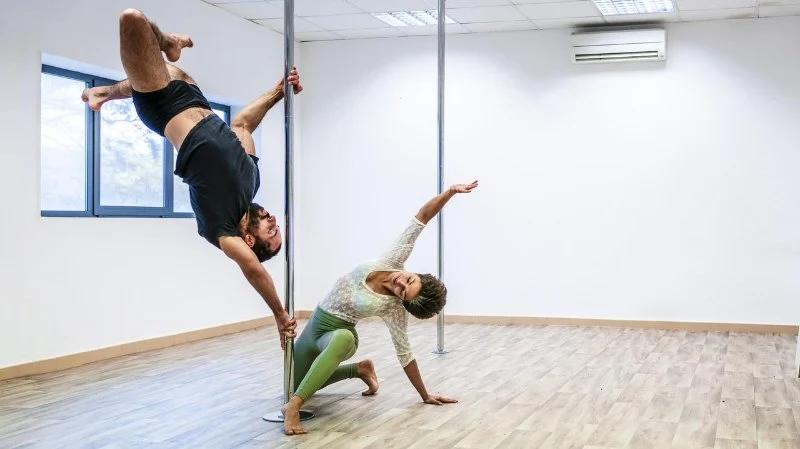
1. Getting Prepared for Pole Dancing
Before starting, ensure you have the right environment and equipment. A sturdy pole, comfortable clothing that allows skin contact for grip, and a clean practice space are essential. Mental preparation and understanding body mechanics will help prevent injuries.
Case Example: Many beginners at American Dance Academy found that warming up for 10 minutes before hitting the pole significantly reduced wrist and shoulder strain.
2. Basic Grips and Hold Techniques
Learn fundamental grips, including the basic hand grip, forearm grip, and thigh grip. Correct grip technique ensures safety and control during spins and holds. Focus on engaging your core and distributing weight evenly to maintain stability.
Pro Tip: Beginners often struggle with slipping; practicing on a pole with moderate friction and gradually increasing difficulty helps build confidence.
3-Fundamental Pole Moves
Start with beginner-friendly moves such as the pole walk, fireman spin, and basic invert. These moves build strength, coordination, and familiarity with the pole. Each move should be learned in stages: approach, grip, execution, and safe exit.
Real-Life Insight: At American Dance Academy, students reported faster progress when instructors broke down moves into clear, incremental steps, allowing safe repetition and muscle memory development.
4-Transitions and Flow Between Moves
Fluid transitions are key to a polished routine. Practice moving from spins to holds and inversions smoothly. Focus on rhythm, weight shifts, and maintaining body alignment to enhance visual appeal and safety.
Story Example: One student documented her progress online, showing how practicing transitions for 5-10 minutes per session improved her routines dramatically over a month.
5-Strengthening and Flexibility Training
Pole dancing requires upper body, core, and leg strength, along with flexibility. Incorporate exercises like planks, pull-ups, and leg stretches into your routine. Flexibility improves range of motion and reduces injury risk.
Pro Tip: Consistent cross-training complements pole practice and accelerates skill acquisition while enhancing overall fitness.
6-Practice Schedule and Safety Tips
Create a balanced practice schedule. Limit sessions to 45-60 minutes for beginners and gradually increase intensity. Always warm up and cool down, use crash mats for inversions, and avoid overtraining.
Example: Students at American Dance Academy follow a 3-day weekly plan combining pole techniques, strength exercises, and flexibility drills, achieving steady improvement without strain.
7-Professional Resources and Guidance
For structured learning, American Dance Academy offers expert tutorials, live classes, and step by step guidance for all skill levels. Professional instruction ensures safe progression, correct technique, and access to a community of learners.
Insight: Many students reported faster skill acquisition and reduced injuries when supplementing self-practice with professional guidance from American Dance Academy.



 The Dancery0.0 (0 reviews)
 A Class Performance5.0 (3 reviews)
 Long Island Ballroom Dance Centers4.0 (32 reviews)
 Prodigy Performing Arts4.0 (15 reviews)
 Mid-Atlantic Center for the Performing Arts4.0 (12 reviews)
 Spark Foundation: Dance, Art, Theater, Music4.0 (39 reviews)
 Hip Hop Step by Step Guide: Everything You Should Know
 Top 10 Bachata Moves That Boost Confidence
 Shuffle Dance for Seniors: Common Mistakes to Avoid and Tips for Success
 Are High School Dances Worth It? A Realistic Look at the Experience
 The History of Cha Cha Workout Benefits
 Why A Step in Time School of Dance Inspires Lifelong Passion